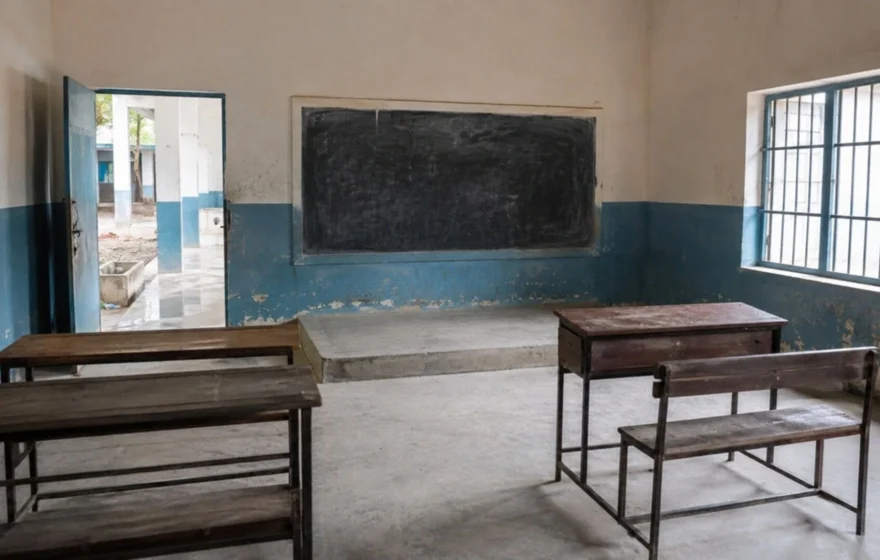
The Khyber Pakhtunkhwa Elementary and Secondary Education Department has ordered the immediate shifting of students out of school buildings and building sections declared dilapidated and dangerous, directing that children be moved to safe classrooms without delay. In a letter sent to all District Education Officers across the province, the department said students studying in unsafe premises must be relocated at once, and that alternative arrangements must be made so that their education is not interrupted.
Under the instructions, students are to be accommodated in safe sections of the same school wherever that is possible. Where a school has no safe space left, children are to be shifted to nearby government schools. If no government school facility is available close by, the department has authorised the arrangement of rented buildings so that classes can continue. The order makes clear that only the portions and rooms declared dangerous are to be vacated and sealed, rather than whole buildings being emptied where part of the premises remains safe.
The dangerous buildings and unsafe sections were identified by the Communication and Works Department and technical experts, whose assessments form the basis of the relocation drive. District Education Officers have been told to take immediate measures to ensure students’ safety and to put alternative arrangements in place. The order comes in the wake of a tragedy that has sharpened attention on school safety across the province. On October 15, a section of the Al-Khair Education System School in Peshawar’s Dir Colony collapsed while classes were under way, killing 33 children and a teacher and injuring dozens more. The disaster prompted a province-wide structural safety audit of educational institutions.
That audit is already producing stark findings. Inspectors have completed structural checks at 8,928 of the province’s 64,167 educational institutions, and of those checked, 2,448 were declared unsafe, a share of more than one in four. A further 2,344 buildings were found to need repairs, while 4,027 were declared safe. The Communication and Works Department is conducting the inspections, and the audit is still under way, which means the number of buildings declared dangerous is likely to grow as more schools are examined.
The scale of the problem extends well beyond the buildings already inspected. Official sources have put the number of dilapidated classrooms in government schools across Khyber Pakhtunkhwa at more than 36,000, with around 19,224 requiring reconstruction and another 17,743 needing repairs. The province has 34,784 government schools and 11,542 registered private schools, so the inspection task facing the authorities is enormous, and the relocation order will test the capacity of district administrations to find safe space at short notice.
For parents, the immediate question is practical rather than administrative: where will their children sit tomorrow, and for how long? The department’s answer is deliberately flexible, allowing safe sections of the same school, neighbouring government schools, or rented premises. That flexibility matters in rural districts, where the nearest alternative school may be some distance away and transport is itself a difficulty. It also places a heavy responsibility on District Education Officers, who must judge, school by school, which rooms can stay open and which must be sealed, and must do so quickly enough that no child spends another day in a room already declared dangerous.
The order also carries an implicit warning to school managements. In a separate move, the Peshawar district administration recently declared 13 private school buildings in the city dilapidated and dangerous and issued notices directing their managements to vacate the premises immediately, warning that managements would be held responsible for any untoward incident resulting from failure to comply. The message from the provincial authorities is consistent: continuing classes in a building known to be unsafe is no longer treated as an administrative lapse but as a risk to children’s lives.
What happens next will depend on how thoroughly the relocation is carried out and how honestly the repair backlog is confronted. Sealing a dangerous room and moving children to a safe one protects them today, but it does not fix the building. Classrooms can only reopen after corrective work is completed and a technical authority certifies the building as safe, and the province’s repair and reconstruction bill runs into tens of thousands of classrooms. The audit must also be completed, since thousands of schools have not yet been inspected at all, and an uninspected building may be just as dangerous as one already declared unsafe.
For now, the department’s priority is clear and narrow: no child should be sitting in a room that engineers have already declared dangerous. The relocation order, the sealing of unsafe sections, and the provision of rented premises where no alternative exists are all aimed at that single objective. Whether the system can sustain that protection through the winter, and then move from emergency shifting to lasting repair, will be the real test of the province’s response to a tragedy that has already cost far too many young lives.
