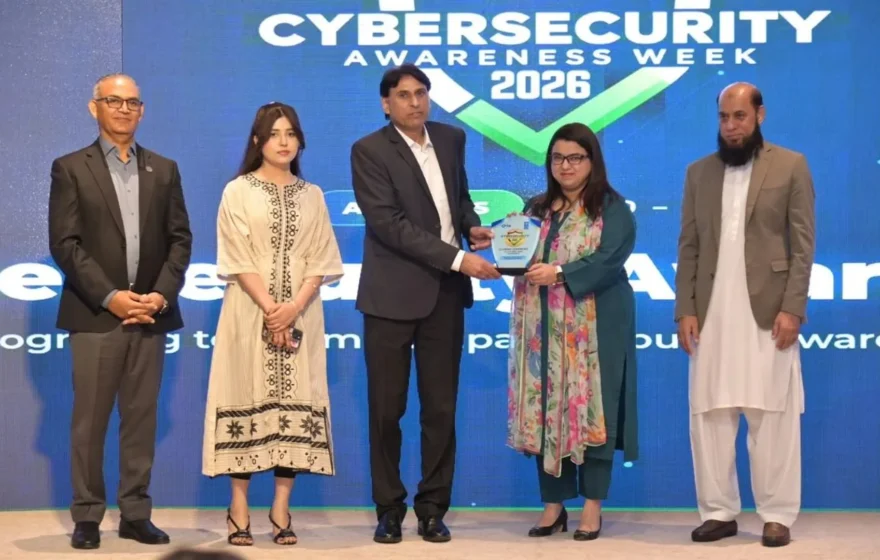
Wateen Telecom has been honoured with an award for Cybersecurity Excellence at the Telecom Cybersecurity Awards 2026, hosted by the Pakistan Telecommunication Authority during the closing ceremony of Cybersecurity Awareness Week 2026. The recognition places the Lahore-based technology company among the operators and firms the regulator singled out this year for the strength of their defences, and it comes at a moment when the safety of Pakistan’s digital networks has become a national concern rather than a technical footnote. For Wateen, a company whose business is carrying other organisations’ data, the award is both a credential and a statement of intent: that the networks it runs can be trusted with the traffic that now flows across them.
The award reflects sustained work rather than a single project. According to the announcement, Wateen was recognised for excellence in cybersecurity governance and implementation, demonstrated through continued efforts to strengthen its security frameworks, enhance organisational cyber resilience and embed robust cybersecurity practices across its digital infrastructure and operations. In plain terms, that means the policies at the top of the company, the controls inside its networks and the habits of the people who run them were judged together, not in isolation. Governance sets the rules, implementation makes them real, and resilience is what matters when something goes wrong, because in cybersecurity the question is rarely whether an attack will come but how quickly it is spotted, contained and recovered from.
That emphasis on resilience is easy to understand when one considers what Wateen actually carries. The company, incorporated in 2005 and operating since 2007, began by building one of Pakistan’s largest fibre optic networks and became the first company in the world to roll out a WiMAX network on a nationwide scale. Today it describes itself as a carrier-neutral national fibre infrastructure provider, serving carriers, enterprises and households with connectivity, cloud services and managed solutions, with a fibre network running into tens of thousands of kilometres and a presence in more than 240 cities. When a business of that shape suffers a security failure, the damage is not confined to one office or one customer: it can ripple through banks, hospitals, schools and government departments that depend on the same infrastructure.
The setting for the award matters too. Cybersecurity Awareness Week 2026, held under the theme of building a safe, secure and resilient cyberspace, brought the industry together around the threats that now face ordinary users as well as large networks: cybercrime, digital fraud, misinformation and online harassment. The week’s closing ceremony was the occasion for the Telecom Cybersecurity Awards, and Wateen was not the only company recognised. Telenor Pakistan secured the top position in Cybersecurity Excellence for the third consecutive year after the regulator’s audit and revalidation process, while JazzWorld took top honours for its performance in the annual audit of compliance with the Critical Telecom Data and Infrastructure Security Regulations and for its cybersecurity awareness campaign video. Those parallel wins show that the awards are not a single prize handed to one favourite but a benchmark applied across the industry, with different strengths recognised in different categories.
That benchmarking role is the real significance of the PTA’s exercise. The regulator’s audit framework, built around the Critical Telecom Data and Infrastructure Security Regulations, sets a common standard for how operators protect sensitive data and critical network infrastructure, and compliance scores give the industry a shared measure of who is meeting it. For customers choosing a provider, and for enterprises deciding whose network will carry their most sensitive traffic, an independent regulatory assessment carries more weight than any marketing claim.
The timing is also telling. Pakistan’s digital transformation is accelerating, with more banking, commerce, education and public services moving online, and that expansion widens the surface that attackers can probe. Telecom operators sit at the centre of that surface, because almost every digital transaction passes through their networks at some point. At the same time, the regulator has been moving on several fronts at once, from warning users against foreign SIM cards that escape local oversight to blocking messaging accounts linked to inactive SIMs, all part of the same effort to close the gaps that fraudsters exploit. In that climate, an award for cybersecurity excellence is not a decorative honour. It is evidence that a company is keeping pace with the threats rather than merely keeping up appearances.
Wateen itself framed the recognition in those terms, thanking the PTA for the honour and for bringing the industry together to build a safer and more resilient digital Pakistan. That language points to the collaborative side of cybersecurity, which no single company can solve alone, since threats cross networks and defences must be coordinated across them. For Wateen, the challenge now is to live up to the recognition: awards are snapshots, and the threat landscape changes constantly, so the governance, controls and proactive risk management that earned this honour will need to be renewed continuously.
