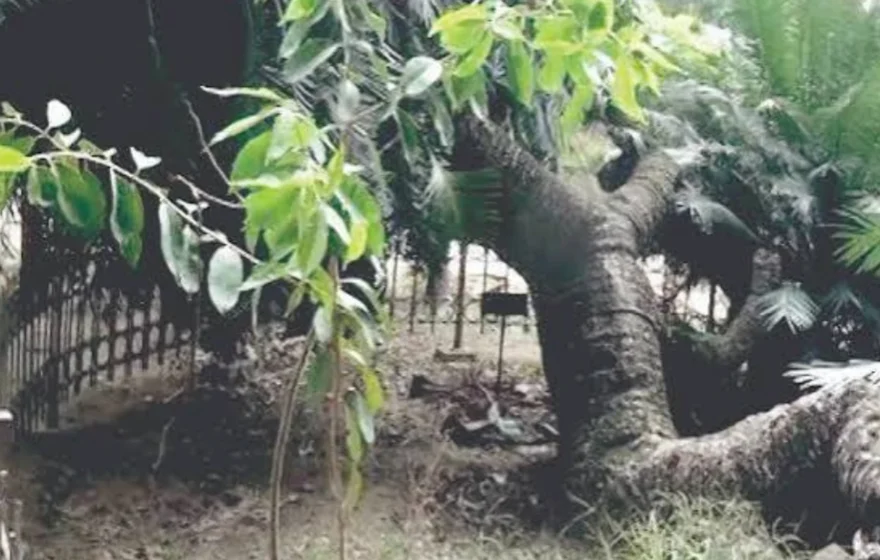
A tree older than the garden around it is in full leaf in Lahore, and its history stretches far beyond the city itself. The 176-year-old Queen Sago Palm at Lawrence Garden belongs to a plant family whose roots reach back hundreds of millions of years, to a time before dinosaurs walked the Earth. According to an officer of the Punjab Horticulture Authority, who spoke about the tree on Sunday, the palm is flourishing, its crown of fronds fully out, in one of the oldest green spaces in the city. To a passer-by it looks like another handsome palm. In truth, it is a survivor from deep time, growing quietly in the middle of a modern city.
The palm predates Lawrence Garden itself. The garden was laid out in the 1860s as a botanical garden and a place of leisure, modelled on Kew Gardens in London, and it grew into one of the great public parks of Lahore. The palm, at 176 years old, was already standing before that story began, which makes it one of the oldest living residents of the grounds. Today the garden is known to most Lahoris as Bagh-e-Jinnah, renamed after Partition in honour of Muhammad Ali Jinnah, having earlier been called Lawrence Gardens. The palm has watched all of that change around it.
Queen Sago Palms belong to the cycads, an ancient group of seed-bearing plants whose fossil record stretches back to the Permian period, roughly 280 million to 300 million years ago. That is a span so vast it is hard to hold in mind: these plants were already old when the first dinosaurs appeared, and they grew in abundance in the Mesozoic Era, when dinosaurs ruled the land. The Jurassic and Cretaceous periods, in particular, saw cycads spread so widely that the age is sometimes described as the Age of Cycads as well as the Age of Dinosaurs. Plant-eating dinosaurs, including the great long-necked sauropods, are believed to have browsed on cycad foliage, cones and nutrient-rich seeds, including those of the sago palms common across that ancient world.
What makes cycads so striking is how little they have changed. Their basic structure has stayed much the same across hundreds of millions of years, which is why botanists commonly call them living fossils. They are also famously slow. A cycad does not hurry; it grows at its own unhurried pace, lives for a very long time, and asks for relatively little in return. Horticulture experts say sago palms generally need around four to five hours of sunlight each day and, once established, relatively little water. Their slow growth also helps them cope with conditions that would defeat faster, thirstier plants, including fairly dry and poor soils. That toughness is part of why a plant from the age of dinosaurs can still thrive on a busy Lahore road, in soil and air far removed from its ancient habitat.
That survival, however, should not be taken for granted. Across the world, cycads are in trouble. Their numbers have fallen sharply, and according to the International Union for Conservation of Nature Red List of Threatened Species, about 60 per cent of the cycad species that have been assessed are now threatened with extinction in their natural habitats. The pressures are familiar ones for ancient plants in a fast-changing world: habitats cleared or broken up, and wild plants collected for gardens and trade. Because cycads grow and reproduce so slowly, a damaged population can take decades to recover, if it recovers at all. A plant that survived the rise and fall of the dinosaurs can therefore be undone, quietly, by a few decades of human pressure. That contrast is what gives the Lahore palm its weight. As the horticulture authority spokesperson put it, the fact that the Lahore sago palm is both prehistoric and belongs to a threatened group makes it especially significant.
The garden around it carries its own long story. Lawrence Garden was planned as a botanical garden on the Kew model, and the Punjab Horticulture Authority says it is regarded as one of Asia’s largest botanical gardens, holding around 150 varieties of trees, including 30 species of palms. Its collection was built up with trees and plants brought in during the British period from across the Indian Empire, as well as from Austria, Palestine, Syria and other parts of Europe. After Partition it was renamed Bagh-e-Jinnah, and today it holds the Quaid-e-Azam Library in its Victorian halls, a mosque, tennis courts and a cricket ground, alongside its botanical collections. For the city, it has long served as a lung: a place for morning walks, family outings and quiet study under old trees.
For visitors, the palm is worth seeking out precisely because it does not announce itself. Its interest lies in what it represents: a direct, living link to a world before flowers, before mammals, before the first dinosaur, still putting out new leaves in 2026. Lahore has many historic buildings and many old stories. Few of them are still growing.
