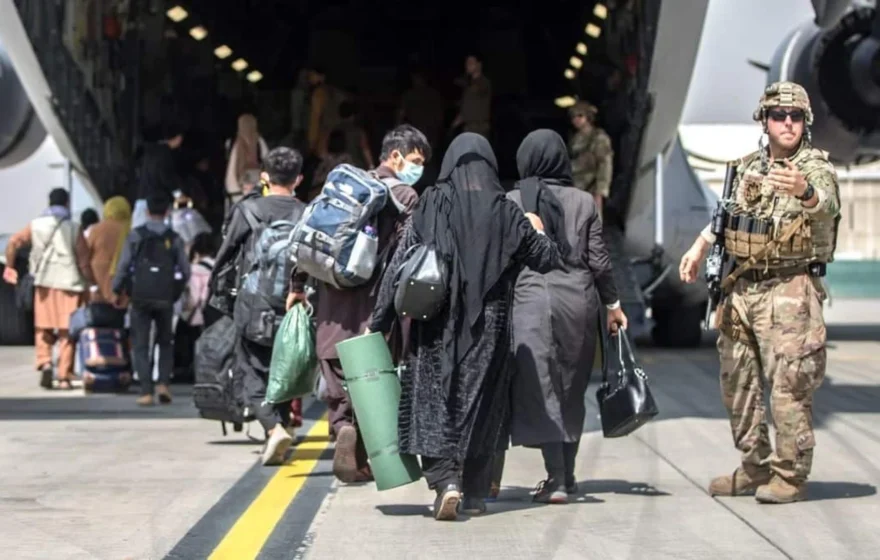
The United States is preparing to send nearly 200 Afghan nationals to Pakistan first, before they are moved onward into Taliban-ruled Afghanistan. The arrangement, laid out in a sworn declaration by an American immigration enforcement officer, has raised questions about who will take charge of the deportees once they leave American custody, whether Pakistan has agreed to the transit role, and what safeguards will apply to people sent back to a country where many fear persecution.
At the centre of the disclosure is a charter flight scheduled for Monday, 3 November. Court documents show that it was to depart from Alexandria in the American state of Louisiana and land in Pakistan, from where the passengers were to continue overland into Afghanistan. The officer who signed the declaration, Sergio Aguilar, a supervisory detention and deportation officer with Immigration and Customs Enforcement, said he had first understood that the aircraft would fly directly to Afghanistan. He later learned that Pakistan would be its final destination by air, with onward travel to Afghanistan to follow.
Aguilar’s declaration was filed on 30 October in a federal case known as Sadat v. Mullin. It concerns Said Mansor Sadat, a 30-year-old Afghan national who had been assigned to the special charter flight. A federal judge, Michael Nachmanoff, had ordered the authorities to explain whether the plane would go straight to Afghanistan or stop in Pakistan first. The declaration answered that question in plain terms: the removal order named Afghanistan as the intended destination, but the journey itself was routed through Pakistan.
The lawyer representing Sadat, Simon Sandoval-Moshenberg, has said that officials separately told both of his clients that they would be flown to Pakistan and then taken overland to the Afghan border. Neither man, he said, was told who would carry out that leg of the journey or how it would be organised. That gap has become one of the most troubling features of the case, because the moment American custody ends, it is far from clear which authority takes responsibility for the people on board.
Sadat himself was later taken off the passenger list and released, after a judge ruled that keeping him in detention any longer violated his due process rights. The lawyer’s second client, however, was still waiting for a decision on an emergency request for a temporary restraining order when the latest filings were made, leaving that person’s fate unresolved as the scheduled flight date arrived.
The court papers also reveal that the Department of Homeland Security has not publicly confirmed whether Pakistan has given assurances for this operation, or whether any such assurances would cover the onward journey into Afghanistan and the treatment of deportees once they arrive there. A department spokesperson has said only that Immigration and Customs Enforcement no longer bears responsibility for individuals once they leave its custody.
Two other federal cases have added further detail. In Texas, District Judge Kathleen Cardone noted in a 15 October order that immigration officials had acknowledged nominating Basir Ahmad Ahmadi for a possible deportation operation to Afghanistan in early November. Ahmadi sought emergency protection, arguing that Pakistani authorities could arrest him and hand him over to the Taliban, but on 29 October the judge rejected his request, ruling that the court did not have jurisdiction to stop his removal.
The wider reaction has been swift. Reports say that 66 members of the United States Congress have written to the administration asking for the operation to be halted, warning that sending people back to Afghanistan could put them at grave risk, particularly those suspected of having helped American forces or criticised the Taliban. Kabul’s foreign ministry, meanwhile, is reported to have voiced serious concern and urged Washington to coordinate directly with it rather than routing deportations through a third country.
Pakistan’s own position is sensitive. The country has hosted Afghan nationals for decades, and since September 2023 it has operated its Illegal Foreigners Repatriation Plan, under which large numbers of Afghans have returned across the border. The United Nations refugee agency has reported that more than one million Afghans returned from Pakistan to Afghanistan during 2025, and it has repeatedly urged Islamabad to exempt people with specific protection needs from the repatriation drive.
For the Afghans at the heart of these cases, the legal stakes could hardly be higher. American removal law draws a sharp line between being sent to a country where a person faces persecution and being moved through a country on the way somewhere else. A person whose removal order names Afghanistan, and who holds no court-ordered protection against return to that country, can in principle be flown through any transit point. But where a court has granted protection against return to Afghanistan itself, sending that person there by any route would breach the order. The sworn admission that the flight ends in Pakistan but the journey continues into Afghanistan therefore matters enormously.
For now, the basic questions remain unanswered: how many of the nearly 200 will actually be flown, which government will oversee their transfer from Pakistan into Afghanistan, and what protection will follow them across that border.
