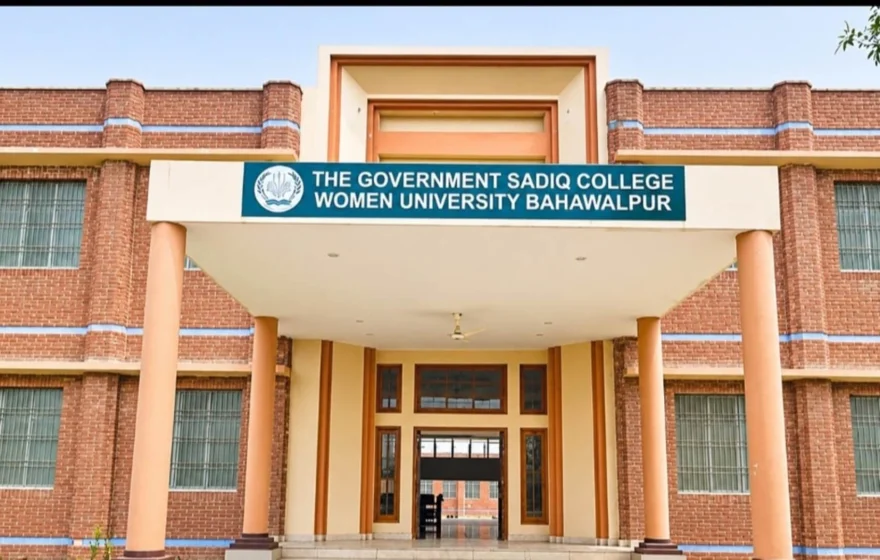
The Punjab government has formally changed the official name of Government Sadiq College Women University Bahawalpur, which will now be known as Government Sadiq College, Bahawalpur. The change, reported on 3 November 2026, removes ‘University’ from the institution’s title and places the Bahawalpur institution within a wider revision of the names of public sector educational institutions across Punjab. Although the new name is shorter, officials have stressed that it is an administrative change to the institution’s official title rather than a change to its academic role, and that its work in higher education will continue as before.
The notification behind the change was issued by the Higher Education Department Punjab on 23 October 2026, and was addressed to vice chancellors and rectors of public and private sector universities. It set out the revised names that follow amendments introduced through the Punjab Public Sector Universities (Amendment) Act, 2026, a law that the Punjab government published in the Punjab Gazette on 6 May 2026. The department also directed universities to take further necessary action in accordance with the amended law, a step that gives the renaming a clear administrative route from notification to implementation.
For the Bahawalpur institution, the practical effect is straightforward on paper but significant in formal terms. Government Sadiq College Women University Bahawalpur will now be known as Government Sadiq College, Bahawalpur, with the word ‘University’ removed from the end of its title. The new form keeps the institution’s historic Sadiq College identity at its centre, while the addition of the city name locates it unambiguously in Bahawalpur.
The notification made an important distinction that is easy to overlook when a well-known name changes. It clarified that the change will only affect the institution’s official name, and that its mandate and functions related to higher education will remain unchanged. In other words, the renaming does not, by itself, alter what the institution does, the level at which it teaches, or the academic standing of its programmes. That assurance matters for current students and staff, whose daily academic life is governed by the institution’s functions rather than by the wording on its letterhead, and for graduates whose qualifications were earned under the former name.
The Bahawalpur change did not arrive in isolation. On the same day, related reports described a series of similar renamings across Punjab, all flowing from the same notification and the same amended law. Lahore College for Women University, for example, was renamed Lahore College for Women, while Government College University Faisalabad became Government College, Faisalabad. The pattern is consistent: the word ‘University’ is removed, and the institution is left with a college title that reflects its historic name and its city. Seen together, these cases show a coordinated administrative exercise rather than a decision taken for one institution alone.
The same pattern applied to women’s institutions in two other cities. Government College Women University Faisalabad was renamed Government College for Women, Faisalabad, and Government College Women University Sialkot became Government College for Women, Sialkot. Those changes, reported alongside the Bahawalpur case, underline that the revision reached women’s colleges as well as general institutions, and that it was applied in a similar form in different parts of the province. For readers following the story from Bahawalpur, the parallel cases provide useful context: the local renaming is one part of a province-wide alignment of official titles.
A related report on the Lahore case noted that the notification covered six public sector educational institutions across Punjab, which helps to explain why several announcements appeared in quick succession. A single notification, issued to vice chancellors and rectors, can therefore produce a run of name changes as each institution updates its official identity in line with the amended law. That sequence also explains why the Bahawalpur, Lahore, Faisalabad and Sialkot announcements share the same legal reference and the same date of notification, even though they concern different cities.
From an administrative point of view, the value of a consistent set of names is clarity. When several institutions carry similar titles, small differences in wording can create confusion in records, correspondence and public references. A shorter, standardised college title reduces that risk, provided that the new name is adopted consistently and that older forms are gradually retired from official use. The department’s direction to take further necessary action points in that direction, since it places responsibility for following through on the change with the universities themselves, working within the framework set by the amended law.
For Bahawalpur, the change also carries a symbolic dimension. The Sadiq College name has long been associated with education in the city, and retaining that element preserves a link with the institution’s history even as the formal ‘University’ designation is removed. The challenge now is one of communication rather than law: ensuring that students, parents and employers recognise the new name and understand that the institution’s higher education mandate is unchanged. If that transition is handled clearly, the renaming should pass into routine use without diminishing the institution’s standing in the city or the wider province.
