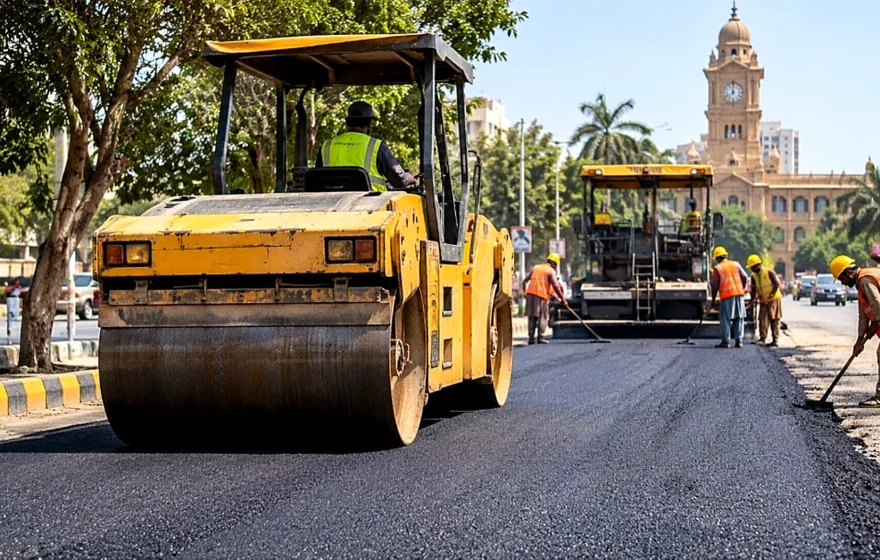
Karachi is about to enter another busy phase of road building, with the city’s municipal corporation preparing to start work on roughly 140 additional roads in the coming days. The programme, valued at about Rs13 billion, is being presented as a further step in a wider effort to repair and improve the road network across Pakistan’s largest city, where daily travel for millions of residents depends heavily on the condition of its streets and main routes.
Mayor Barrister Murtaza Wahab announced the plan on Monday at the Karachi Metropolitan Corporation’s head office, telling reporters that the tendering process had already been completed. That detail matters, because it means the corporation is not still at the stage of inviting bids or weighing proposals; instead, it is ready to move to the next administrative step and hand formal instructions to the firms that will carry out the work.
According to the mayor, those work orders are expected to be issued within two to three days, with construction due to begin before the week is out. The short timetable sets a clear public expectation: residents should soon see activity on the ground, rather than hearing about a scheme that remains on paper for months. It also places the corporation’s own schedule under immediate scrutiny, since any delay beyond the promised window will be easy to notice.
The roads covered by the scheme are spread across all seven districts of Karachi, a point the mayor emphasised when he said the work would proceed without political discrimination. In a city where neighbourhoods often compete for attention and resources, that promise is significant. It suggests that the selection of roads was intended to reflect need across the whole city, rather than favouring particular areas, and it gives residents in every district a reason to watch for progress in their own streets.
Funding for the work comes from a development allocation of Rs13 billion, set against a much larger sum earmarked for development at the start of the current financial year. The mayor said between Rs68 billion and Rs70 billion had been allocated for development projects overall, a figure that puts the road programme in context. It is a substantial commitment in its own right, but it is also only one part of a broader municipal spending plan that must cover many competing demands.
Wahab also used the announcement to frame the corporation’s approach to its responsibilities. He said the local government was working to meet its commitments and was taking practical steps to improve infrastructure and public services, rather than offering excuses about limited powers or scarce resources. That language appears designed to answer a familiar criticism of civic bodies in Karachi: that overlapping authorities and constrained budgets are too often cited when services fall short.
For ordinary road users, the importance of such a programme is easy to understand. Karachi’s roads carry an enormous volume of cars, motorcycles, buses, trucks and rickshaws every day, and worn or broken surfaces slow journeys, increase vehicle damage and raise the risk of accidents. When a road is properly repaired, the benefit is felt immediately in smoother travel, shorter journey times and less strain on vehicles, especially for people who rely on the same route for work, school or hospital visits day after day.
Rehabilitation, however, is about more than laying a fresh surface. A durable result depends on the quality of the underlying work, including drainage, levelling and the materials used, because a road that looks new but fails to cope with rain or heavy traffic will soon deteriorate again. Karachi’s climate and traffic load make that challenge particularly acute, and residents will therefore judge the programme not by the ceremony surrounding its launch, but by how long the repaired roads remain in good condition.
The way the work is carried out will matter almost as much as the work itself. Road projects in a crowded city inevitably cause disruption while they are under way, with diversions, dust and temporary closures testing the patience of commuters and traders. Clear information about which roads are being worked on, and in what order, can help people plan their journeys, while poor coordination can turn even a welcome project into a source of frustration.
There is also a question of follow-through. Announcing a programme and issuing work orders are important milestones, but they are not the same as completing 140 roads to a consistent standard. The real test will come over the following weeks and months, as work progresses district by district and residents are able to compare what was promised with what has actually been delivered on the ground.
If the timetable is met and the standard of work holds up, the programme could make a visible difference in many parts of Karachi, easing journeys and improving safety. If work stalls or quality slips, it will quickly be remembered as another unfulfilled pledge. For now, the commitment is clear, the funding has been identified and the clock is running, with construction expected to begin within days.
