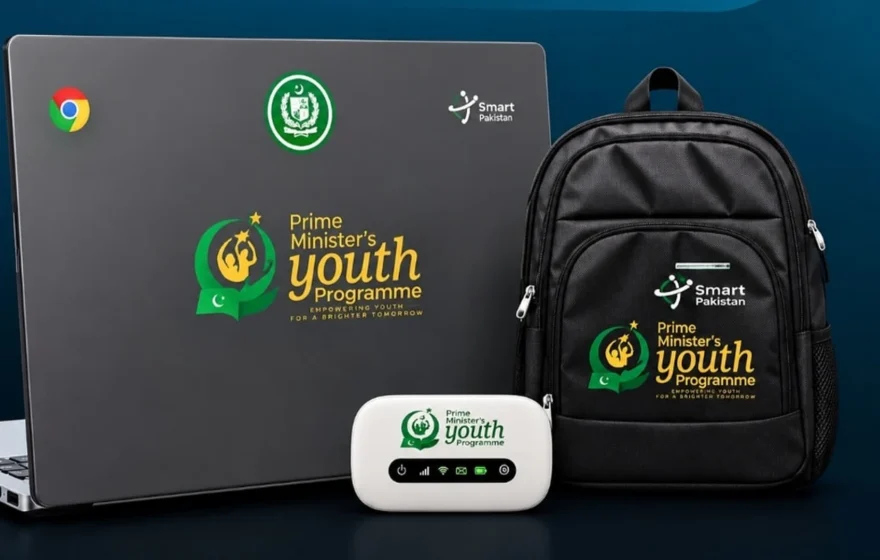
Thousands of private school students and their parents have been asking the same question since the Prime Minister’s Youth Chromebook Scheme opened for registration: can a student at a private school apply for a free Chromebook? The short answer, according to the rules on the official registration portal, is no. For now, the scheme covers students of government schools only.
The scheme is one of the largest student device programmes Pakistan has attempted. Prime Minister Shehbaz Sharif launched it in Islamabad on 25 October 2026, announcing that 500,000 refurbished Chromebooks would go to talented students over two years, purely on merit. Each device comes with a MiFi internet unit and a bag.
At the launch ceremony, the prime minister handed Chromebooks to high-achieving ninth-grade students and seminary students. It was only when families opened the registration portal that the picture became narrower, and the gap between that broad promise and the portal’s written rules is where the confusion began.
What Does the Official Portal Say?
The portal is run by the Inter Boards Coordination Commission, the body that links Pakistan’s school examination boards, at pmychromebooks.ibcc.edu.pk. It states that only top-performing Grade 9 students from government schools in Punjab, Sindh, Khyber Pakhtunkhwa and Balochistan will be considered, ranked on their Annual Examinations 2026 results. In Azad Jammu and Kashmir, the Islamabad Capital Territory and Gilgit-Baltistan, top students of both Grade 9 and Grade 10 are covered.
The portal makes no mention of private schools. It specifically identifies enrolment in a government school as a requirement, and that is the wording families see when they try to register. Reports based on the portal add that students need at least 50 per cent marks in their latest Grade 9 examination to be considered, although the merit lists will decide who actually receives a device.
Selection runs through the examination boards, not through open applications. Each board sends a merit list of its top students to the IBCC, and a student on that list can search for their record on the portal using a CNIC or B-Form number, a roll number or registration number, and a date of birth. The student then uploads a photograph and documents; each student can apply only once.
The distribution plan gives Punjab the largest share, with 181,090 devices, followed by Islamabad with 100,000, Sindh with 85,925, Khyber Pakhtunkhwa with 51,170, Balochistan with 31,815, and Azad Kashmir and Gilgit-Baltistan with 25,000 each. Within every region, four out of five devices are for school students and one in five for students of registered seminaries, vetted separately by the Directorate General of Religious Education.
No nationwide closing date has been announced, but the work is moving board by board. The Board of Secondary Education Karachi published its merit list for Class 9 students of affiliated government schools on 7 November, and those students must still register on the IBCC portal.
Why Has There Been Confusion About Private Schools?
If the portal is so clear, why did so many families believe private school students were included? The answer lies in what was said around the launch. The government’s announcement referred to providing devices to students from schools and madrassas, without drawing the line the portal now draws. Some reports described a broader arrangement that included private schools supported by provincial education foundations.
None of that broader description has appeared on the application portal. It mentions only government schools, and it does not explain how a student from a foundation-supported private school would get onto a board’s merit list. Until the portal is updated, or the education ministry issues a fresh clarification, a private school student who tries to apply is likely to find that their record simply is not there.
That leaves families in an awkward position. A student at a fee-paying private school should not assume enrolment alone makes them eligible, and should not pay agents or unofficial websites that promise to arrange a device. The only safe route is the official portal and the student’s own examination board. Parents whose child’s school is funded through a provincial education foundation should put the question directly to their board or education department.
The scheme is a serious attempt to close a real gap. A Chromebook with an internet connection can change what a bright student from a modest background can do after school hours, and the government has said the connectivity could benefit around 2.5 million people. But a scheme of this size depends on trust as much as on hardware, and trust depends on families knowing exactly where they stand.
For now, the position is clear enough to act on. Government school students who topped their Grade 9 examinations should check their board’s merit list and register promptly. Private school students should check the portal, confirm their position with their board, and wait for an official update rather than assuming they qualify. One updated line on the portal would settle the question for thousands of families.
