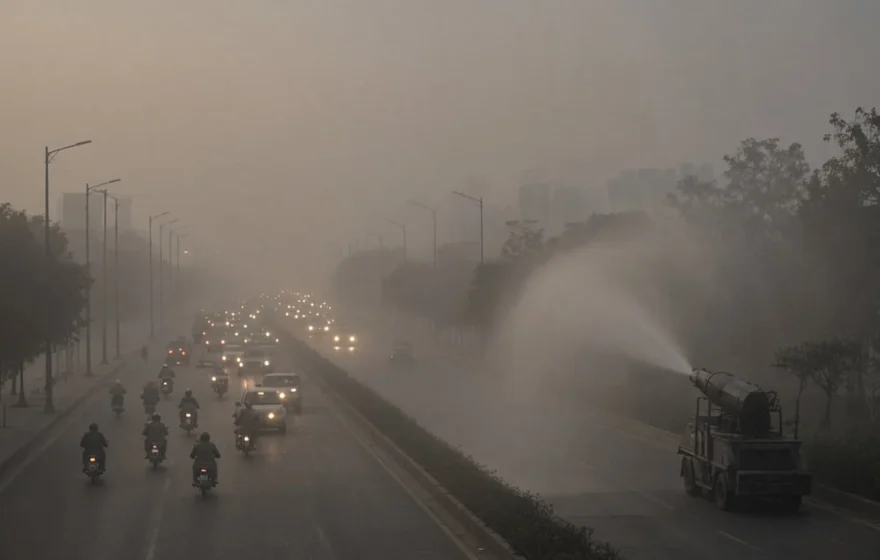
The Punjab government has warned that the smog hanging over Lahore could grow thicker in the coming days, as large-scale fireworks set off in India for Diwali send fine particles drifting across the border into Punjab. Senior Punjab Minister Maryam Aurangzeb said the smoke from the celebrations would add to the pollution already sitting over the region, and people should prepare for worse air in the days ahead.
In a statement on X, Aurangzeb said a deep layer of fog and polluted air stretching from the Bay of Bengal was already covering the region. She said wind direction and speed, and how still the air remains, would decide how bad Lahore’s air quality index becomes over the next few days. With little wind to carry the haze away, the smog tends to thicken in the early morning and after sunset, when the air cools.
The warning comes at the worst time of year for Lahore’s air. Every winter, as temperatures fall, cold, dense air traps smoke from vehicles, building sites and burning crop waste close to the ground, pushing the city’s pollution to some of the highest levels in the world. Only last week, on Tuesday 3 November, Lahore was ranked the world’s most polluted city, with its air quality index touching 447 in the early hours, according to IQAir. At that level the concentration of PM2.5, the fine particles that lodge deep in the lungs, stood at 60 times the World Health Organization’s annual guideline. Delhi’s air was also poor, at 215 on the same measure and 332 on the reading of India’s Central Pollution Control Board, which rated it very poor.
Diwali, the Hindu festival of lights, fell on 8 November this year, and fireworks are a central part of the celebrations in India. The bursts release a dense mix of fine particles and gases that can linger in the air for days, and when the wind blows from the east, across the border into Punjab, Lahore is among the first cities to feel it. India’s Supreme Court had allowed only low-polluting fireworks to be set off, and only for three hours each on Saturday and Sunday, but the celebrations still leave heavy smoke in the air. By Monday, Lahore’s air quality index still stood at 184, rated unhealthy, with PM2.5 named as the main pollutant, and calm winds in the city offered little chance of the haze clearing quickly.
Chief Minister Maryam Nawaz Sharif has directed the administration to speed up monitoring and anti-smog operations across the province. Aurangzeb said smog guns and water sprinkling have been stepped up in areas where the air quality index is expected to run high, with particular attention to the eastern corridor towards the Indian border, along which the smoke is most likely to travel. The environment department’s teams are watching the smog around the clock, including through the night, so action can follow the changing air.
The minister also asked the public to do its part in holding back the pollution made inside Punjab itself. She urged farmers to stop burning rice stubble completely, and reminded residents that burning garbage, plastic and other waste in the open is banned. She asked people not to take smoke-emitting vehicles onto the roads in the coming days, and to avoid travel that is not necessary, so the city’s own emissions do not add to what drifts in from across the border.
The figures suggest the crackdown on crop burning is having some effect. Between 1 October and 4 November, the department recorded 459 crop-fire reports, down 28 percent from 637 in the same period last year. In the same season, 57 first information reports were registered for crop burning between 1 October and 2 November, with enforcement increased across the province.
For people in Lahore, the warning is a reminder to take the smog seriously. Fine particles are small enough to pass deep into the lungs and the bloodstream, and doctors advise children, older people and anyone with asthma or heart trouble to stay indoors when the haze is at its worst, keep windows shut, and wear a mask when they have to go out. A few days of heavy smog can mean sore throats, watering eyes and breathing trouble for thousands across the city, and schools and workplaces watch the readings closely.
The episode also underlines how little of Lahore’s smog problem stops at the border. Much of the smoke is made at home, from vehicles, waste and stubble, and the province’s figures show enforcement can bring those numbers down. But when the wind carries in smoke from celebrations and burning hundreds of kilometres away, even a city that has cut its own fires can wake up to grey skies. Until the air clears, the government’s answer is the same mix it has used all season: keep watch through the night, spray the worst-hit roads, chase down the fires that can be stopped, and ask the public to add as little smoke of its own as possible. Whether the coming days bring relief will depend on the wind.
