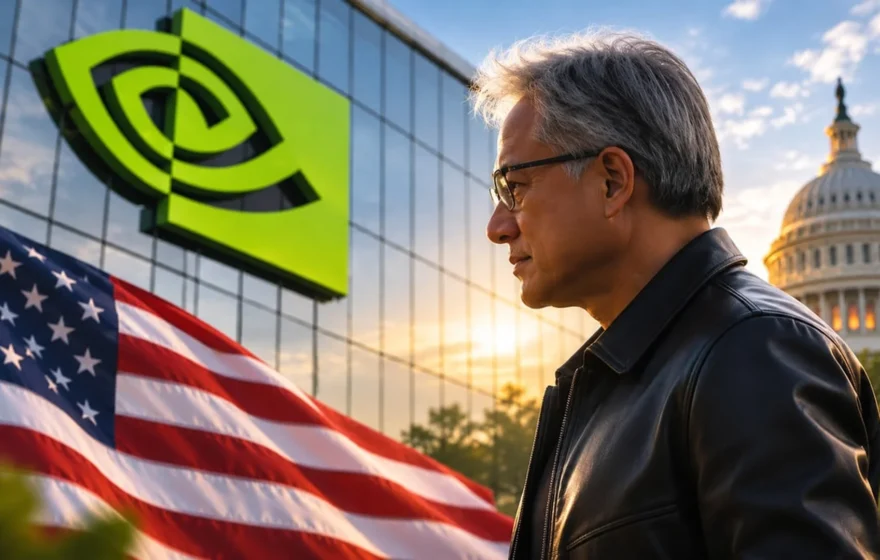
Jensen Huang has made his first statement since stepping down as the head of Nvidia, and he has framed a possible return in terms far wider than his own career. The former chief executive said he would be willing to come back if the board believed it would serve shareholders, employees, the company, and the United States itself.
Huang co-founded Nvidia in 1993 and led it from a small graphics-chip maker into the company whose processors now sit at the centre of the global artificial intelligence boom. That is why his departure has been about much more than one man’s job. It has shaken investors and drawn Washington into a debate about who should run a company America now treats as a matter of national importance. He described Nvidia as his life’s work, and he made clear he was not demanding his job back, only offering to return if the board decided it was in the interests of the company and of America.
Huang Appeals to America
Huang placed his American identity at the heart of his appeal. He recalled arriving in the United States 53 years ago, and he described becoming an American citizen as one of the proudest moments of his life. He credited the opportunities available in America for allowing Nvidia to grow from a start-up into a global chipmaker.
His statement went well beyond a request for his old job. He pointed to the challenges Nvidia now faces on several fronts at once, in technology, in markets, in competition, and in geopolitics, and he argued that steady leadership mattered at such a moment. He said employees, investors, business partners, and customers had contacted him since his departure, and many had encouraged him to return.
Nvidia Rejects His Return
Despite the appeal, Nvidia’s board has made its position clear, and it has not moved. The directors have rejected calls to reinstate Huang, saying they do not intend to reverse the decision that ended his tenure. That message was delivered during the company’s earnings call on November 17, when chairman Harvey Jones said Huang had voluntarily resigned on November 12, after disclosures about his personal conduct that violated the company’s standards and its corporate culture, and that the board had unanimously accepted that resignation.
Nvidia announced the change on November 12, naming chief financial officer Colette Kress as interim chief executive. The company gave no reason for his departure in its formal announcement, but the resignation followed days of intense scrutiny over his personal relationships, including reports of an affair with a woman US officials suspect of having links to Chinese intelligence. Huang had previously acknowledged being unfaithful to his wife and admitted he had made serious mistakes in his personal life. In his latest statement, he accepted responsibility for the problems he had created for the board and promised to cooperate with its independent investigation. The tone was contrite, but the substance was unchanged. He still wants to come back, and the board still says no.
National Security Concerns Grow
Huang’s appeal comes as Nvidia faces serious scrutiny over its relationships with China and the movement of advanced AI chips. His resignation followed reports involving Alice Huang, a former executive at Megaspeed, whom US officials suspect of having links to Chinese intelligence. Beijing has rejected the espionage allegations, and the claims have not been independently established as findings of wrongdoing, but the episode has already drawn the attention of Congress. Megaspeed is also under investigation over allegations involving the diversion of restricted Nvidia chips to China, a case that touches on the export controls Washington has built around advanced semiconductors.
Following Huang’s departure, Nvidia established a National Security and Export Control Oversight Committee to supervise its national security policies, its export compliance, and its global trade risks. The committee will be chaired by director Suzanne Nora Johnson and will work with independent legal and national security experts, while the company’s existing security and trade compliance teams will report to interim chief executive Colette Kress on operational matters.
Nvidia Moves Forward Without Huang
Nvidia has appointed finance chief Colette Kress as interim chief executive while it searches for a permanent replacement, and the company plans to consider both internal and external candidates. Kress has served as chief financial officer since September 2013, and she will keep her finance role while she leads the company. The board has also appointed Harvey Jones as its first-ever chairman. Although Huang has received support from employees and prominent technology figures, including Elon Musk, the board has maintained its decision against reinstating him. President Donald Trump has even suggested former Apple chief executive Tim Cook as a possible successor.
Huang’s statement leaves his willingness to return beyond doubt, but Nvidia’s leadership has made equally clear that it intends to move forward with a new chief executive. Huang says the company and the country would benefit from his experience at a moment of technological and geopolitical strain. The board says the standards of the company, and the investigations still under way, matter more than any single person, even its founder.
