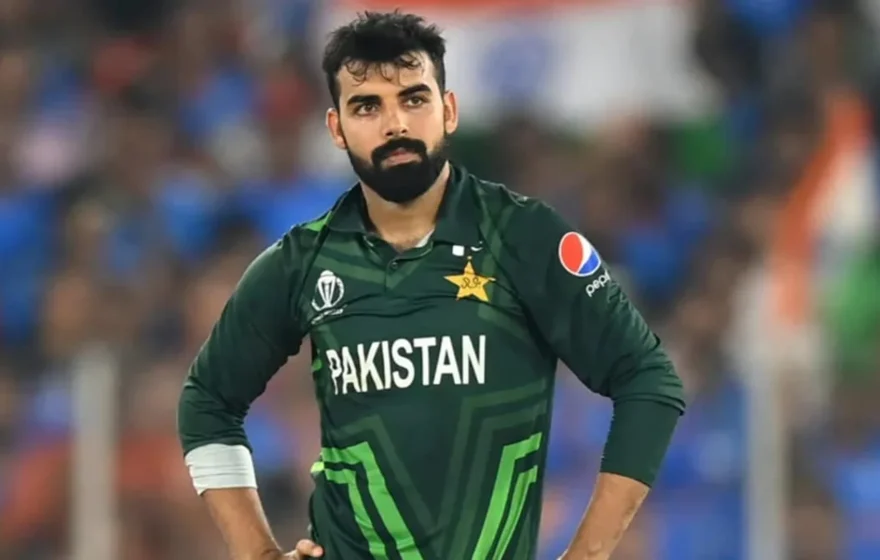
Former Pakistan spinner Saqlain Mushtaq has finally broken his silence on one of the most stubborn talking points in Pakistan cricket, firmly rejecting suggestions that he used his influence to win his son-in-law Shadab Khan a place in the national team. In a candid interview, the former head coach said he had never approached a selector or a Pakistan Cricket Board official on Shadab’s behalf, and he pointed to a simple fact his critics keep overlooking: Shadab was already Pakistan’s vice-captain before he married into the family.
Shadab announced his nikkah to Saqlain’s daughter on 23 January 2023, and from that day on, every selection and every lean spell has been viewed by some fans through the lens of that connection. Saqlain’s argument is that the timeline alone settles the question. Shadab made his international debut in 2017, established himself as a leg-spinning all-rounder, and had already been trusted with the vice-captaincy long before the wedding. A player does not climb that far, he insisted, on the strength of a relationship that did not yet exist.
The former spinner blamed social media for keeping the allegation alive. On the internet, he said, a claim can travel around the world before anyone stops to check whether it is true. He added that his family life is far more ordinary than the theories suggest: he lives in the United Kingdom, while Shadab is usually in Pakistan or travelling with the team, and the two rarely get the chance to meet at all.
Saqlain was equally blunt about the idea that connections alone can keep a player in international cricket. No cricketer, he said, can hold a place in a national side without performing consistently, because the game itself eventually exposes anyone who does not belong. A bowler who does not take wickets and a batter who does not score runs will be found out quickly, whatever their family ties. That is the real test Shadab has passed again and again.
He did not pretend he has kept quiet about Shadab’s cricket. Saqlain acknowledged that he has spoken publicly in support of the all-rounder, but he insisted his praise has always come from a coach’s eye rather than a father-in-law’s heart. He believes Shadab can be a genuinely valuable player for Pakistan if he is given a clearly defined role and used properly: a leg-spinner who can turn the ball both ways, a lower-order batter who can change the tempo of an innings, and one of the sharpest fielders in the side.
He also dismissed the suggestion that his family relationship creates a conflict of interest. When he watches Shadab play, he said, he does so as a former international player and a qualified coach, not as a father-in-law, and he judges the performance on its merits. The player has said the same himself, explaining that it hurt him when the connection was brought up again and again, since he had been playing for the national team for six or seven years and had married only two years earlier.
The interview also gave Saqlain the chance to revisit the unhappy end of his own time as Pakistan’s head coach. He served in the role while Ramiz Raja was chairman of the PCB, but when Najam Sethi replaced Raja, his tenure came to an abrupt end. Saqlain said a board official simply informed him that his services were no longer required, without offering any explanation. He tried repeatedly to secure a meeting with Sethi, offering to serve in any capacity, including coaching junior players, but he received no response and was eventually asked to leave the National Cricket Academy as well.
That experience has left him deeply critical of the way Pakistan cricket has been run since 2023. He blamed the constant chopping and changing of board leadership, coaching staff and policies for disrupting the team’s progress, arguing that players cannot build confidence when the people above them keep changing. He drew a contrast with India, where he said consistent policies and a willingness to let qualified people work independently have produced far more stable results.
Saqlain also used the conversation to pay tribute to Wasim Akram, crediting the great left-arm fast bowler with helping him develop during his playing career, and to defend Babar Azam against claims that the former captain is arrogant. Babar, he said, was a leader who welcomed suggestions and was always open to discussing team strategy.
Taken together, the interview says as much about Pakistan cricket as it does about one family. The suspicion that has followed Shadab since his wedding reflects a wider trust deficit, where fans who have watched years of instability at the top assume the worst about selection. Saqlain’s answer is that the record tells a different story: a debut in 2017, a vice-captaincy earned before the marriage, and a career built on wickets, runs and fielding rather than family influence. Whether supporters accept that will depend on Shadab’s own performances, because in Pakistan cricket the scoreboard is the only argument that settles a debate.
