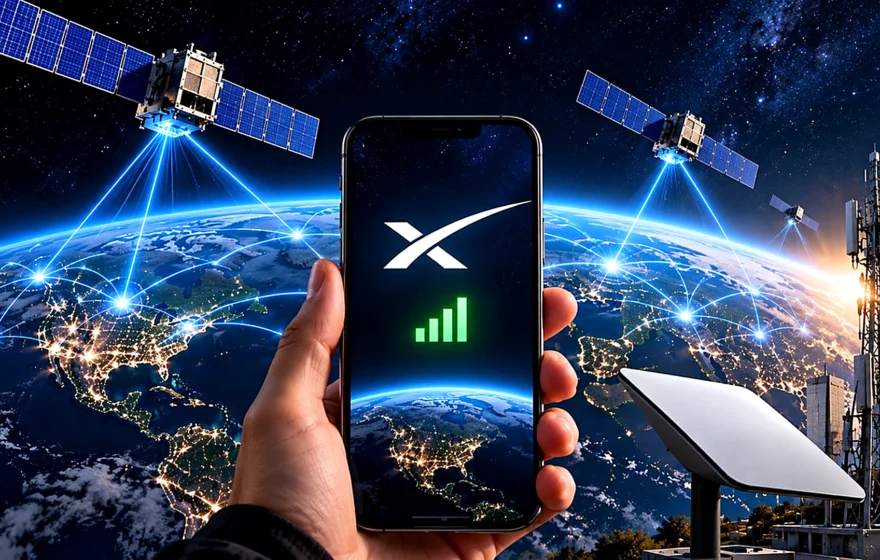
Elon Musk’s SpaceX is reportedly in talks about a move that would take Starlink well beyond satellite broadband and turn it into a genuine rival to America’s biggest mobile networks. According to a report in The Washington Post, the company has discussed a possible deal with EchoStar, the parent company of Boost Mobile, under which SpaceX could either buy the budget carrier outright or gain access to the mobile network arrangements it already uses. No agreement has been confirmed, and neither company has publicly said a purchase or partnership will go ahead, but the talks alone show how seriously SpaceX now treats the idea of becoming a full mobile operator in the United States.
The attraction is easy to understand. Starlink already provides satellite internet to homes, businesses and remote communities, and it is expanding services that connect ordinary mobile phones directly to satellites. That technology is powerful where there are no masts nearby, yet it has clear limits. A satellite signal struggles to reach deep inside buildings, and it cannot by itself match the capacity of a dense ground-based network in a crowded city. A complete mobile service still needs traditional cellular towers, licensed airwaves and commercial agreements that let customers use other networks. Buying or partnering with an existing carrier would be the fastest way for SpaceX to acquire those missing pieces, rather than building every one of them from scratch.
When Could Starlink Become a Full Mobile Carrier?
SpaceX has not announced a date for a complete nationwide mobile service, and the estimates offered so far differ sharply. Leadership at Verizon has previously suggested that building the required infrastructure could take between four and six years. Musk, by contrast, has suggested SpaceX might complete the process in roughly half that time. Both figures remain uncertain, and they underline the scale of the challenge. Even a company with SpaceX’s engineering resources and its enormous satellite constellation cannot simply declare itself a mobile carrier overnight. It must secure spectrum, arrange tower access, build billing and customer support systems, and satisfy regulators, all while keeping its satellite business running.
SpaceX Is Investing Billions in Mobile Networks
The Boost Mobile talks do not stand alone. SpaceX has already been spending heavily to secure the wireless spectrum that any mobile service depends upon, recently agreeing to acquire roughly eight billion dollars’ worth of additional wireless spectrum licences. Spectrum is, in simple terms, the set of radio frequencies over which mobile phones and network equipment communicate, and holding the right frequencies in the right places is one of the most valuable assets a carrier can own. More spectrum would help SpaceX improve its mobile coverage and build a stronger link between its satellite network and additional cellular services, so a phone can move between the two without the user noticing a break.
Why SpaceX Wants Boost Mobile
Boost Mobile offers something that spectrum and towers alone cannot: a ready-made route into the mobile market. Unlike the major carriers, which operate their own nationwide networks, Boost Mobile mainly rents network capacity from AT&T and T-Mobile. If SpaceX could make use of those arrangements, Starlink Mobile customers could connect through regular cell towers whenever a satellite signal is unavailable, giving them the everyday reliability a satellite-only service cannot yet promise. The result would be a combined service, satellite coverage where there is nothing else, and conventional mobile coverage everywhere else, sold as a single product.
Elon Musk Reportedly Met With EchoStar
The discussions are said to have been under way for several months, which suggests a considered negotiation rather than a passing idea. According to the report, Musk met EchoStar chairman Charlie Ergen in October to discuss a potential deal. Two broad options are understood to be on the table. One would involve SpaceX buying Boost Mobile outright, giving it full control of the brand, its customers and its commercial arrangements. The other would be an agreement giving SpaceX access to Boost Mobile’s existing network arrangements without a purchase, a lighter arrangement that might be quicker to agree but would leave SpaceX with less control.
AT&T, Verizon and T-Mobile Rejected SpaceX
There is, however, a significant complication, and it comes from the very companies SpaceX hopes to compete with. SpaceX reportedly approached AT&T, Verizon and T-Mobile before turning to Boost Mobile, asking them to allow it to use their networks, and all three are said to have rejected those requests. That history matters, because Boost Mobile’s existing network agreements may require approval from AT&T and T-Mobile before they can be transferred to a new owner. Without that approval, SpaceX might not automatically be able to use the same cellular networks, even if it completes a purchase.
For now, the story is best read as a signal of intent. SpaceX is spending billions on spectrum, seeking tower access, and exploring a deal that would give it a mobile brand, customers and network agreements in one step. Whether that leads to an acquisition, a partnership, or nothing at all will depend on price, on regulatory and contractual hurdles, and on whether the big carriers cooperate or obstruct. If it succeeds, American consumers could eventually face a genuinely different kind of mobile operator, one that blends satellites in orbit with towers on the ground.
