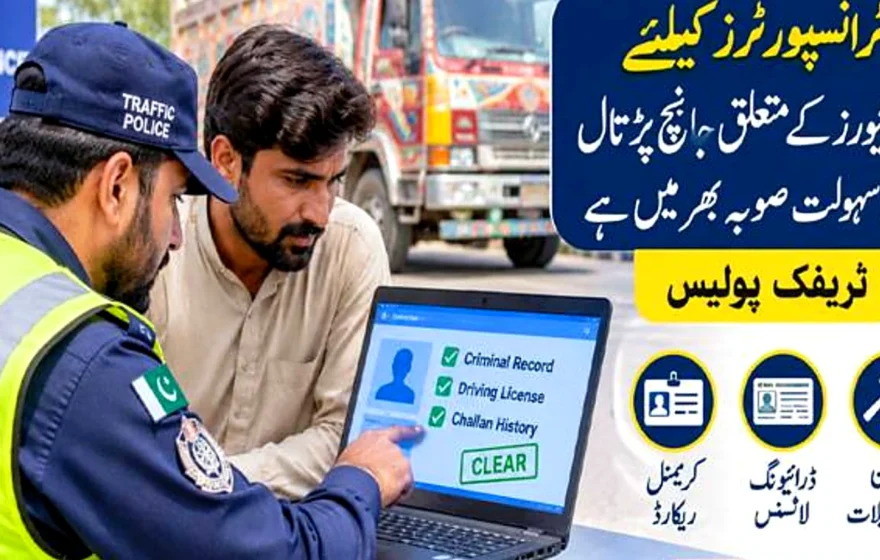
Punjab’s transporters can now check a driver’s full record free of charge before giving them the keys to a vehicle, under a new facility from the Punjab Traffic Police. The service allows operators to verify a driver’s criminal record, driving licence and traffic challans, and to obtain the record of any driver involved in an accident. For an industry where one hiring decision can put dozens of passengers, or tonnes of cargo, in a stranger’s hands, that information is not a formality. It is the difference between a calculated risk and a blind one.
According to the Punjab Traffic Police, the facility is available across the province, and transporters can have drivers’ details verified through the relevant traffic offices. The police have directed transporters to verify drivers thoroughly before hiring them, and have encouraged the employment of healthy and trained drivers. The message is practical: checking a record takes a visit to a traffic office, while skipping that check can cost lives. By making the service free, the police have removed the one excuse that might have stopped a small operator from using it.
The man behind the announcement framed it in those terms. Muhammad Waqas Nazir said the Punjab Traffic Police’s efforts to prevent accidents and protect precious human lives are ongoing, and that the verification facility will help reduce traffic accidents and make roads safer. His confidence is backed by a notable figure: a 35 per cent reduction in fatal accidents has been recorded this year on roads under its management. That improvement is the result of sustained enforcement, and the new service is the next step in the same campaign, aimed at drivers themselves rather than only at their vehicles.
The need for such a check becomes clear from the wider road safety picture. Data for the first nine months of 2026 showed a 35 per cent decrease in fatal traffic accidents across the province, alongside a significant reduction in non-fatal accidents. Yet driver negligence was a factor in 76 per cent of all fatal accidents, with speeding and improper overtaking among the primary causes. The roads are getting safer, but the remaining danger is overwhelmingly human: a driver who speeds habitually or drives without a valid licence is the single most common cause of a fatal crash.
That pattern is even sharper for commercial vehicles. In Lahore, traffic police began verifying the criminal records of 348,000 commercial vehicle drivers after data showed they were involved in 48 per cent of fatal road crashes, despite making up only about five per cent of the city’s roughly 8.2 million registered vehicles. Under that initiative, drivers with criminal records, repeated crashes or habitual violations would not be granted permits to operate commercial vehicles, and owners were told not to employ any driver without background verification, including a valid character certificate.
The new province-wide facility extends that logic beyond Lahore. A transporter in Multan, Faisalabad, Rawalpindi or any other district can now obtain the same check through local traffic offices, covering criminal history, licence validity, outstanding challans and accident involvement. That matters because commercial transport is not a city business: buses, trucks and wagons cross district boundaries every day, and a driver barred in one city could previously find work in another where nobody knew their history.
Enforcement around the new service is tightening in parallel. In Lahore, traffic police have moved to register first information reports against drivers for overspeeding, and have directed transporters to provide complete records of their drivers. Drivers will also be required to obtain fitness certificates, with mobile medical camps set up to examine eyesight, colour blindness, medical fitness and psychological health. These steps share a single idea: driving a public or commercial vehicle is a position of trust, earned through a clean record, a valid licence and proven fitness, not assumed at hiring.
The scale of enforcement in Punjab shows how much work the system already does. More than 6.7 million driving licences have been issued since January 2026, while more than 15 million traffic violation challans have been issued in the same period. Motorcycles account for 84 per cent of registered vehicles in the province, yet were involved in 39 per cent of traffic accidents in the first nine months of 2026.
What happens next depends on transporters themselves. The police can offer a free check, but they cannot force every operator to use it before every hiring decision, and the operators who cut corners are often the ones running the oldest vehicles on the tightest margins. The strongest incentive may be self-interest: an operator who hires an unverified driver risks a crash, a police case and a damaged reputation. If the facility is used widely, it could turn hiring from a gamble into a routine safeguard, and help Punjab build on the fall in fatal accidents already recorded this year. The roads will not become safe because a single service exists, but they will become safer if the people who put drivers behind the wheel treat a record check as the first step, not an afterthought.
