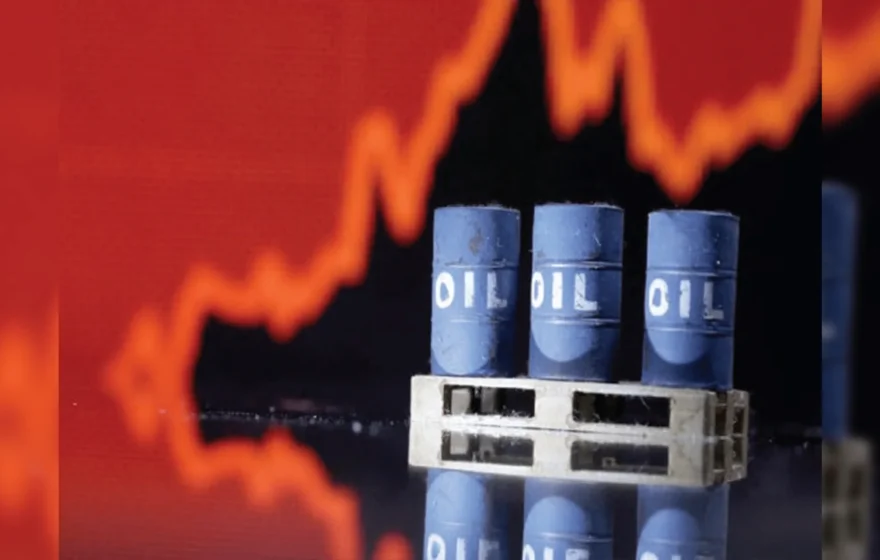
Oil prices dropped sharply on Monday after signs of diplomatic movement between the United States and Iran gave traders hope that the Middle East conflict might be brought to an end without further escalation. The fall was large enough to push the American benchmark below one hundred dollars a barrel, a level that had come to reflect how nervous the market had become about the risk of a broader war.
The scale of the decline was striking. Brent crude, the international benchmark, for delivery in January fell by 3.94 percent to 108.96 dollars a barrel by half past seven in the morning Eastern Time. West Texas Intermediate, the American benchmark, for delivery in December dropped by 4.17 percent to 99.78 dollars a barrel. When prices move by around four percent in a single session, it is usually a sign that traders are rapidly reassessing a major risk, and on Monday that risk was the prospect of a direct military confrontation between Washington and Tehran.
Oil markets react so strongly to Middle East tensions because the region sits at the heart of global energy supply. Even when production has not been disrupted, the fear that it might be is enough to push prices higher, as buyers pay a premium for security of supply. Any credible hint that diplomacy might succeed tends to unwind that premium quickly, which is what appeared to happen on Monday.
Washington and Tehran Point Towards Talks
United States Secretary of State Marco Rubio said that President Donald Trump would prefer to settle the dispute with Iran through diplomatic means rather than through military force. According to Rubio, the president had not yet taken a decision on further military action, but remained confident in the ability of the American armed forces to respond if that became necessary. The message, as presented by Rubio, was deliberately two-sided: a preference for negotiation, backed by a reminder of military strength.
Iranian officials, for their part, also suggested that an agreement was still within reach after two days of discussions mediated by Qatar, provided that whatever was agreed was put into practice in a concrete and verifiable way. That condition was reported by Al Jazeera. The emphasis on tangible implementation matters, because previous rounds of engagement between the two countries have often broken down over questions of sequencing and trust, with each side doubting whether the other would honour its commitments.
The diplomatic signals arrived against a more unsettled backdrop. Reports in The Wall Street Journal and The New York Times have suggested that the United States is preparing for possible renewed military strikes after the American midterm elections on November 3. That reporting has kept traders on edge, since it points to a window in which diplomacy could still fail and force could return to the forefront. On Saturday, Iranian Supreme Leader Mojtaba Khamenei urged the armed forces of his country to answer any level or type of threat with an immediate and forceful response, without geographic limits. His remarks underlined how quickly a miscalculation on either side could turn a tense standoff into open conflict.
Why the Market Moved So Fast
That wider risk has not gone away, even after Monday’s fall. The anxiety is not only about Washington and Tehran but also about the continuing war in Ukraine, where attacks on civilians have cast doubt over the chances of a lasting ceasefire. In the Middle East, repeated attacks on ships and refineries have added further uncertainty, reminding traders that energy infrastructure itself has become a target. As long as those attacks continue, the market is likely to stay sensitive to every headline, rising on bad news and falling on good news in quick succession.
What Happens Next
The immediate question is whether the diplomatic opening that moved prices on Monday can be turned into something durable. The talks mediated by Qatar will need to produce terms that both sides can present as acceptable at home, and the history of this dispute suggests that will not be straightforward. Washington has paired its talk of diplomacy with warnings about military readiness, while Tehran has paired its openness to a deal with demands that any agreement be implemented in practice rather than left as a promise.
The calendar also matters. With the American midterm elections falling on November 3, the coming days will be watched closely for any sign of whether the diplomatic track survives the political season or gives way to the military preparations that have been reported. For households and businesses, the practical consequence is continued volatility. A single day of falling prices does not guarantee cheaper fuel in the weeks ahead, because the same market that fell sharply on Monday could rise just as sharply on one worrying headline. What Monday did show is how much of the recent price level was built on fear of war, and how quickly that fear can ease when diplomacy, however fragile, returns to the table.
