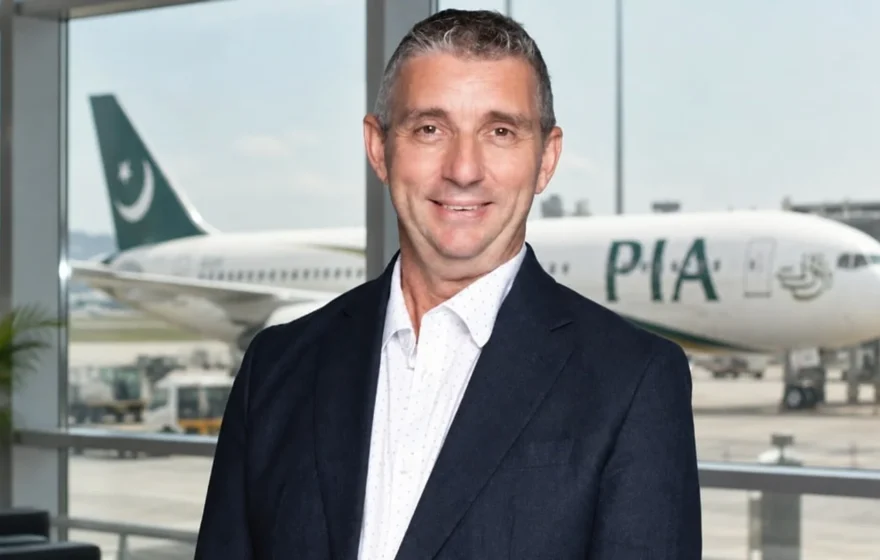
Pakistan International Airlines has formally appointed Adrian Hamilton-Manns as its new chief executive officer, giving the national carrier a leader with more than thirty years of experience in aviation. Hamilton-Manns has officially taken charge, and his appointment is one of the first major leadership changes at the airline since an Arif Habib-led consortium took over its management on June 29, 2026. The move marks a clear step in the carrier’s new chapter under private ownership, after decades in which it struggled with losses, operational problems and political interference.
Hamilton-Manns arrives with a career built largely around low-cost airlines and turnarounds. He led Salam Air, the Muscat-based low-cost carrier, from July 2024, and before that he served as president and chief executive of Kazakhstan’s Fly Arystan from April 2020 to July 2024. Earlier in his career he held senior commercial roles at India’s IndiGo, South African Airways, Virgin Australia’s Pacific Blue and Indonesia’s Mandala Airlines. That experience is part of why the new owners turned to him at a moment when PIA needs to rebuild both its operations and its reputation.
The appointment had been expected for some weeks. Reports in mid-October said Hamilton-Manns, a New Zealand-born aviation executive, had been nominated for the role, with his formal announcement held back while security and other clearances were completed. Those reports described the job as one of the most significant appointments since the airline passed into private hands, and they noted that he was expected to take charge by the end of October. The formal announcement now confirms that process, and it closes a period of uncertainty about who would lead the privatised carrier.
For the new owners, the choice is also a statement of intent. The Arif Habib Corporation-led consortium took management control after the first financial closing of the privatisation transaction, following a long and often delayed effort to sell the airline. The consortium won a 75 percent stake with a bid of Rs135 billion, well above the government’s reference price, and under the agreed terms most of the proceeds are to be invested back into the airline itself. The new board’s first chairman was Lt Gen (retd) Anwar Ali Haider, managing director of the Fauji Foundation, and the appointment of a chief executive with a low-cost background suggests the owners want a sharper commercial focus, tighter costs and a more disciplined route network.
Hamilton-Manns takes over from Air Vice Marshal (retd) Aamir Hayat, whose tenure the consortium and the board have publicly acknowledged. Hayat led the airline through a difficult period, and during his time in charge PIA improved its aviation safety standards, a change that mattered enormously for its international future. European and British authorities had imposed restrictions after a deadly crash near Karachi in 2020 and the controversy over pilot licences that followed, cutting the airline off from some of its most valuable routes. The European Union lifted its ban in November 2024, and Britain removed Pakistan from its Air Safety List in July 2025, opening the way back.
That return has already begun to show results. PIA resumed flights to Paris in January 2025, returned to Manchester, and in March 2026 landed back at London Heathrow after a six-year absence, operating from Islamabad and later adding Lahore. Manchester alone has carried more than 100,000 passengers since its service reopened, according to recent reporting, a sign of how strong demand remains among Pakistanis in Britain. The airline now regards Britain, Europe and North America as lucrative markets, but it has also faced a shortage of aircraft, which has limited how quickly it can expand.
The challenges facing Hamilton-Manns are therefore considerable. The airline’s fleet is far smaller than the 64 aircraft the new owners have spoken of reaching over the coming years, and about half of its current aircraft have been reported as inactive. The consortium has pledged substantial investment, including money for fleet renewal, renovated cabins and better punctuality, and it is exploring options with Airbus and Boeing as well as leasing and financing routes. Turning those plans into reliable daily operations, however, will require careful scheduling, maintenance and customer service, areas where low-cost carriers live or die on efficiency.
There is also the question of what privatisation means for passengers and staff. Supporters of the sale argue that private management, free from the political interference that weighed on PIA for years, can finally make the airline financially sustainable, and they point to its first pre-tax profit in two decades as evidence that a corner has been turned. Critics will watch closely to see whether cost discipline comes at the expense of jobs, routes to smaller cities and service standards. Hamilton-Manns, with his background at Salam Air and Fly Arystan, two carriers built on keeping fares low while expanding quickly, will be judged on whether he can balance those pressures. His appointment gives PIA a chief executive who has done this kind of work before, in markets that were also difficult and competitive, and the coming months will show whether that experience can translate into a carrier that Pakistanis can rely on again.
