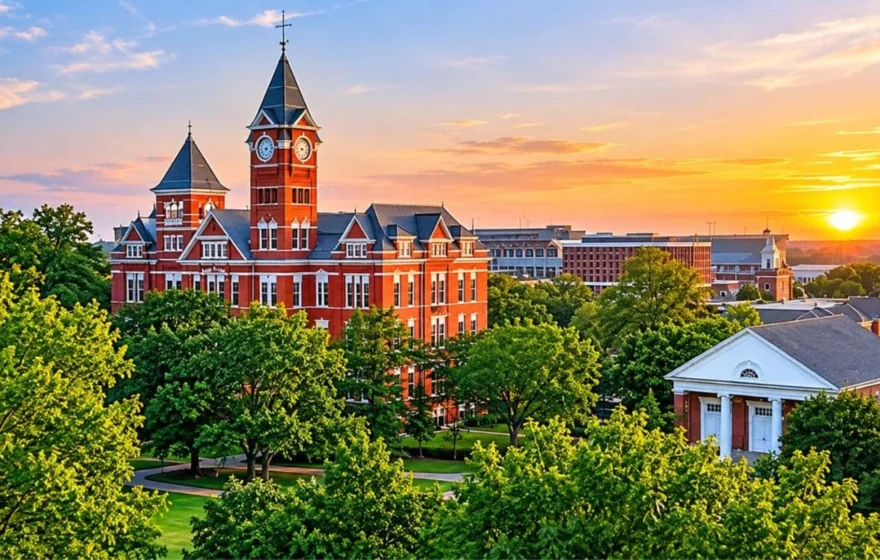
Auburn University in the United States has opened funded research places for master’s and doctoral students who want to work on pine forests, and the roles carry an annual salary of between twenty-five thousand and twenty-seven thousand dollars. The openings sit in the university’s College of Forestry, Wildlife and Environment in Alabama, and they focus on forest genetics and on making forests better able to cope with a changing environment.
The university plans to take on either two master’s students, each following a separate research project, or a single doctoral student who would bring both research areas together. Either way, the work centres on improving how pine forests are managed, strengthening their resilience, and developing planting methods that give young trees a stronger start. That practical link between genetics and everyday forest management is what makes these particular places stand out from a standard scholarship notice.
What the Research Roles Offer
The financial package is straightforward. Selected graduate researchers will receive an annual salary in the range of twenty-five thousand to twenty-seven thousand dollars, and they will work between twenty and forty hours each week depending on how their research appointment is arranged. Alongside the pay, the roles offer experience in forest genetics, environmental research and sustainable forest management, with the chance to work beside faculty researchers and to contribute to scientific studies that feed directly into how forests are run.
There are, however, details that applicants will need to pin down for themselves. The announcement does not spell out exactly how long the funding will last, nor does it explain tuition waiver arrangements or health insurance benefits. Those are important questions for any international applicant, because the real value of a graduate place depends on the full package and not on the headline salary alone.
Who Can Apply
Applicants must hold at least a bachelor’s degree in forestry, biology, ecology, plant science, soil science, natural resources, statistics or a closely related field. The university also welcomes people who bring experience in R or Python, quantitative genetics, forest modelling, plant physiology, soil science and microbiology. Experience in greenhouse experiments, field research and environmental data analysis may also strengthen an application.
Beyond technical skills, candidates should show strong communication skills, a genuine interest in research, and the ability to work both independently and as part of a team. Previous research experience is described as particularly valuable for doctoral applicants, and the listing summary mentions at least one year of experience, although the detailed description does not explain how that requirement will be assessed. The announcement also does not set a minimum grade point average or an English-language test score, so international applicants should confirm Auburn University’s graduate admission and English proficiency requirements separately rather than assuming the research announcement covers them.
What Applicants Must Prepare
The application itself is deliberately compact, and preparing it well will take care. Applicants must put together an updated curriculum vitae setting out their academic qualifications, relevant research experience and technical skills. They must also write a one-page statement of research interests and career goals, explaining which research area they prefer and how their academic background connects with the proposed project. That single page carries real weight, since it is where a candidate shows not just what they have studied but why this particular forest research matters to them and where they hope it will lead.
Alongside those two documents, candidates must provide unofficial academic transcripts and the contact information for three references. They must also state clearly whether they are applying for a master’s or a doctoral place. All of the material must then be combined into a single PDF file before submission, so applicants should check the finished document carefully, making sure nothing is missing and that the file opens cleanly, before they send it.
How to Apply
Applications go directly to the research faculty by email. Candidates should send their combined PDF to Dr Hao Chen at hzc0134@auburn.edu, and they must copy the message to Dr Chris Anderson at andercj@auburn.edu and to Dr Ajay Sharma at azs0365@auburn.edu. The announcement requires applicants to use the subject line it specifies and to mention their preferred degree and research project in the application. The deadline is the fifteenth of November 2026, and successful students can begin their research in January 2027 or in the autumn of 2027.
A mid-November deadline leaves only a short window for gathering transcripts, contacting referees and writing a convincing statement, so anyone interested should start at once rather than waiting for the final week.
For graduates from Pakistan and elsewhere in South Asia, where forestry, agriculture and environmental science produce strong candidates each year, this kind of opening is worth taking seriously. English is the working language of the research, the skills involved are in demand internationally, and forest resilience is becoming more urgent as heat, drought and pests test planted forests around the world. The opportunity is competitive, the deadline is close, and the application is short, which is precisely why a careful, early and complete submission is the best way to stand out.
