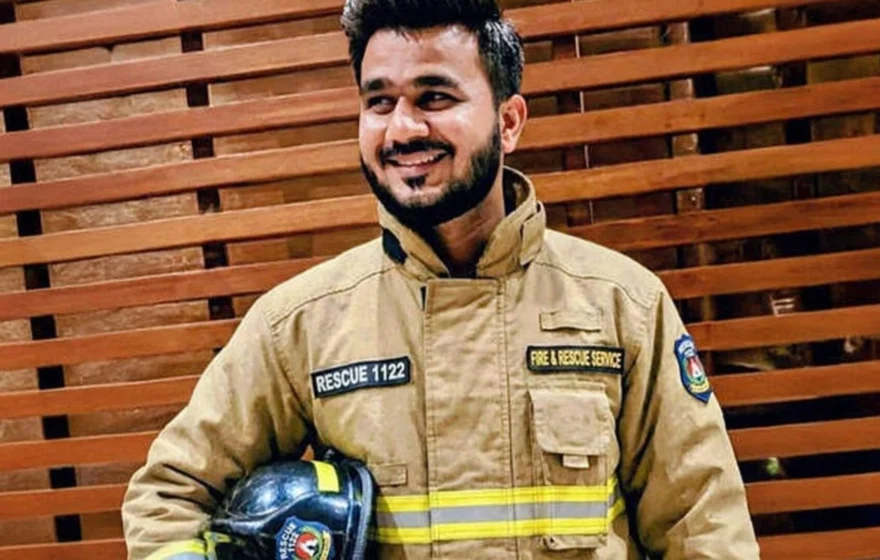
President Asif Ali Zardari has approved the Tamgha-e-Shujaat, Pakistan’s Medal of Bravery, for Shaheed Furqan Ali, the Karachi firefighter who lost his life while trying to save people trapped in the Gul Plaza fire. The national honour, announced months after the tragedy on the city’s M.A. Jinnah Road, follows sustained efforts by Karachi Mayor Barrister Murtaza Wahab to secure recognition for a man whose death became a symbol of the risks firefighters take every time they enter a burning building.
The Tamgha-e-Shujaat is among Pakistan’s civil decorations for acts of bravery, awarded to citizens whose courage in the face of danger stands apart from the ordinary call of duty. Firefighters rarely feature in national honours lists, even though their work routinely involves the same danger that soldiers and police officers are decorated for, and that is part of why this announcement has resonated in Karachi.
Who Was Furqan Ali
Furqan Ali was thirty-six years old and posted at the Nazimabad Fire Station, where he served in the Karachi Metropolitan Corporation’s Fire Department. He had joined the department in 2018, entering service on the deceased quota after his father, who was also a firefighter, passed away while still in service. That detail says much about the family and the profession: firefighting in Karachi is often a calling passed from one generation to the next, with sons following fathers into stations where the dangers are well known and the resources are often stretched thin. Furqan had married about a year and a half before his death and had a child, a young family left behind by a man who went to work on an ordinary night and never came home.
His colleagues remember a firefighter who understood the job from the inside, having grown up in a firefighter’s household before wearing the uniform himself. In a service where experience is built incident by incident, eight years on the job had made him a dependable member of his crew, trusted in the most hazardous phases of an operation.
Killed Under the Debris
Furqan was part of the team battling the blaze at Gul Plaza on Karachi’s M.A. Jinnah Road, which broke out on the night of 17 January 2026 and burned for around thirty-six hours before it was brought under control on the morning of 19 January. During the operation, he fell into the wreckage and was trapped under the debris, where he lost his life. The image of a firefighter buried beneath the ruins of the very building he was trying to save captures the particular horror of the Gul Plaza disaster, in which the structure itself became as deadly as the flames, and in which rescue work had to continue even as the building’s stability deteriorated hour by hour.
The fire was one of the deadliest in Karachi’s history. The final investigation report put the death toll at seventy-nine, a figure that shocked the city and forced a wider conversation about fire safety in commercial buildings. Gul Plaza was a busy shopping centre on one of Karachi’s main roads, where blocked exits, poor wiring, absent alarms and unenforced building rules can turn a fire into a mass-casualty event. The tragedy pushed Punjab to issue new fire safety rules for commercial buildings, underlining how the lessons of a Karachi disaster were felt across provincial boundaries.
Fire Station to Carry His Name
After his death, Mayor Wahab announced that the Nazimabad Fire Station, Furqan’s own station, would be renamed after Shaheed Furqan Ali. He also announced Rs. 10 million in financial assistance for the family and assured them that all of Furqan’s benefits and entitlements would continue to be paid. Renaming a station is a lasting remembrance: every firefighter reporting for duty there will be reminded of the man whose name it carries. The financial assistance and continued benefits matter equally, addressing the practical reality facing a young widow and child, for whom a national honour cannot replace a husband and father.
The Tamgha-e-Shujaat now adds national recognition to a sacrifice that officials described as an act of exceptional courage and devotion to saving human lives. The award, the renamed station and the support for his family together form a fuller tribute than any one of them alone, recognising both the heroism of the act and the human cost left behind. Yet the truest test of whether Karachi has honoured Furqan Ali will be found in whether the city’s commercial buildings become safer, its fire stations better equipped, and its firefighters better protected than they were on the night of 17 January. If the Gul Plaza fire leads to stricter enforcement, working alarms and exits, and safety inspections that are actually carried out, then the seventy-nine lives lost will have changed something real. That would be a memorial worthy of the bravery the Tamgha-e-Shujaat now records.
