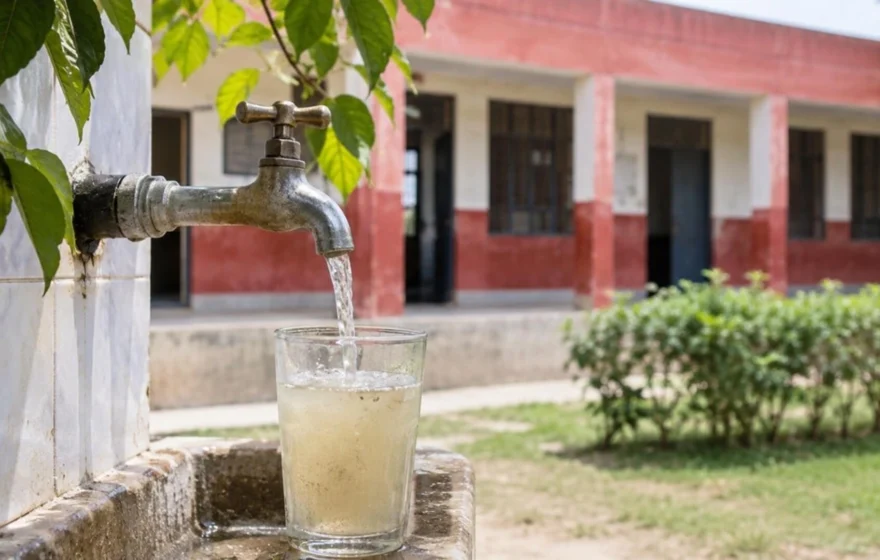
Drinking water at 145 government schools in Punjab’s Chiniot district has been declared unsafe after laboratory testing found contamination, raising urgent questions about the health of thousands of pupils who rely on school taps every day. The findings, published on 3 November, show that almost one in three of the schools tested in the district failed to meet basic safety standards, a result that has alarmed parents and put the spotlight on the state of water supplies in public schools.
According to a report by the District Research Laboratory, water samples were collected from 451 government schools across Chiniot and put through a series of checks. Of those, 145 samples failed, meaning the water at those schools was not considered safe to drink. The scale of the failure is striking because the testing covered a large share of the district’s public schools, giving officials an unusually clear picture of a problem that might otherwise have gone unnoticed.
The affected schools span all levels of schooling. They include 36 high schools, 26 elementary schools and 83 primary schools, spread across different parts of the district. That spread matters, because it suggests the problem is not confined to a single neighbourhood or a single supply line. Primary schools account for the largest share of the failures, which is especially worrying, since their pupils are the youngest and most vulnerable to illness from unsafe water.
District Research Officer Irshad Ahmed said the tests examined several indicators of water quality, including colour, taste, pH levels and total dissolved solids, known as TDS. Each of those measures tells a different part of the story: colour and taste can signal visible contamination, pH shows whether water is unusually acidic or alkaline, and TDS reflects the combined amount of dissolved minerals and salts in a sample.
It is the TDS readings that stand out most sharply. While levels of up to 1,000 are generally considered acceptable, samples from the affected schools recorded levels above 2,000, more than double that benchmark. High TDS on its own does not identify a single contaminant, but it is a clear warning sign that the water contains far more dissolved material than it should, and that further investigation is needed into what exactly is present.
For children, the stakes are high. Pupils spend much of the day at school, and in hot weather they need regular access to drinking water. If the only water available is unsafe, they face a difficult choice between going thirsty and drinking water that may make them ill. Contaminated drinking water is linked to stomach infections, diarrhoea and other waterborne illnesses, which can keep children out of class, weaken their concentration and, in serious cases, require medical treatment.
The laboratory results do not, on their own, explain why so many supplies failed. Possible causes range from ageing pipes and poorly maintained storage tanks to groundwater problems and a lack of regular filtration or treatment at school level. Identifying the cause at each school will matter, because a remedy that works for one supply, such as replacing a tank, may be useless for another where the source itself is the problem.
In the immediate term, the priority must be to make sure pupils are not drinking the affected water. That could mean supplying safe water from tankers or bottled sources while repairs are made, closing affected taps, and clearly informing teachers, parents and pupils which supplies are safe to use. Clear communication is essential: if families are not told promptly and plainly, children may continue to use taps that have already failed testing, and trust in the school system will suffer.
Beyond the emergency response, the findings point to a wider need for routine, published testing of school water supplies. A one-off survey can reveal a crisis, but it cannot prevent the next one. Regular checks, prompt repairs to pipes and tanks, and working filtration plants at schools would give parents confidence that the water their children drink each day has actually been checked, rather than assumed to be safe.
The case also highlights the broader challenge facing public schools in Punjab, where large numbers of children depend on state provision for basic facilities as well as education. Clean water is not an extra; it is a foundation for learning. A child who is ill, dehydrated or worried about the water from the school tap is less able to concentrate, attend regularly and make the most of the classroom. Investment in safe water, like investment in classrooms and teachers, is therefore investment in education itself.
For now, the laboratory report has done the most important job: it has made a hidden problem visible. The test of the response will be what happens next, and how quickly. Parents in Chiniot will reasonably expect to see affected supplies fixed or replaced, fresh tests confirming that the water is safe, and a plan to stop the same failures recurring. Until those steps are taken and verified, the finding that 145 schools have unsafe drinking water will remain not just a statistic from a laboratory, but a daily risk carried by the district’s schoolchildren.
