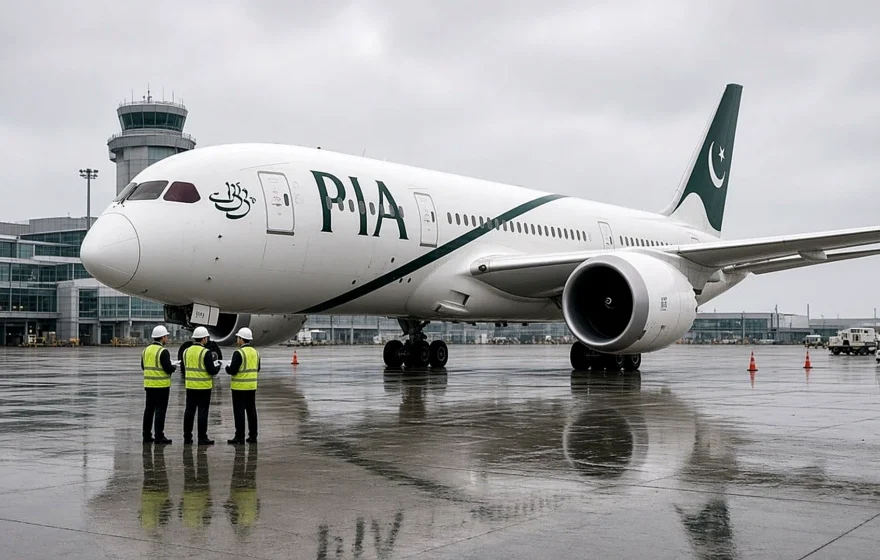
Pakistan International Airlines is flying with barely half its fleet in the air, officials have told parliament, with 16 aircraft grounded while only 17 or 18 planes are in operation. The figures emerged during a briefing to the National Assembly’s Standing Committee on Privatization, where lawmakers raised pointed questions about the airline’s service quality and its failure to provide a required report on its performance.
The session also exposed a wider frustration in parliament. Committee members criticised several ministries for failing to answer parliamentary questions or submit requested information. The meeting itself lacked the required quorum, and no ruling coalition member was present, prompting objections that the committee could not properly proceed.
For PIA, the fleet numbers tell a familiar story. An airline that cannot put most of its aircraft in the air struggles to run a reliable schedule, and reliability is the first thing travellers judge. The briefing offered signs of recovery, including new aircraft and restored routes, but the grounded fleet shows how far that recovery still has to go.
PIA Fleet and Flight Operations
During the briefing, officials said PIA’s aircraft previously had an average age of 21 to 22 years, a figure that explains much about the airline’s maintenance burden. Older aircraft need more frequent and more expensive attention, and finding suitable engines has been a recurring obstacle. Officials said repairs were being carried out where suitable engines were available.
There was better news on renewal. The airline has received one Boeing Dreamliner, with another expected in January, and the two aircraft are between seven and eight years old, far younger than the fleet average. Younger aircraft are cheaper to maintain and more fuel efficient, so each addition matters disproportionately for an airline trying to rebuild.
Officials also told the committee that PIA’s London flights had resumed on a daily basis, with services to Manchester and Birmingham expected to start, and Karachi-London flights scheduled to begin in March 2027. The British routes matter greatly to the airline, since the United Kingdom is one of its most important markets, home to a large Pakistani community and a steady flow of family, business and student travel. The Secretary of the Privatization Commission added that passengers were being served meals on London flights and had responded positively to the biryani and pulao on offer.
Committee Questions PIA’s Service Quality
Committee member Sahar Kamran questioned PIA’s service standards despite the tax relief available to the airline. She said private airlines were providing better services and operating flights on time, while PIA’s performance remained unsatisfactory, and the committee had yet to receive the required report on the national carrier.
The comparison with private carriers cuts to the heart of PIA’s problem. Passengers judge an airline against the alternatives on the same route, not against its history or difficulties. If a private competitor departs on time with a cleaner cabin and friendlier service, excuses about fleet age and engine shortages carry little weight with a traveller who has missed a connection.
In response, the Secretary of the Privatization Commission clarified that PIA had received a sales tax exemption only on the purchase of new aircraft, and had not been granted any other tax exemptions following its privatization. The distinction matters, because it frames the relief as an investment incentive rather than an open-ended subsidy, lowering the cost of fleet renewal while leaving the airline to stand on its own operating performance.
Even so, the exchange highlighted a gap between parliament’s expectations and the airline’s delivery. Lawmakers want a report they can scrutinise and service improvements they can point to. Until both arrive, PIA will face the same questions at every briefing.
Ministries Criticised Over Missing Responses
Beyond PIA, the committee expressed serious concern over several ministries’ failure to respond to questions and provide requested information. Farooq Sattar said some ministries had submitted no answers at all, with the words “awaiting response” appearing against the relevant questions. Sahar Kamran said documents had only been provided the previous evening, leaving members little time to prepare.
Kamran further said Parliament and its committees had effectively become inactive, pointing out that the meeting lacked the required quorum and no ruling coalition member was present. Natasha Daultana objected to holding the meeting informally, while Sattar said members were not even participating through Zoom.
That procedural breakdown is more than a footnote. Parliamentary committees are one of the few mechanisms through which the public can hold state-owned enterprises and ministries to account between elections. When ministries do not answer, reports do not arrive, and meetings cannot reach quorum, oversight becomes theatre rather than scrutiny.
For PIA, the path forward is clear enough even if it is not easy. Grounded aircraft must be returned to service or replaced, the new Dreamliners must be followed by further renewal, and the restored British routes must run reliably enough to win back passengers who have drifted to competitors. None of that will happen quickly. The fleet figures are a reminder of the scale of the task: an airline flying barely half its planes cannot promise its passengers very much until that number changes.
