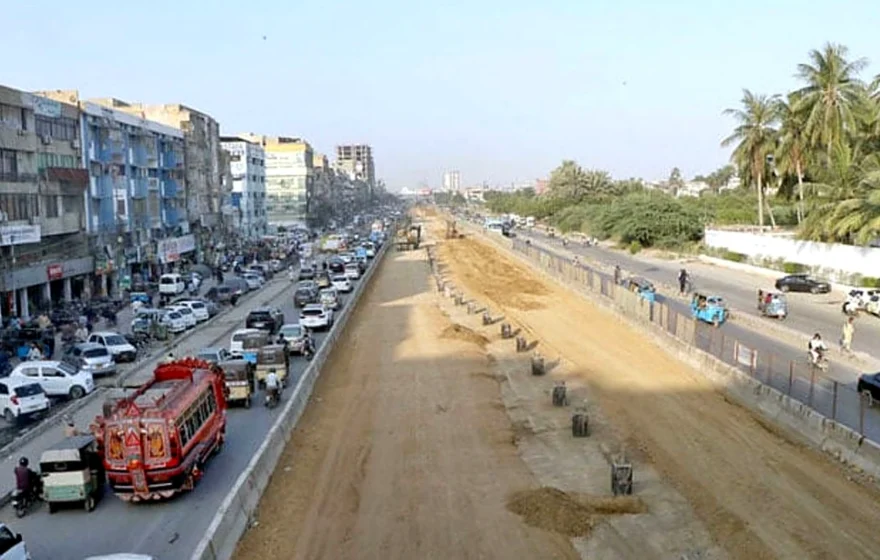
Commuters on Karachi’s University Road are in line for some relief after the Sindh government decided to reopen a U-turn on the busy corridor that had been closed while work continues on the Red Line bus rapid transit project. The decision was taken at a meeting of the Transport and Mass Transit Department chaired by Sindh Senior Minister Sharjeel Inam Memon, who also holds the information portfolio in the provincial cabinet.
The reopening is a small change on paper, but on University Road small changes matter. The road is one of the busiest routes in the city, carrying students, office workers and families between Gulshan-e-Iqbal, Gulistan-e-Johar and the city centre, and it has spent years narrowed by construction barriers, diversions and dug-up stretches. For drivers who have had to travel long distances to find a legal turning point, a restored U-turn should cut out detours and ease some of the pressure at neighbouring intersections, particularly during the morning and evening rush.
The meeting also reviewed arrangements for the double-decker and electric buses that have recently arrived in Karachi. Memon directed officials to finalise suitable routes for the new vehicles, and he expressed hope that another batch of double-decker and electric buses would reach the city later this month. The emphasis, he said, should be on comprehensive planning covering both operations and services, so that the buses go where residents need public transport most rather than simply where it is easiest to run them.
That point matters because Karachi’s public transport shortage is felt most sharply in densely populated neighbourhoods and on corridors where private options are expensive. A new bus is only useful if its route connects homes, workplaces, schools and hospitals, and if it runs often enough for people to rely on it. Officials at the meeting were therefore asked to look beyond the launch of the vehicles themselves and to plan the timetables, stops and maintenance support that will keep them running day after day.
Memon also told officials to take extraordinary measures to ensure the timely completion of the Red Line project itself. The instruction reflects the long and difficult history of the corridor. The Red Line, planned to run for around 26 kilometres from Malir Halt to Numaish Chowrangi, was launched in 2022 with an original completion target of 2024. That deadline has since been pushed back repeatedly, and reporting in August 2026 put the revised completion date at June 2027, after years in which large sections of University Road were left riddled with potholes, broken surfaces and diversions.
Running alongside the Red Line works is a separate but closely connected job: the K-IV water pipeline augmentation between Nipa Chowrangi and Hassan Square. That work, involving large-diameter pipelines, has kept one carriageway of University Road closed and has itself been delayed well beyond its original schedule. Reporting in late October 2026 said a 1.4-kilometre section between Hassan Square and Baitul Mukarram Mosque was expected to be handed over for Red Line road construction in the first week of November, with the remaining 1.3 kilometres targeted for handover by December 31. Until those sections are handed back, full resurfacing and reopening of the road cannot happen.
It is in that context that the minister’s other direction from the meeting should be read. Memon ordered the early completion of the remaining construction work on the second section of the Taj Haider Bridge and instructed officials to monitor construction activities daily. Bridges and flyovers on this corridor are not decorative extras; they are the structures that let traffic keep moving while bus lanes, stations and drains are built underneath and alongside them. Daily monitoring, if it happens in practice, would give the government an early warning when a section slips, rather than leaving problems to be discovered months later.
The bus fleet itself is also growing. At a provincial cabinet briefing on November 4, Memon said more than 100 electric buses were expected to arrive in Sindh by the end of November, with double-decker buses also due to reach the province soon, and he added that construction of the Red Line depot was progressing rapidly. Those arrivals, combined with the buses already in the city, would give planners more vehicles to spread across new routes, provided depots, charging facilities and trained drivers keep pace with the deliveries.
For commuters, the honest assessment is that the U-turn decision is welcome but modest. It does not finish the Red Line, it does not resurface University Road, and it does not by itself solve the congestion that has built up over four years of construction. What it does do is remove one daily frustration, and it signals that the government is paying attention to the small traffic measures that make a difference while the larger project grinds on. What happens next will be watched closely: the actual reopening date, the routes chosen for the new buses, and whether the December pipeline handovers are met. If those milestones hold, the road could begin to feel different before the year ends; if they slip again, patience on University Road will wear thinner still.
