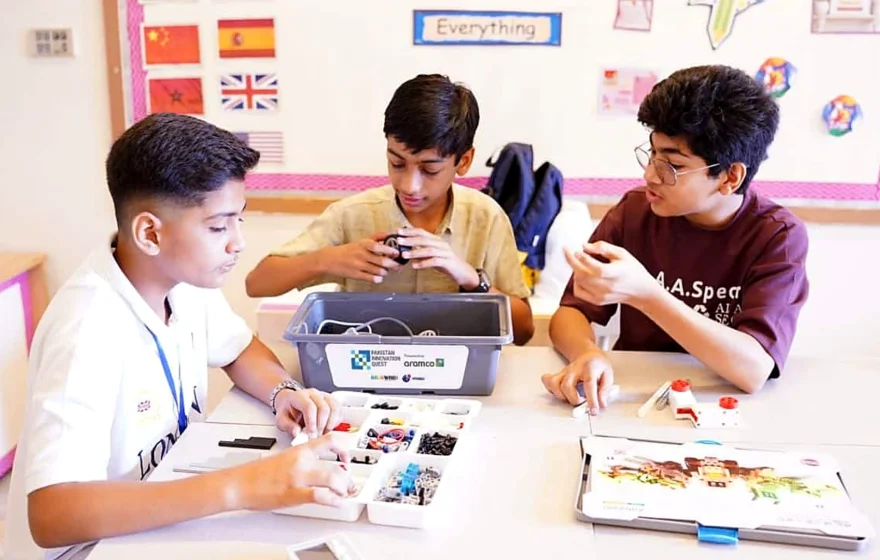
A nationwide programme is opening the doors of robotics and science learning to young Pakistanis who have rarely had the chance to touch a robotics kit. The Pakistan Innovation Quest, run by the Pi Space Science Education Centre in partnership with the World Robot Olympiad Association and powered by Aramco, is designed for learners shut out by cost, distance, gender or disability, targeting ten thousand students and three hundred teachers.
The idea behind the programme is simple to state and hard to deliver. Talent, its organisers argue, is spread evenly across the country, but opportunity is not. A child in a well-resourced private school in a big city may meet robotics as a matter of routine, while a child in a low-income neighbourhood, a small town or a school for children with disabilities may never encounter it at all.
At the heart of the programme are short, intensive training sessions called RoboStarter Sprints. More than sixty of these sprints are planned, alongside six regional competitions and a national showcase. In a sprint, students work with real kits, learn how a robot is put together, test their ideas, fail, fix and try again. The sessions follow the project cycle used by the World Robot Olympiad’s Future Innovators stream, in which young people identify a real-world problem and design an original solution for it. Students can also work towards World Robot Olympiad certification.
Teachers are treated as just as important as students. Teachers receive professional development so that robotics teaching can continue inside their own institutions long after the visiting trainers have gone. That matters, because a programme depending entirely on outside visitors fades quickly, while one training local teachers leaves skills that keep working year after year.
The numbers reported so far suggest the approach is gaining ground. More than six thousand learners and five hundred and eighteen teachers have already taken part, across Karachi, Lahore, Hyderabad, Gujranwala and Kasur, with around sixty institutions now in the network. The programme is aiming for female participation above forty per cent and plans to donate one hundred robotics kits to institutions that need them most, so that learning does not stop when a sprint ends.
One of the most striking parts of the story comes from Deaf Reach School, where deaf students took part in hands-on robotics training supported by interpreters and trainers fluent in sign language. For many of those students, it was the first time they had worked with a robotics kit as builders and problem-solvers in their own right, rather than as spectators.
Zartaj Ahmed, chief executive and co-founder of the Pi Space Science Education Centre and national organiser of the World Robot Olympiad in Pakistan, summed up the mission in a single line: talent is universal, but access is not. With Aramco’s backing, she said, the programme is reaching the child who has never held a robotics kit, the girl who has never pictured herself as an engineer, and the deaf learner who deserves to create without barriers.
Aramco’s role comes through its global science, technology, engineering and mathematics education programme. Hussain N. Hanbazazah, the company’s vice president for communications operations and corporate citizenship, described science and technology education as an investment in the innovators, problem-solvers and leaders of tomorrow, bringing ten thousand robotics opportunities to students across Pakistan.
The pathway the programme offers does not end with a sprint. Regional winners will move on to a national showcase, where students and teachers present their solutions to school leaders, government representatives, science and technology partners and international guests. The strongest performers will then find routes into future World Robot Olympiad Pakistan competitions, which feed into an international contest drawing young teams from dozens of countries.
That sense of possibility is the programme’s real product. Pakistan’s schools are full of students curious about how things work. What has often been missing is structured, practical exposure at the right age, delivered by people who know the subject and in settings welcoming every learner. Robotics teaches more than wiring and coding. It teaches patience, teamwork, testing and revision, and the habit of breaking a large problem into smaller parts that can actually be solved.
There are, of course, questions that will decide how far the programme’s impact reaches. Ten thousand learners is a strong target, but it is a fraction of Pakistan’s school-age population, and sustaining the work will depend on schools, teachers and local partners keeping it alive. The donation of kits and the training of teachers are encouraging signs on that front, as is the plan for regional competitions that give students a reason to keep practising.
For now, the Pakistan Innovation Quest stands as a reminder that technology education does not have to belong only to the privileged few. By taking free, practical robotics training into ordinary schools and underserved communities, and by insisting that girls and learners with disabilities belong at the centre of it, the programme is helping young Pakistanis see themselves not merely as users of other people’s technology, but as the people who will build what comes next.
