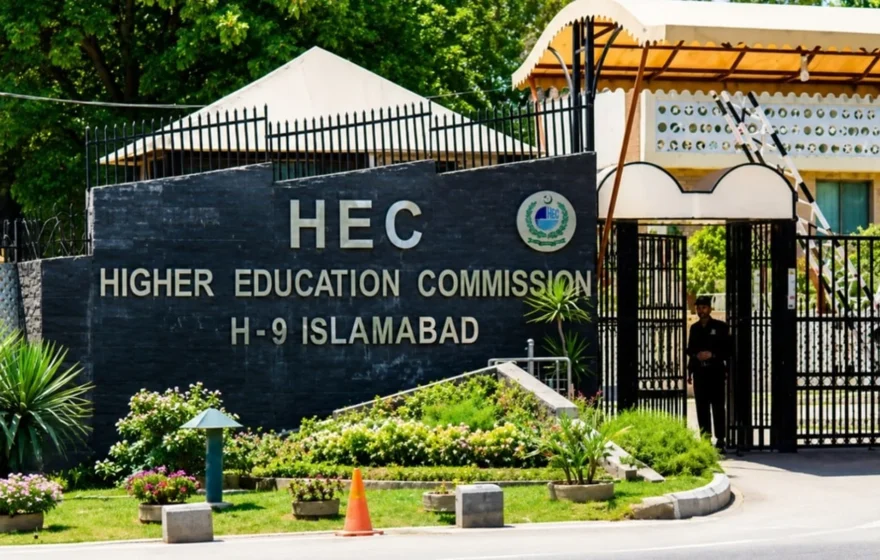
The Higher Education Commission has set up a 22-member National Task Force to design a ranking system for universities across Pakistan, giving the country’s long-paused national league table its first serious revival in a decade. The commission announced the move today, saying the task force will review and finalise a proposed framework for ranking universities, drawing on internationally recognised methods while keeping the realities of Pakistan’s higher education system firmly in view.
The task force has been given a wide brief. It will examine the indicators that should count towards a university’s rank, the weight each indicator should carry, how institutions should be assessed, what data universities must submit, how that data should be verified, and how scores should be calculated. The aim, the commission said, is a system that is fair, transparent and built on evidence rather than reputation alone, so that students, parents and employers can compare institutions on a common and credible basis.
The task force will be led by Dr Ghulam Mustafa, the director of the Pakistan Institute of Engineering and Applied Sciences, who will serve as its convenor. Muhammad Ali Baig, the national coordinator for university rankings at the commission and deputy director of its Higher Education Data Repository, will act as secretary. The pairing signals that the exercise is meant to be driven by numbers and verification rather than by committee opinion.
Membership has been drawn from across the sector. Representatives of leading public and private universities will sit on the task force, including Quaid-i-Azam University, the National University of Sciences and Technology, the Lahore University of Management Sciences, Aga Khan University, the University of Karachi and the University of the Punjab. The provincial higher education bodies of Punjab, Sindh and Khyber Pakhtunkhwa will also take part, which matters because most public universities answer to their provinces, and any national ranking will need their cooperation to gather reliable data.
The move fills a gap that has been open for years. The commission has published national rankings of higher education institutions in the past, releasing lists in 2006, 2012, 2013, 2014 and most recently 2015, but no full new edition has followed since. The 2015 exercise, the fifth of its kind, judged institutions on five measures that added up to a score out of 100: quality assurance carried 15 marks, teaching quality 30, research 41, finance and facilities 10, and social integration and community development four. Quaid-i-Azam University topped that list with a perfect score of 100, followed by the University of the Punjab on 83.28. A decade on, the data behind that list is far out of date, and a new framework is overdue.
The need is sharpened by how Pakistani universities fare on the world’s best-known league tables. In the 2026 edition of the QS World University Rankings, 18 Pakistani institutions won places among more than 1,500 universities from over 100 countries, yet not one of them broke into the world’s top 350. Quaid-i-Azam University led the national showing at 354, followed by the National University of Sciences and Technology at 371, the University of the Punjab at 542 and the Lahore University of Management Sciences at 555. Global rankings weigh academic and employer reputation, research citations, the ratio of faculty to students and the share of international staff and students, measures on which Pakistan’s universities, starved of funding and research support, have long struggled. A national system cannot by itself fix those weaknesses, but it can measure things the global tables miss, such as teaching quality, service to surrounding communities and graduate employment inside Pakistan.
That is also where the risks lie. Rankings are argued about everywhere in the world, and they are only as good as the data fed into them. Universities can be tempted to chase the measures rather than improve the substance behind them, polishing their numbers while classrooms and laboratories stay the same. The task force’s emphasis on verification procedures and data requirements suggests the commission is aware of the danger. Whether the final framework publishes its full methodology, its weightings and the underlying data will decide how seriously it is taken, because a ranking whose workings are hidden invites suspicion however fair its intentions.
What happens next will unfold over months rather than days. The task force must first settle the framework itself, then universities will have to submit their data, that data will have to be checked, and only then can a list be published. Students, vice chancellors and policymakers will all be watching the weightings the task force settles on, since those choices will quietly set the priorities of the whole sector. If the commission gets it right and repeats the exercise on a regular cycle, Pakistan will finally have a current, homegrown yardstick for its universities. If the framework stalls or appears once and disappears, it will join a long line of well-meant announcements. The test of this task force will not be the list it produces, but whether that list is trusted, transparent and still being published years from now.
