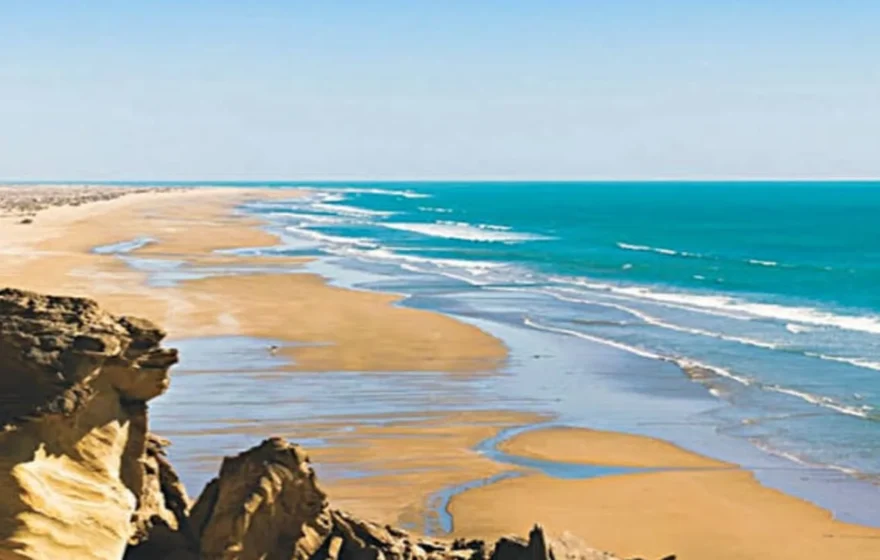
A dead blue whale, the largest animal ever known to have lived on Earth, washed ashore at East Bay in Gwadar on Wednesday, two days after people along the Balochistan coast first saw it swimming just off the shore. The carcass came to rest behind the Coast Guard office, and officials estimated the animal to be around 30 feet long, a modest size for a species that can grow to more than three times that length.
Local people had first noticed the whale off Gwadar two days earlier, before the waves carried it towards East Bay. By the time it reached the shore it was already dead, its body lying in the shallows where the water is too thin for an animal of its kind to move freely. The stranding has left marine experts asking what killed it.
WWF-Pakistan has begun an investigation, and its technical adviser on marine affairs, Muhammad Moazzam Khan, said the early signs pointed to the whale having wandered into water too shallow for it. Once a whale of this size enters the shallows, he explained, its ability to navigate can be badly affected, and it can lose its way and drift towards the coast. The exact cause of death remains unknown.
Khan described the loss of a large whale as a matter of real concern for marine biodiversity. A single blue whale is not just an impressive sight. It is part of a population still recovering from decades of hunting, and every death matters for an endangered species. WWF-Pakistan keeps records of whales that wash up along the coast and works to conserve rare marine life and raise awareness of the creatures in Pakistan’s seas.
The animal that died at Gwadar belongs to a species that has no equal in size. The blue whale, known to science as Balaenoptera musculus, is the largest animal ever known to have existed, bigger than any dinosaur that walked the Earth. A full-grown adult can reach around 33 metres, or close to 100 feet, and weigh as much as 190 tonnes. Yet this giant feeds almost entirely on krill, the tiny shrimp-like creatures that drift in vast numbers through the ocean.
Blue whales are not strangers to Pakistani waters, even though they are rarely seen close to shore. They are one of three baleen whales reported from the country’s seas, alongside the Bryde’s whale and the Arabian humpback whale. Two subspecies live in the northern Indian Ocean, the pygmy blue whale and the Indian Ocean blue whale, and the smaller animals found dead along the Makran coast in recent years may well have been pygmy blue whales. The most recent confirmed live sighting before this week came off Gadani in Balochistan in April 2024, and in 2017 a mother blue whale was seen with her calf near Churna Island, off Karachi.
Sadly, dead whales have also become a familiar sight along the same coastline. In April 2019 a whale of around 34 feet was found dead on the Gwadar coast, in May 2023 another of roughly 42 feet at Bandari beach in Jiwani, and later that year a 27-foot Bryde’s whale near Pasni. In June 2024 a whale of about 35 feet was seen floating dead near Kantani, not far from Gwadar, and in June 2025 a 35-foot blue whale was found dead in Gwatar Bay, between Pakistan and Iran, after a fisherman spotted it drifting in the water. WWF-Pakistan said it had probably died days earlier in the open sea, with entanglement in fishing gillnets named as a possible cause.
Those repeated losses point to the dangers whales face in these waters. Fishing gear is one of the best known threats, and a whale caught in a net can drown or be injured so badly that it cannot survive. Shallow water is another hazard for a young or weakened animal that has lost its bearings. The International Union for Conservation of Nature lists the blue whale as endangered, and its global population is estimated at only between ten thousand and twenty five thousand animals, a small figure for a creature that once roamed every ocean in far greater numbers.
In Pakistan, all whales and dolphins are protected under the wildlife and fisheries laws of Sindh and Balochistan, and conservationists have pressed for stronger federal protection, so the animals are covered across the country’s entire exclusive economic zone and not only within provincial waters. WWF-Pakistan has also worked towards declaring places such as Churna Island a marine protected area, where sea life would have a safer place to feed and breed.
For now, the investigation into the Gwadar whale will try to establish what went wrong in its final days. The animal had been alive and swimming only two days before it was found dead, and the answers may tell experts a great deal about the risks whales face along this coast. The hope among those who study these animals is that its death will not be wasted, but will sharpen the effort to keep the seas off Pakistan safe for the largest animal the world has ever known.
