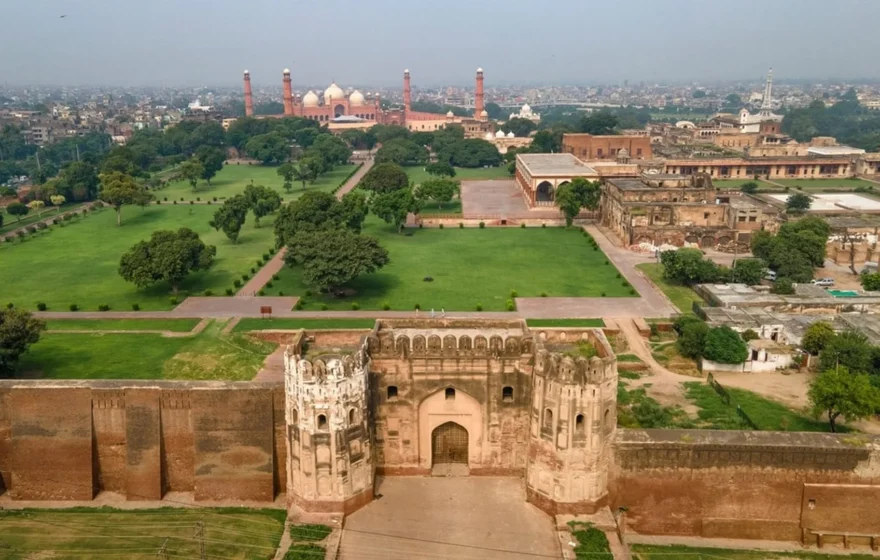
One of Lahore’s oldest gateways has come back to life. The historic Akbari Gate of Lahore Fort, closed since the days of British rule, has been restored and reopened, reconnecting the Walled City with the fort after a separation that lasted for generations. For Lahore, it is another step in the slow rescue of one of Pakistan’s great historic sites.
The gate stands at the eastern end of Lahore Fort, where the royal enclosure once met the crowded streets of the old city. For centuries it was one of the main entrances through which the life of the city flowed into the fort and back again. That connection was broken under British rule, when the gate was closed, and it stayed closed through the decades that followed, leaving the fort to be entered through its other gates while this one faded from everyday use. Now the entrance is open again, and the authorities plan to install a ticketing booth so that it can operate properly for visitors and for residents of the Walled City.
A soft launch ceremony was held to mark the occasion, celebrating the restoration of the Akbari Gate and of the Curator’s House, another historic structure within the fort complex. The Curator’s House, a British-era building first used as a guard room, is to be converted into an eatery for visitors. The ceremony was a quiet affair rather than a grand opening, but its meaning was considerable: years of painstaking conservation work had reached the point where the public could once again walk through a gate that had been shut to them for so long.
The restoration was carried out under the Heritage and Urban Regeneration: Tourism Development in Lahore Fort and its Buffer Zone project, known by its short name, HURL. The project was launched in 2022 with support from the Agence Francaise de Developpement, the French development agency, and it is being implemented by the Punjab Walled Cities and Heritage Areas Authority, working alongside Aga Khan Cultural Service Pakistan. The agreement between the French agency and the Punjab government was signed in July 2022, and the site was handed over to the Aga Khan team in 2023, after which a detailed process of documentation, condition assessment and emergency stabilisation began.
The gate itself is a remarkable building. It was constructed in 1566 by the Mughal Emperor Akbar, who laid the foundations of the modern Lahore Fort, and it is also known as the Maseeti Gate. The two-storey structure blends military architecture with fine design, with heavy semi-octagonal bastions, battlements, machicolations and a sturdy timber gate. Below it lay a basement that was known as the Akbari Sarai, Akbar’s rest house. The gate faces the Rim Market and the Maryam Zamani Mosque, which Emperor Jahangir built for his mother, placing it at the meeting point of the fort, the market and the religious life of the old city.
Lahore Fort is one of the most important historic sites in Pakistan. Its foundations date to 1566, when Akbar occupied the site as a post guarding the north-west frontier of his empire, and it was almost entirely rebuilt in the seventeenth century, when the Mughal Empire was at the height of its splendour. Spread over more than twenty hectares at the northern end of the Walled City, it contains twenty-one notable monuments, including the Sheesh Mahal, the Naulakha Pavilion and the grand Alamgiri Gate built by Emperor Aurangzeb. In 1981, the fort was inscribed as a UNESCO World Heritage Site, together with the Shalimar Gardens, for its outstanding collection of Mughal monuments.
The Aga Khan Cultural Service Pakistan is no stranger to the fort. Its teams completed the restoration of the Shah Burj Gate in March 2020, with funding from the Royal Norwegian Embassy, the Walled City of Lahore Authority and the Aga Khan Trust for Culture. The Akbari Gate project continues that patient approach, in which documentation and stabilisation come before any visible repair, and in which the aim is to preserve what survives rather than to invent what has been lost.
The Director General of the Punjab Walled Cities and Heritage Areas Authority, Najmus Saqib, said the restoration would improve public access to historic sites, attract tourists and create economic opportunities. A restored gate that people can walk through brings visitors, and visitors bring business to the shops, food stalls and workshops of the Walled City.
The chief executive of Aga Khan Cultural Service Pakistan, Tausif Khawaja, said the conservation work aimed to preserve Lahore’s cultural heritage while supporting local communities and economic activity. The reopening of the Akbari Gate is therefore about more than a single restored building. It restores a historic route between the fort and the city, gives residents of the Walled City a direct entrance to the fort they live beside, and adds another destination to a heritage trail that already draws visitors from across Pakistan and beyond. After decades behind a closed door, Lahore’s oldest gateway is open, and the city can once again walk through it.
