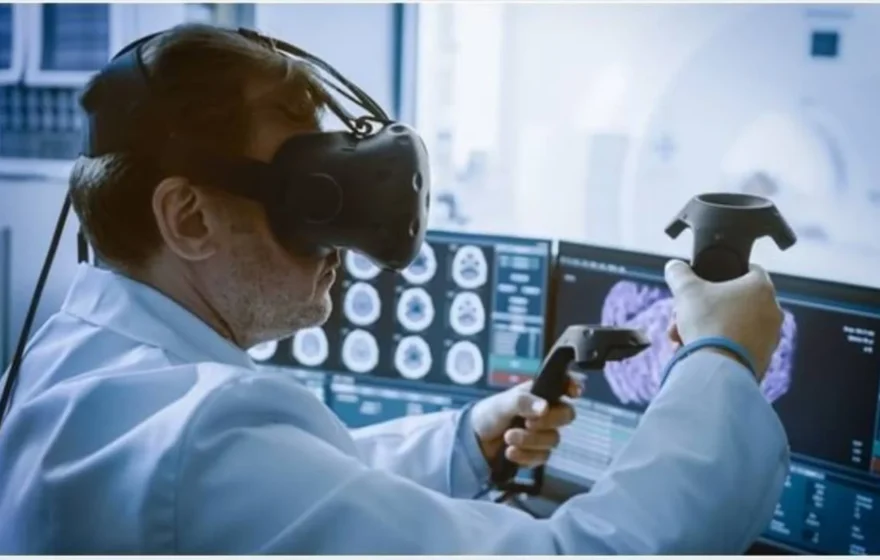
Pakistan has taken a striking step into the future of medicine, carrying out its first robotic telesurgery in Islamabad. In the landmark demonstration, a surgeon guided robotic instruments from a conference hall while the patient lay in an operating theatre across the city, and the operation was completed successfully. For a country where specialist surgeons are concentrated in a handful of big cities, the achievement hints at a future in which distance no longer decides who gets expert care.
The procedure was a cholecystectomy, the surgical removal of the gallbladder, performed with robotic assistance. It was carried out by Professor Dr Syed Tanseer Asghar, a well-known robotic surgeon who serves as Registrar of Shaheed Zulfiqar Ali Bhutto Medical University, known as SZABMU. Instead of standing beside the operating table, he controlled the robotic surgical instruments from the venue of the International Conference on Future of Healthcare, FHCC 2026, at the Gandhara Heritage and Culture Centre in Islamabad. The patient, meanwhile, was in the operating theatre of Kulsum International Hospital, where the surgical team and the robotic system received his commands in real time over a digital connection.
What makes telesurgery different from ordinary robotic surgery is the separation between the surgeon and the patient. In a standard robotic operation, the surgeon sits at a console a few metres from the patient, guiding robotic arms that hold the instruments. In telesurgery, that console can be in another building, another city or even another country, with the commands travelling over a secure, high-speed network. The robotic arms at the patient’s side reproduce the surgeon’s hand movements with a steadiness that human hands alone cannot always match, filtering out even the smallest tremor.
The idea itself is more than two decades old. The first complete telesurgery on a human patient took place on 7 September 2001, when French surgeon Jacques Marescaux, sitting in New York, removed the gallbladder of a 68-year-old woman lying in an operating theatre in Strasbourg, France, more than 6,000 kilometres away. The operation, named Operation Lindbergh after the pilot who made the first solo flight across the Atlantic, lasted about 45 minutes and was a complete success. Until then, specialists had believed that around 500 kilometres was the practical limit for remote surgery because of the delay in transmitting signals. The New York to Strasbourg link, running over a dedicated high-speed fibre optic network, held the delay to under 200 milliseconds, well inside the safety window.
The gallbladder operation was a natural choice for such a demonstration, then as now. Laparoscopic cholecystectomy, the keyhole removal of the gallbladder, is one of the most common operations performed anywhere, and it has long been regarded as the gold standard for treating gallbladder disease. Its steps are well understood, its instruments are standardised, and the benefits of the robotic approach, smaller incisions, a magnified view and extremely fine control, are easy to show.
In much of the country, particularly in smaller towns and remote districts, patients who need specialist surgery must travel long distances to Karachi, Lahore or Islamabad, or wait for a visiting surgeon. Many simply go without the care they need. Telesurgery offers a way to close that gap, allowing a specialist in a major hospital to operate on a patient in a district hospital hundreds of kilometres away, with a local team present to prepare the patient and handle any emergency. The report of the demonstration notes that it highlighted the potential of robotic telesurgery to improve access to specialised surgical services in remote and underserved areas, while adding that this would depend on the right infrastructure, clinical safeguards and regulatory frameworks being in place.
That caution matters. A remote operation is only as reliable as the network carrying it, and any interruption or delay in the connection could put a patient at risk. Hospitals attempting telesurgery need backup systems and clear protocols for handing control to a surgeon physically present in the theatre. The cost of robotic systems is also considerable, which is why early use is likely to remain concentrated in major teaching hospitals and specialist centres.
SZABMU appears determined to build on the demonstration rather than treat it as a one-off event. The university’s Vice Chancellor, Professor Dr Tanwir Khaliq, has secured approval for its first Robotic Surgery and Artificial Intelligence Health Centre, which will work on surgical education, research and innovation, and on applying artificial intelligence to healthcare.
The demonstration was a joint effort, bringing together SZABMU, Kulsum International Hospital and the international healthcare conference. For now, the Islamabad demonstration stands as a beginning rather than a finished service. More trials, training and investment will be needed before a patient in a remote district can routinely be operated on by a surgeon in another city. But the first step has been taken, and it was taken in public, before an audience of the country’s medical community. If the momentum behind it is sustained, Pakistan could in time join the small group of countries where the operating theatre is no longer limited by geography.
