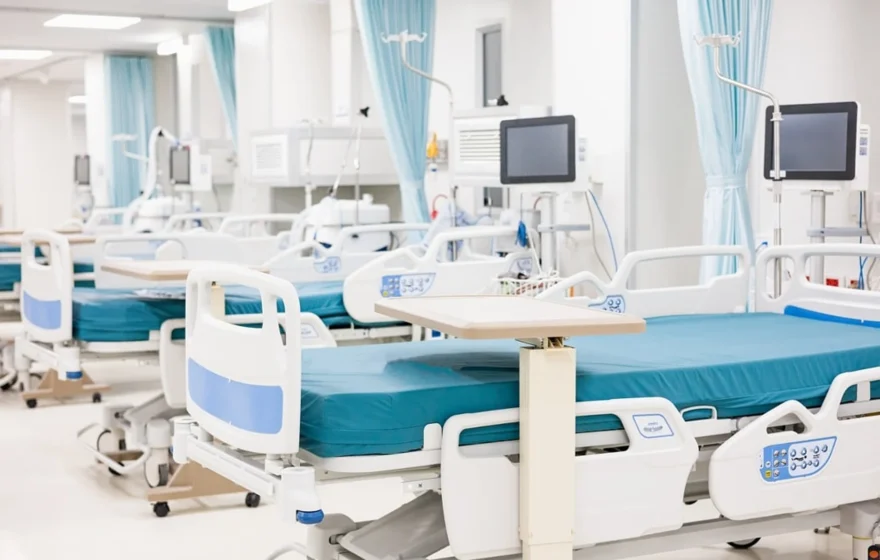
Larkana is set to get a major new hospital that will treat patients free of charge, after Pakistan Peoples Party Chairman Bilawal Bhutto-Zardari laid the foundation stone of a 600-bed facility in the city. The hospital is expected to be completed by 2028 and will offer modern healthcare to Larkana and the underserved areas around it, taking pressure off an older hospital stretched far beyond its capacity.
Sindh Chief Minister Murad Ali Shah attended the ceremony, where Project Director Yasir Bhatti briefed the two leaders. Bilawal said the need for a new hospital had become clear soon after he was elected to the National Assembly from Larkana, when he visited Chandka Hospital and saw how much strain its doctors and staff were under. The hospital was built in the 1970s for a far smaller population, yet it now treats patients from Larkana and nearby cities as well.
That pressure has only grown with time. Patients travel to Larkana from across upper Sindh and from parts of Balochistan, including Naseerabad, because few large public hospitals in the region can handle serious illness. Chandka Hospital was a gift from former prime minister Zulfikar Ali Bhutto to the people of the area, and it has served them for half a century, but Bilawal said it could no longer cope with the growing number of patients arriving at its doors.
Bilawal also said residents would be able to receive treatment through the Sindh Institute of Urology and Transplantation, the Karachi-based institute known for providing free specialist care. The promise reflects the PPP’s wider pitch on health: the party wants to provide internationally standard healthcare, and no citizen should be denied treatment because of a lack of money. For families who now travel to Karachi for treatment they cannot afford, or who simply go without it, a free hospital in their own city would change the arithmetic of getting care.
The project itself has been in the works for some time. In December last year, Chief Minister Murad Ali Shah approved the design, scope and financial framework of the hospital, describing it as a major healthcare project for upper Sindh. Officials told him the facility would be a six-storey building with a basement, built in two phases, with a total capacity of 596 beds: the first phase will provide 288 nursing-care beds, 92 emergency beds and 48 intensive-care beds, and the second will add 144 nursing-care beds and 24 more intensive-care beds. The estimated cost of the civil works alone stands at around Rs3.108 billion.
The scale shows the gap it is meant to fill. An emergency department with 92 beds and an intensive-care unit with 72 beds would put Larkana’s public healthcare on a different footing, and the phased construction means the first tower can start treating patients while the second is still being built.
The hospital was not the only announcement Bilawal made in Larkana. He also set out plans to improve the city’s water supply and sewerage services, problems that affect daily life for almost every household. Work has begun to restore and expand the Ratodero water supply scheme, while the city’s sewerage system will be upgraded to meet its needs for the next 25 years. At a separate meeting at Bhutto House in Naudero, Public Health Engineering Secretary Sohail Qureshi said the feasibility study for Larkana’s water supply, sewerage and rainwater drainage project had been completed, and it aims to provide clean drinking water to every household in the city within two years.
There was also progress to report from nearby Shahdadkot, where 50 per cent of the sewerage scheme has been completed and the remaining work is expected to finish next year. Together, the water and sewerage works are a broad attempt to fix the basic services of a city that has grown far beyond the infrastructure built for it decades ago.
Bilawal also highlighted the Sindh government’s investment in higher education, saying the province currently provides Rs45 billion to universities and plans to increase that funding. The University of Larkana has already been established by bringing together former campuses of Sindh University and Quaid-e-Awam University, giving the city a university of its own.
The visit also carried a political message. Bilawal urged the federal government to give up confrontation and engage all political stakeholders, saying the country’s economic hardships required collective effort and ordinary people were finding it difficult to make ends meet. He thanked Prime Minister Shehbaz Sharif for accepting the PPP’s proposal to set up an electoral reforms committee.
For Larkana itself, though, the day will be remembered for the hospital. A free 600-bed facility, finished by 2028, would give the city and the districts around it a level of public healthcare they have never had. The test, as with every foundation stone, will be whether the building rises on schedule and whether the doctors, nurses, equipment and medicines arrive with it. If it does, the people who now queue at Chandka Hospital or travel hundreds of kilometres for treatment will finally have a hospital built for the Larkana of today, not the Larkana of the 1970s.
