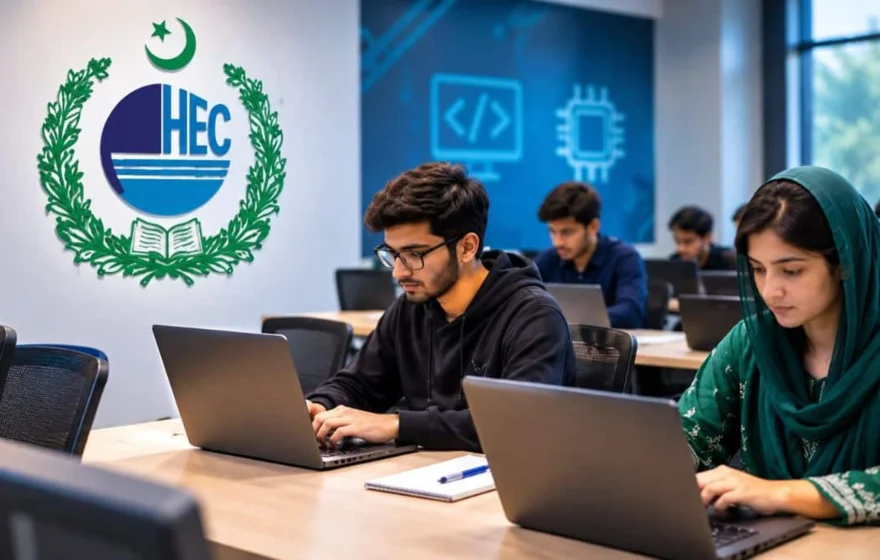
The Higher Education Commission has announced that the National Skill Competency Test will return in 2027, and this time there will be no choice about taking part. Students in the seventh and eighth semesters of Computing and IT-related degree programmes across Pakistan will have to sit the test, which measures whether final-year students actually have the practical skills employers expect from a computing graduate. The decision turns last year’s voluntary experiment into a formal requirement, and it will affect tens of thousands of students at universities and colleges across the country.
According to the official announcement, the test, known as NSCT 2027, assesses the skills and competency levels of students before they complete their degrees. The commission presents it as a check that university education in computing is keeping pace with what the technology industry needs, rather than simply confirming that a student has passed written examinations.
When and How the Test Will Run
The commission has tentatively scheduled the test for January 23 and 24, 2027. The dates are tentative, so students and universities should watch for final confirmation, but the shape of the exercise is already clear. It will be computer-based, and the commission plans to hold it at more than 100 locations across the country, so students from different regions can take part without travelling long distances.
The scale is considerable. The first cycle, held in 2026, covered more than 33,000 seventh- and eighth-semester computing students at 165 centres in 112 cities. A second cycle on a similar scale would be one of the largest standardised assessments of university students ever attempted in Pakistan. The commission’s portal, nsct.hec.gov.pk, handles registration, the student guide and the list of competency areas, and students should follow announcements there rather than relying on rumours on social media.
Who Has to Sit the Test
The requirement applies to students in Computing and IT-related degree programmes, including computer science, software engineering, artificial intelligence, data science and related fields. Participation will be mandatory for seventh- and eighth-semester students, final-year undergraduates months away from the job market. The net is deliberately wide: it covers not only main university campuses but also sub-campuses, constituent colleges and affiliated colleges, so eligible students at affiliated institutions must take part too.
That breadth is important, because it closes a gap that could otherwise have undermined the exercise. If only students at large public universities had been tested, the results would have said little about the system as a whole. By including affiliated and constituent colleges, the commission is insisting that the standard applies everywhere.
Why the Commission Is Doing This
The test was first introduced in February 2026 under directives from the prime minister, developed with the Ministry of Information Technology and Telecommunication, the Pakistan Software Export Board and the Pakistan Software Houses Association, known as P@SHA. The thinking was simple: Pakistan produces large numbers of computing graduates every year, yet technology employers have repeatedly said many arrive without the working knowledge expected of an entry-level professional.
Students who perform well receive a joint certificate from the Higher Education Commission, the Pakistan Software Export Board and P@SHA, along with inclusion in a national talent pool that local and international employers can draw on. Successful students also earn one academic credit and gain priority access to internships, apprenticeships and international certification opportunities. Participation is free, so that students from all backgrounds have equal access. Universities are ranked on their students’ performance, which gives institutions a direct stake in the outcome.
The first cycle also showed that the commission is willing to act on what the test reveals. In June 2026, admissions to computing programmes at 44 institutions were suspended pending audits and reviews, and the commission has said it will attest only degrees from computing programmes accredited by the National Computing Education Accreditation Council from June 2027 onwards. The test feeds into rankings, accreditation and admissions, and a poor showing carries consequences.
What Students Should Do Now
For students who will have to sit the test, the most useful step is to prepare for what it actually measures rather than treating it like another university examination. The competency areas, finalised by a technical committee led by P@SHA, cover programming, databases, operating systems, software engineering, data structures, cybersecurity and artificial intelligence, and the Virtual University of Pakistan conducts the computer-based test. Students should check the official portal for the student guide and syllabus, and contact the focal person at their university if they are unsure whether they are registered.
There are fair questions about whether a single test can capture the skills that matter in a fast-moving industry, and some participants in the first cycle felt the questions leaned too heavily on familiar examination material rather than on the practical problems employers actually set. That criticism is worth taking seriously, because a test that only repeats university exams adds little. The commission has made the test compulsory, tied it to rankings and accreditation, and scheduled the next cycle for January. For final-year computing students, the practical choice is not whether to take the test but how well to prepare for it.
