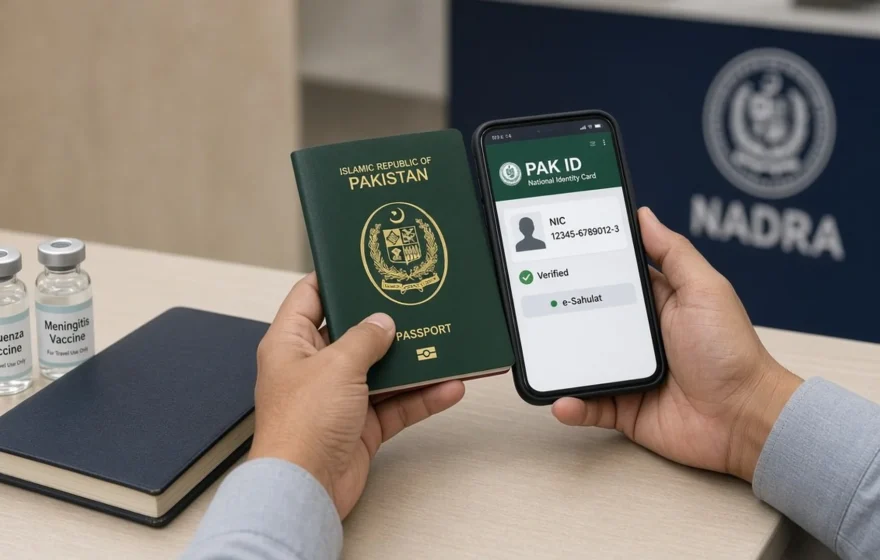
The National Database and Registration Authority has temporarily stopped taking registrations and collecting fees for influenza and meningitis vaccines for people travelling abroad, leaving intending passengers unsure how to complete a health requirement that only became compulsory weeks ago.
NADRA confirmed the suspension in an official notice, saying Border Health Management had instructed the halt. It had been offered through the Pak ID mobile app and the e-Sahulat franchise network, and both channels have now stopped accepting new registrations for the two vaccines. Travellers needing guidance have been told to contact Border Health Management directly.
No reason was given, and no date was mentioned for a restart. The halt is described as temporary, but for passengers flying in the coming days that offers little comfort: registration had become the gateway to the certificate they need before boarding.
What Service Has Been Suspended
The suspended facility covered registration for the two vaccines and collection of the fees charged for them. Both steps were handled digitally, through the Pak ID app or at an e-Sahulat outlet, where identity was verified biometrically before payment. That receipt was the document a passenger carried to the vaccination centre, and without it the rest of the process could not begin.
The notice, as reported, mentions only influenza and meningitis, saying nothing about the polio or yellow fever certificates that form part of wider travel health requirements. Travellers who need those should not assume they are affected. For many passengers the effect is immediate: anyone who planned to register this week, pay and then visit the centre will find the first step closed, with no alternative route announced.
A System Only Weeks Old
The service that has now been paused was itself brand new, growing out of a September decision to make a NADRA-linked digital vaccination certificate compulsory for Pakistanis travelling abroad, starting with pilgrims heading to Saudi Arabia.
A Border Health Services Pakistan notification dated 7 September said only NADRA-integrated certificates would be accepted for international travellers. The rule took effect on 14 September, with enforcement starting at Karachi airport, where only a NADRA-integrated certificate counted from 25 September. The same checks were to follow at Peshawar, Islamabad and Lahore.
The system worked like this: a traveller registered and paid through the Pak ID app or an e-Sahulat franchise, with biometric verification done at the same time. The fee was Rs 2,785 for meningitis and Rs 1,720 for influenza, and the receipt stayed valid for 90 days, during which the passenger could visit the vaccination centre for the jabs. Doses were recorded in NIMS, the National Immunization Management System run by NADRA, and a digital certificate with a QR code could be downloaded for Rs 100. A dedicated centre at Karachi airport’s health quarantine ran around the clock from 24 September.
The vaccines sit at the centre of Saudi Arabia’s entry rules for pilgrims. Its health ministry requires every Hajj and Umrah pilgrim to have a quadrivalent meningococcal vaccine, known as ACYW, at least ten days before arrival, and advises seasonal flu vaccination alongside it. Pakistan’s own departure check sat on top of that: a NADRA-integrated certificate has been enforced for Umrah flights from Karachi since 10 October, and from Peshawar since 25 October.
The rollout was not smooth: when the Karachi deadline arrived in September, the NADRA system went down and staff wrote certificates by hand, prioritising passengers with the earliest flights. The deadline had already been pushed back once, from 14 to 25 September. The suspension is the latest disruption to a process travellers and agents were still learning to navigate.
What Travellers Should Do
For now, the only official advice is to contact Border Health Management directly — the body that instructed NADRA to stop the service, and the authority for health measures at Pakistan’s points of entry under the International Health Regulations. Passengers with imminent travel should make that contact before setting off for the airport.
Anyone who registered and paid before the suspension should keep the receipt safe. Under the September advisory it stayed valid for 90 days from issue, and nothing has been said about existing receipts being cancelled. Travellers holding one should still confirm with Border Health Management that it will be honoured at the vaccination centre.
What Happens Next
The immediate question is how long the suspension lasts and whether it signals a wider rethink of the system. The notice gives no clue. A short pause to fix a technical problem would be a minor inconvenience; a longer one, with no alternative route, would leave a growing number of travellers unable to meet a requirement airlines and airport health staff still enforce.
The timing makes it harder to bear. The winter Umrah season brings a steady flow of Pakistani pilgrims to Saudi Arabia, each needing the meningitis vaccine under Saudi rules and the NADRA-linked certificate under Pakistan’s departure rules. Border Health Management now has to explain what travellers should do while the service is suspended, and when registrations will reopen. Until it does, the safest course is to seek that guidance directly and keep every receipt.
