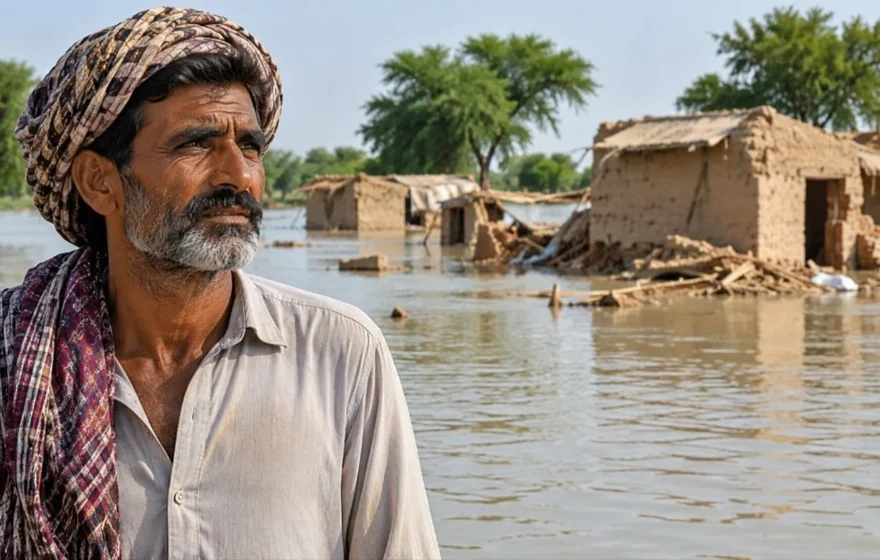
Thirty-nine farmers from Sindh have taken two of Germany’s biggest companies to court, seeking compensation for the ruin they suffered in the devastating floods of 2022. The farmers argue that the greenhouse gas emissions of energy firm RWE and cement maker Heidelberg Materials helped to warm the planet and intensify the rains that destroyed their crops, livestock and homes.
The lawsuit is unusual in what it does not claim: the farmers accuse neither company of running a polluting plant in Pakistan, or of any specific act on Pakistani soil. Instead, they say the two firms bear a share of responsibility for the world’s industrial emissions, which helped to drive the climate change that turned the monsoon of 2022 into a catastrophe. The plaintiffs estimate that RWE accounts for 0.68 per cent of global industrial emissions, while Heidelberg Materials accounts for 0.12 per cent.
The case was filed at the Regional Court in Heidelberg, Germany, on 22 December 2025. The farmers come from Jacobabad, Larkana and Dadu, among the areas worst hit, and together they seek more than one million euros. They had notified both companies on 28 October 2025, inviting them to talk and enter mediation, before going to court.
Behind the farmers stand a coalition of organisations from Pakistan and Europe. The European Centre for Constitutional and Human Rights and the aid group medico international are supporting the case, alongside the HANDS Welfare Foundation and the National Trade Union Federation in Pakistan. The farmers are represented by German lawyers Roda Verheyen and John Peters. Verheyen, who was also involved in the earlier case that opened the door to such lawsuits, says the new claim goes further and accuses the companies of wrongful behaviour.
The floods were among the worst disasters in Pakistan’s history. In the summer of 2022, monsoon rains of extraordinary intensity submerged around a third of the country, killing around 1,700 people and affecting some 30 million. In Sindh, whole districts stood under water for weeks, and many families lost everything in a matter of hours.
For the farmers bringing the case, the disaster is personal, not a statistic. Abdul Hafeez Khoso, a 43-year-old farmer from Jacobabad, said even the oldest people in his village had never witnessed such weather. Munawar Khatoon, a 43-year-old landowner from Usman Samtio, told how floodwater submerged her wheat seed shortly before the harvest, wiping out her family’s main source of income. Abdul Khaliq Laghari, from Dadu, put his losses at around 14,000 dollars.
Mir Keerio, of the HANDS Welfare Foundation, which helped bring the farming communities together, said climate change is making extreme weather more frequent and more intense, and that the biggest contributors should answer for it. The harm, the farmers argue, did not fall where the emissions were produced: the gases went into a shared sky, and the rain fell on Sindh farmers who had done almost nothing to cause the warming.
That argument rests on a landmark case decided only last year. In May 2025, a higher regional court in Hamm, Germany, ruled on a claim by Saúl Luciano Lliuya, a Peruvian farmer, against RWE. He argued the company’s emissions were melting a glacier above his home and putting his property at risk. The court dismissed his claim, but accepted a principle never established before: a major emitter can, in theory, be held liable under German civil law for climate damage suffered abroad.
The Pakistani farmers’ case is built on that ruling. Their claim relies on two provisions of the German Civil Code, covering nuisance and tort, and asks the Heidelberg court to move from the principle that liability is possible to an actual award of damages. Verheyen argues the companies have known about the general effects of climate change since the 1960s and should have done far more to cut emissions.
The two companies have rejected that argument in strong terms. Heidelberg Materials told AFP its operations complied with German law and companies should not be judged by retroactive standards. RWE called the lawsuit yet another attempt to move climate policy into German courtrooms, arguing companies should not face civil liability for state-permitted emissions.
The proceedings are civil and are likely to take years. The court must weigh how far one company’s emissions can be linked to a particular flood, how much damage can fairly be attributed to it, and whether the law should hold a company responsible for harm felt thousands of miles from its plants. Expert evidence on warming’s role in the 2022 rains will be central, as will what the companies knew, and when.
Whatever the outcome, the case already matters beyond the courtroom, as part of a growing movement to seek climate damages from corporations through the courts. For the farmers of Jacobabad, Larkana and Dadu, the lawsuit is about more than money: they want the companies they hold responsible to be held to account, and the world to recognise that the floods that destroyed their lives were not simply an act of nature. It will take years to resolve, but the farmers have made clear they are prepared to wait for justice.
