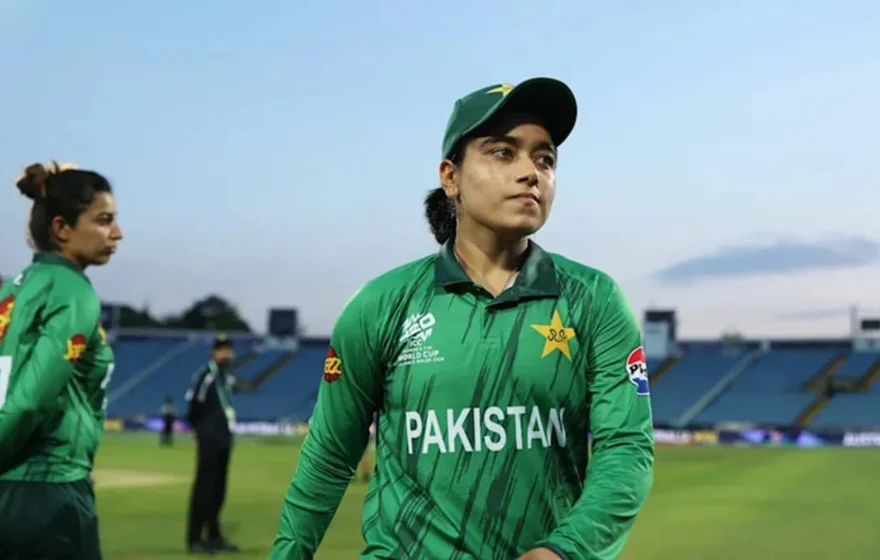
Pakistan women’s captain Fatima Sana has called for women cricketers in the country to be treated as equals to their male counterparts, saying that respect, investment and opportunity are not favours but rights earned through performance.
Speaking after Pakistan’s campaign in the ICC Women’s Cricket World Cup 2025 in Sri Lanka, Sana said that women’s cricket in Pakistan had come a long way, but that the structures around it had not kept pace with the players’ ambition. She said that women cricketers deserved the same facilities, the same support and the same recognition as the men, and that anything less was holding the game back.
“We are not asking for special treatment,” Sana said. “We are asking to be treated as equals. We play for the same country, we wear the same shirt, and we work just as hard. The difference is in the support we receive, and that has to change.”
Sana’s comments came after a World Cup campaign in which Pakistan finished seventh out of eight teams, winning one match and losing six. The team’s only victory came against Bangladesh, and Sana said that the results did not reflect the effort the players had put in, or the conditions they had been working under.
The 23-year-old all-rounder, who was appointed captain in 2024, has become one of the most prominent voices in Pakistan women’s cricket. She has spoken out on a number of issues, including pay, facilities and the lack of a domestic structure for women, and she has said that she will continue to use her platform to push for change.
“When I started playing cricket, there were very few opportunities for girls,” Sana said. “We had to fight for every chance, and we had to prove ourselves over and over again. That has not changed enough. Young girls still have to fight to be taken seriously, and that is not right.”
Sana said that the Pakistan Cricket Board (PCB) had made progress in recent years, including introducing central contracts for women players and increasing the number of domestic tournaments, but that more needed to be done. She said that the board needed to invest in grassroots cricket for girls, and to provide better facilities at the domestic level.
“The PCB has done some good things, and I want to acknowledge that,” she said. “But we need to be honest about where we are. The men have academies, they have high-performance centres, they have coaches and analysts and all the support they need. The women have a fraction of that, and we are expected to compete at the same level.”
Sana’s call for equality is not just about money. She said that women cricketers also needed better access to grounds, to training facilities and to medical support, and that they needed to be given the same opportunities to play in overseas leagues and to gain experience in different conditions.
“We need to play more cricket,” she said. “The men play all year round, in different countries and in different formats. The women play a handful of series a year, and then we are expected to perform at a World Cup. That is not a fair comparison, and it is not a fair way to judge us.”
The captain also spoke about the cultural challenges facing women cricketers in Pakistan, where cricket is still seen by many as a man’s game. She said that families were often reluctant to let their daughters play, and that girls who did play faced criticism and pressure to give up the sport.
“I know what it is like to be told that cricket is not for girls,” Sana said. “I heard it when I was young, and I still hear it now. But I also know that things are changing, and that more and more girls are playing cricket. We need to support them, and we need to show them that there is a future in this game.”
Sana said that the success of the Pakistan women’s team would depend on the next generation of players, and that the PCB needed to invest in them now. She said that the board should be looking at schools and colleges, and at providing coaching and facilities for girls at a young age.
“If we want to be competitive at the next World Cup, we need to start now,” she said. “We need to find the next Fatima, the next Nida, the next Sidra, and we need to give them the chance to develop. That will not happen on its own. It needs investment, and it needs a plan.”
The captain’s comments have been welcomed by former players and by women’s cricket advocates in Pakistan, who have said that Sana is speaking for a generation of players who have been overlooked. Former captain Sana Mir, who led Pakistan for many years, said that Sana’s words were “long overdue” and that the PCB needed to listen.
“Fatima is right to speak out,” Mir said. “The women have been patient for a long time, and they have achieved a lot with very little. It is time for the board to match their ambition with investment, and to treat them as the professionals they are.”
Sana said that she was optimistic about the future of women’s cricket in Pakistan, despite the challenges. She said that the talent was there, and that the interest was growing, but that the structures needed to catch up.
“I am proud to captain Pakistan, and I am proud of my team,” she said. “We have shown that we can compete, even with limited resources. Imagine what we could do if we were given the same support as the men. That is what I am asking for. Not more, not less. Just the same.”
For now, Sana and her team will return to domestic cricket, where they will prepare for the next international series. The captain said that she would continue to push for change, both on and off the field, and that she hoped her words would be heard by those in a position to make a difference.
