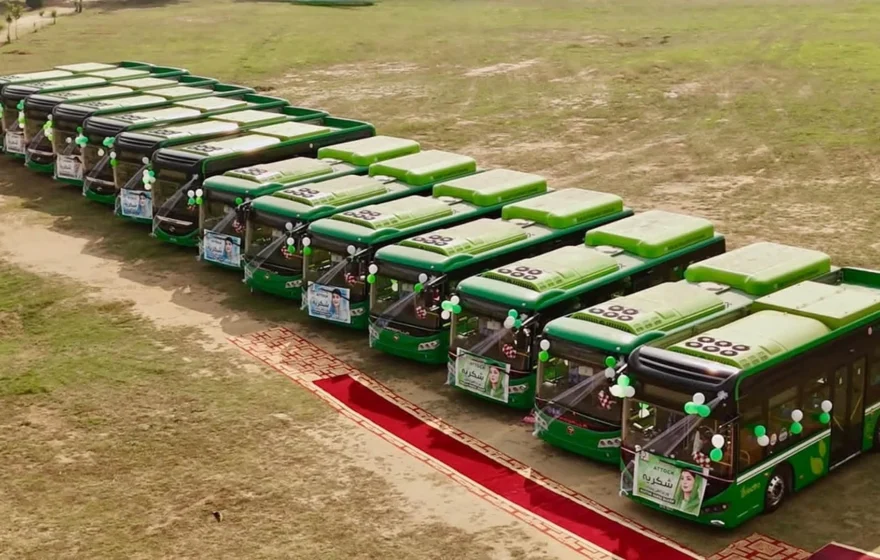
Chief Minister Maryam Nawaz Sharif has announced that Green Bus services will begin in Dina, Sohawa and Pind Dadan Khan in January 2027, extending Punjab’s electric bus network to three more towns in Jhelum district. She made the announcement at a ceremony in Jhelum for the distribution of Honhaar Scholarships and laptops among students on November 10, saying the provincial government was taking development beyond the big cities so that residents of smaller towns received the same facilities.
Maryam Nawaz also said the Nawaz Sharif School of Eminence in Jhelum would become operational on December 15, 2026, and she spoke about the Rs16.75 billion Lillah-Jhelum Road, expected to connect four districts and benefit over one million people. She said she had visited Sahiwal, Attock and Mandi Bahauddin recently and that similar attention would be given to Jhelum, where she vowed zero tolerance for corruption in public projects.
The heart of the announcement was the promise that smaller towns would no longer wait behind the big cities for modern transport. Maryam Nawaz said the Green Buses running in Lahore and Rawalpindi were the same buses now running in Khushab, Layyah and Bhakkar, and students across Punjab could travel free of charge on Green Buses, making it easier for them to reach schools and colleges.
The three towns named in the announcement sit in the north of the province, in a district where public transport has long meant crowded wagons and private vans rather than a scheduled bus service. Dina and Sohawa are tehsils of Jhelum district, and Pind Dadan Khan, known for its salt mines, is another of the district’s towns. For students and workers there, a regular bus service on a fixed timetable would change the daily journey to school or work, and the chief minister’s message was that they would not have to wait long for it.
The announcement fits into a much larger programme that has been gathering pace through 2026. In July, the chief minister inaugurated 77 electric buses on 17 routes across seven more districts, Vehari, Lodhran, Kasur, Gujrat, Narowal, Sheikhupura and Nankana Sahib. At that point 511 electric buses were already operational in 29 districts and one tehsil, taking the total to 588 across 36 districts. She said the number would reach 1,100 by the end of August, and she set a longer target of 5,000 electric buses running across the province within five years. The project, described as the biggest public transport undertaking in the province, is reported to cost around Rs200 billion.
The next stage is to take the service down to tehsil level. In October, the provincial cabinet approved the deployment of 1,500 electric buses across 91 tehsils of Punjab, with Transport Minister Bilal Akbar given responsibility for carrying out the plan. Depots are to be established at tehsil level to look after the buses, and the service is scheduled to begin in January 2027, with a target of 3,000 electric buses operational across the province by June 2027. The planned allocation includes 169 buses for nine tehsils in Multan, 215 for 11 in Bahawalpur, 202 for 12 in Faisalabad and 219 for 16 in Rawalpindi. The January start date for Dina, Sohawa and Pind Dadan Khan lines up with that tehsil-level rollout.
Jhelum is not new to the electric bus network. The district already has a service running on three routes, from six in the morning to ten at night, connecting residential areas, hospitals, educational institutions and commercial centres. One route runs from Fauji Foundation to Mangla through Dina, so the town already sees electric buses passing through. The new announcement goes further, bringing a dedicated service to Dina, Sohawa and Pind Dadan Khan themselves rather than leaving them as stops on the way somewhere else.
The buses run entirely on electricity, so they produce no exhaust smoke and far less noise than the diesel wagons they replace, and they can be charged in around three hours before running for a full day on the road. The fare is Rs20 per ride, while students, senior citizens and people with disabilities travel free. That low fare matters in towns where a daily commute can eat into a household budget, and free travel for students is aimed at keeping young people in education rather than losing them to transport costs.
For the people of Dina, Sohawa and Pind Dadan Khan, the test will be whether the buses actually arrive in January as promised and run on time. Announcements of new routes are easy to make, and residents of smaller towns have heard many of them over the years. What is different this time is that the network around them is already running, the buses are already on the roads of neighbouring districts, and the tehsil-level plan has a date, a budget and a minister responsible for delivering it. If the January launch goes ahead, three more towns in Punjab will have a clean, cheap and regular bus service, and the province’s promise that small towns get the same transport as big cities will have moved a step closer to being true.
