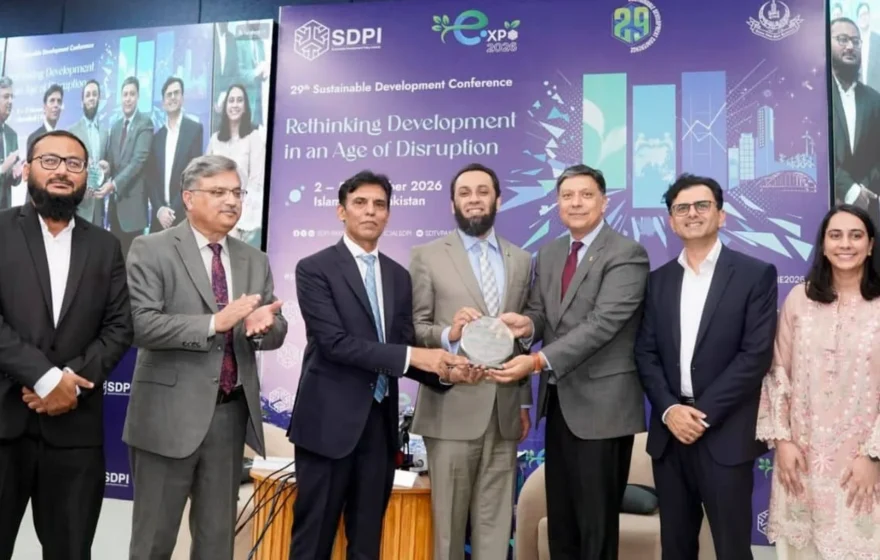
Nestlé Pakistan has picked up two awards at one of the country’s biggest gatherings on sustainable development, a recognition of the food and beverage company’s work on cleaner farming, careful use of water and a lighter carbon footprint. At the 29th Sustainable Development Conference and the Sustainability Investment Expo in Islamabad, the company received the Sustainability Award in the Circular Economy and Resource Efficiency category, along with the Best Pavilion Presentation Award.
The awards were presented by Federal Minister for Information and Broadcasting Attaullah Tarar. The recognition aligns with the United Nations Sustainable Development Goals on climate action, zero hunger and responsible consumption and production.
The conference, organised by the Sustainable Development Policy Institute, ran from November 2 to 5 at Allama Iqbal Open University in Islamabad under the theme of rethinking development in an age of disruption. More than 300 speakers from around 20 countries took part, examining how conflict, climate change and economic pressure are reshaping development priorities. Alongside it, the fourth Sustainability Investment Expo brought companies, investors and policymakers together around resilient development.
For Nestlé Pakistan, the recognition was not entirely new. At last year’s conference, the company had secured first position in the renewable energy and low-carbon transitions category and also won the best pavilion award at the expo. This year’s double honour suggests the judges saw sustained progress rather than a one-off effort.
Much of the company’s presence at the conference centred on farming, where its biggest footprint lies. Nestlé Pakistan co-hosted a high-level plenary session on transforming Pakistan’s agriculture and food systems in an age of disruption, with a focus on artificial intelligence for regenerative and climate-smart agriculture.
Faisal Nadeem, the company’s Head of Technical, spoke about the mounting pressure on cultivable land and on soil health. Katarzyna Grzybowska, Sustainability Delivery Manager at Nestlé’s global headquarters, said the company aims to source half of its key ingredients from farmers who have adopted regenerative practices by 2030, and that Nestlé Pakistan is already about halfway there. She added that solutions must reflect local realities and keep the economics of farming at the centre.
Anita Hirsch, Country Director of the World Food Programme in Pakistan, stressed the need to keep food supplies flowing, using community-based approaches, artificial intelligence and better supply chains to strengthen food security and give farming families more predictable incomes. Dr Abid Qaiyum Suleri, Executive Director of the Sustainable Development Policy Institute, highlighted smart agriculture and public-private partnerships, while Dr Zaigham Shahzad of Lahore University of Management Sciences pointed to education and research, including a certification programme recently launched with Nestlé.
Behind the discussion sit figures that show the scale of the work already under way. Nestlé Pakistan is now scaling regenerative agriculture across 125 farms, supported by 135 solar systems and 25 biogas plants. Water-saving measures include drip irrigation across 299 acres and smart soil moisture sensors across 722 acres. The company has also cut greenhouse gas emissions by 48 per cent by 2025 on its road to net zero, and says it has achieved full water regeneration for its Waters business.
Under its net zero plan, the company aims to cut greenhouse gas emissions by half by 2030 compared with 2018 levels and reach net zero by 2050 at the latest, and it has joined the United Nations-backed Race to Zero campaign. In Pakistan, that journey has included investment of around two billion rupees in renewable power and sustainability initiatives, including solar plants of about 9.5 megawatts and a biomass boiler, plus a 3.5 megawatt solar plant and a biomass steam plant at Sheikhupura.
Waste is the other side of the circular economy story. Nestlé Pakistan’s Clean Gilgit-Baltistan Project has facilitated the management of more than 11,000 tons of plastic and paper packaging waste in the mountain region, and the project was extended this year to Askole and Zero Point, near the K2 base camp. At the expo, the company’s pavilion showcased that work.
The backdrop to all of this is a country that is among the most exposed in the world to climate change. The World Bank has warned that the combined risks of extreme weather, environmental degradation and air pollution could reduce Pakistan’s gross domestic product by at least 18 to 20 per cent by 2050, and that yields in the agri-food system, the country’s largest employer, could fall by half over the same period without a change of course. The floods of 2022, which killed more than 1,700 people and displaced over eight million, remain a stark reminder of what is at stake.
Against that background, the two awards won in Islamabad carry a meaning that goes beyond a trophy on a shelf. They show that a large company in Pakistan can be rewarded when its farming, energy and waste practices reduce pressure on the country’s land and water. The test now is whether the work showcased at the expo keeps growing, from 125 farms to many more, and whether the partnerships discussed in the plenary turn into lasting change for the farmers who grow the ingredients on which the company depends.
