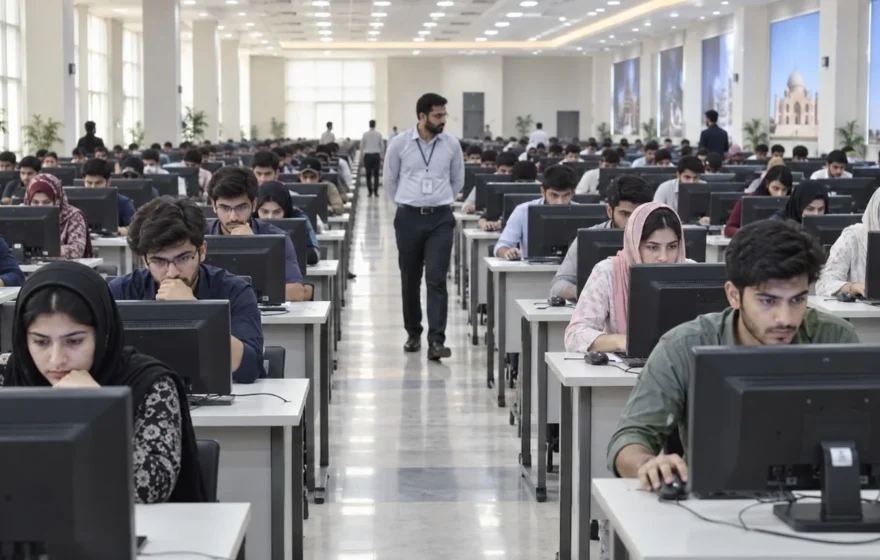
For hundreds of thousands of Pakistani students, the road to university begins in an examination hall, and often in several of them. A student hoping for a place at a good university can spend a whole summer travelling from city to city, sitting one entry test after another, each with its own fee. That exhausting routine may soon change: the Higher Education Commission has put forward a plan for a single, standardised system of undergraduate admissions, now formally reviewed by the federal education ministry.
The plan, the National Framework for Standardized Undergraduate Admissions, was placed before the Joint Steering Committee set up by the Ministry of Federal Education and Professional Training. The committee reviewed it in detail, and the early response was encouraging. It was presented by Dr Imtiaz Haider, chief executive of the Education Testing Council, the HEC body that runs national admission tests. Participants praised its clarity and welcomed its direction.
At its heart is a simple idea: instead of every university running its own test from its own question bank, the scattered databases and item banks that already exist would be merged into one Common Item Bank. From that shared pool, a single standardised test could be built for undergraduate admissions across the country. The committee has agreed to set up a Technical Committee and fix timelines for finalising the framework, so the proposal now has people and deadlines behind it.
Transparency and Merit
The stated aim is to make admissions more transparent, fair and merit-based. A single test, drawn from a common question bank and marked to one standard, would give every student the same paper, wherever they studied and whichever province they come from. That, the HEC argues, would give students nationwide an equal chance and lift much of the burden of multiple entry tests from students and their families. Once finalised, it should bring uniformity to admissions across the country, making the process simpler, fairer and more student-friendly.
The need for change is plain. Medical colleges admit through the Medical and Dental College Admission Test, an annual examination of 180 multiple-choice questions run by the Pakistan Medical and Dental Council. Engineering aspirants face the Engineering College Admission Test and the tests of individual universities. The National University of Sciences and Technology runs its own entry test four times a year, letting candidates keep their best score. The National Testing Service offers its National Aptitude Test in several categories, while the HEC runs the Undergraduate Studies Admission Test, a quarterly SAT-style examination, in six streams from pre-medical to arts and humanities.
The USAT shows both the promise and the limits of the current arrangements: a 100-mark test of 75 multiple-choice questions plus a 25-mark essay component, with 50 marks as the qualifying score. The latest cycle is under way, with registration open from November 8 to November 22 and the test scheduled for December 13. Yet the USAT remains optional: the HEC recommends it, but each university may accept it or run its own test instead. The result is that a determined applicant can still end up preparing for half a dozen different examinations, each with its own syllabus and fee.
The cost of that duplication falls hardest on families with the least to spare: every extra test means another fee, another journey to a test centre, and often another round of coaching. Students from smaller towns must travel to big cities, stay overnight, and lose days of study to the journey itself. A single test would not remove the cost of preparation altogether, but it would cut the repeated fees and travel at a stroke, and let students concentrate on one paper rather than spreading their energy across many.
There are genuine questions to settle first, and the HEC has already felt the resistance such change provokes. In May it announced that MS, MPhil and PhD admissions would move to a centralised system based on the Graduate Assessment Test and the Higher Education Aptitude Test. It was deferred to the fall of 2027 after universities asked for more time, a reminder that institutions guard their control over admissions. A national examination also only looks fair if the starting line is remotely similar, and in Pakistan it often is not: well-resourced city schools offer coaching and past papers that a student in a small town may never see. When one test becomes the gate, schools teach to it, and the pressure to memorise past papers can squeeze out writing, inquiry and independent thinking.
None of those questions is a reason to keep the present maze. They are reasons to build the new system carefully, with the item bank tested, the test offered in enough cities, and the rules published before students must rely on them. The committee’s decision to set up a Technical Committee and agree on timelines suggests the work will be done step by step rather than by announcement alone. For the students who will sit the next round of entry tests, what matters is whether it reaches them in time, in a form they can trust, and at a price their families can afford.
