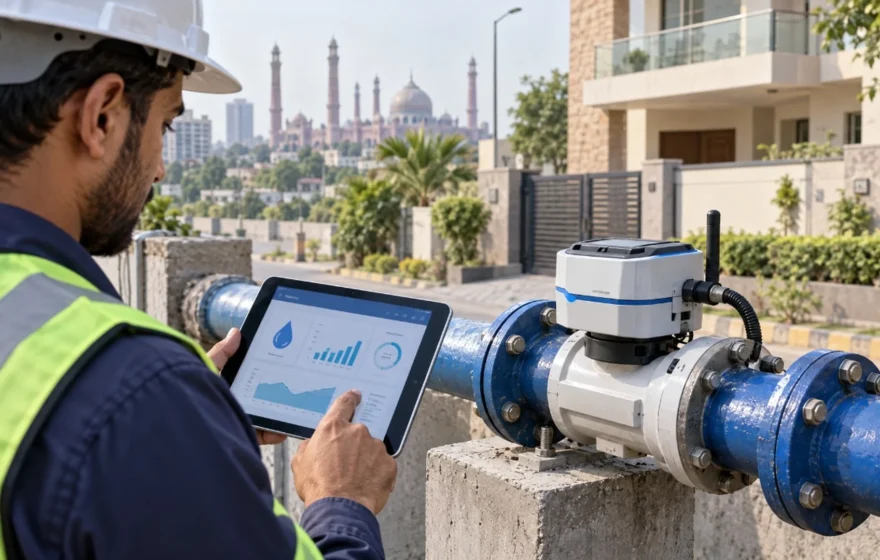
The Water and Sanitation Agency in Lahore has officially launched a modern smart water metering system, switching on 1,000 ultrasonic smart meters in Johar Town and taking the first concrete step towards charging the city's water users for exactly what they consume. The meters have been installed and activated, and the agency says the system is already being monitored through a central dashboard.
WASA Managing Director Ghufran Ahmed reviewed the smart metering system and its device management dashboard, while Director Planning and Evaluation Mudassar Javed briefed him on the technical aspects of the project. The visit was a formal launch rather than a trial announcement: the meters are in the ground, they are recording consumption, and the data is flowing to the agency's monitoring system. That matters, because Lahore has heard promises about water metering for years, and this is the first time in the current programme that a completed installation has been switched on and shown working.
Billing on Actual Usage
Under the new system, consumers are billed according to their actual water usage rather than a flat rate or an estimate. Households can see their daily consumption, meter readings, bills and usage details through the Punjab WASA app, which gives them the same kind of visibility over water that they already have over electricity and gas. According to officials, every meter is being monitored through the device management dashboard, which lets the agency spot unusual consumption, detect faults and build a clearer picture of how much water different parts of the city actually need and use.
The shift to measured billing addresses one of the oldest problems in Lahore's water supply. For decades most households have paid a fixed charge regardless of how much water they draw, which removes any incentive to fix a leaking tap or think twice about leaving a hose running. The result has been heavy wastage in a city where groundwater levels have been falling for years, and a utility that recovers only a fraction of the cost of the water it pumps, treats and delivers. Smart meters alone do not solve those problems, but they make waste visible to the household and the agency alike, and that visibility is the precondition for everything else.
Project Expansion
WASA Lahore says the project will now be expanded, with 10,000 more smart water meters to be installed over the next three months. That would carry the programme well beyond Johar Town into other parts of the city. The expansion follows a plan announced in November 2025, when Punjab said it would curb excessive use by charging strictly for consumption. WASA issued its first tender to buy 10,000 smart meters at a total cost of Rs 500 million, with the pilot beginning in Johar Town's A-1 Block. Each meter would cost Rs 35,000, payable in easy instalments, supported by a revolving fund to finance purchases.
The ambition stretches further than Lahore. In September 2026 the Punjab government announced plans to install more than 150,000 smart water meters in Lahore, Rawalpindi and Faisalabad by 2029, as part of a wider effort to manage water better and slow the decline in groundwater. Officials told a meeting chaired by the housing secretary that Punjab needs more than 1.5 million meters in total, and that the new systems would record readings automatically, cutting the need for staff to visit homes and making billing more transparent. The same meeting reviewed groundwater recharge work, including 40 recharge wells being developed in Lahore.
Lahore has been here before, and the history is a caution. In 2021 and 2022 the agency announced a much larger scheme to install more than 700,000 smart meters across the city under a public-private partnership, at a cost of around Rs 9.2 billion, with consumers paying in monthly instalments of Rs 170 over ten years. The project was meant to recover revenue lost to unbilled water, which officials then put at around 40 per cent, and to curb illegal connections and irresponsible use. That scheme never reached the scale promised, which is why the current launch matters less as a headline number and more as a test of delivery. One thousand working meters in one neighbourhood is modest beside the city's needs, but it is real, and the 10,000 that are supposed to follow in three months will show whether the agency can repeat the exercise at speed.
The stakes go beyond billing. Lahore's groundwater has been dropping for years as the city grows and tube wells pump ever harder, and every litre wasted through an unmetered connection is water the city cannot afford to lose. Metering gives the agency the data to find leaks, chase illegal connections and plan supply honestly, and it gives households a reason to care about how much they use. If the Johar Town launch is followed through, it could be the start of the most consequential change to Lahore's water system in a generation. If it stalls, it will be another entry in a long list of metering plans that never left the pilot stage.
