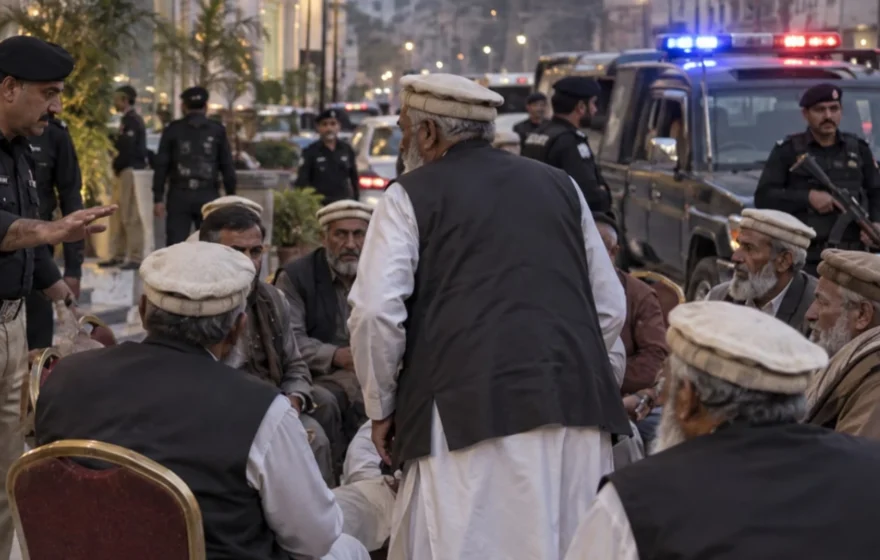
Peshawar police have banned private jirgas across the city, warning that organisers, and anyone who lends them a venue, will face strict legal action. The order was announced on Friday by Capital City Police Officer Dr Mian Saeed Ahmad, in a strong move against a practice long operating in the shadow of the formal justice system.
Under the ban, private jirgas will not be allowed at hotels, wedding halls or any other venue in Peshawar. Organisers face legal proceedings, and the premises where such gatherings are held will be sealed. The message is blunt: these gatherings have become a security problem the city will no longer tolerate.
The decision follows a recent firing incident during a private jirga at a hotel in the city, in which two people were killed. Police said the shooting exposed the risks that come with these gatherings, where rival parties often arrive armed and a negotiation can turn into a gunfight. Senior police officials told Dawn that complaints and several such incidents had built up over time, and the latest killing forced their hand.
The CCPO pointed to three problems. The first is gun culture: private jirgas, he said, promote the open display of weapons. The second is money: parties must deposit hefty sums as surety before the elders will hear them, and the jirga members charge both sides for their services. The third is the setting: lavish meals at hotels and restaurants, with the bill passed on to the disputing parties.
The Jirga System
The jirga is one of the oldest forms of dispute resolution in this part of the world. Tribal elders and community leaders gather to settle civil, criminal and communal disputes through consultation and consensus, and for many families in Khyber Pakhtunkhwa it is the first place to turn. Supporters say it is faster and cheaper than the courts, and that it can restore relations between families in a way a court order never could.
Yet the system has also drawn sustained criticism. Some jirga decisions have been deeply controversial, handing down rulings that violate the law and the rights of the people before them. Over the years, jirgas have ordered forced marriages and girls handed over as compensation in disputes. Women and children have borne the worst of these verdicts, and because the gatherings operate outside any formal procedure, so there is no appeal and no record to challenge.
What the Law Already Says
The ban does not come out of nowhere in legal terms. In January 2019, the Supreme Court ruled on the legality of jirgas and panchayats in a case brought by the National Commission on the Status of Women. The verdict, authored by then Chief Justice Mian Saqib Nisar, held that jirgas as they functioned violated Pakistan’s commitments under the Universal Declaration of Human Rights, the International Covenant on Civil and Political Rights and the Convention on the Elimination of All Forms of Discrimination against Women.
The court found that jirgas attempting to adjudicate civil or criminal matters breached Articles 4, 8, 10-A, 25 and 175(3) of the Constitution, and that no group could assume the jurisdiction of a court without lawful authority. At the same time, it left a door open: jirgas could continue as arbitration, mediation or reconciliation forums in civil disputes, provided both sides consented willingly. It was the act of posing as a court, not the gathering itself, that the court declared illegal.
The Shooting That Forced the Issue
The incident that pushed the police into action shows why the ban was framed in terms of public safety. Earlier this month, a jirga meeting at a restaurant on Peshawar’s Ring Road, called to settle a property and financial dispute, ended in gunfire. Two men, Muhammad Adam and Painda Khan, were killed on the spot, and two others, Fazal Maabood and Muhammad Karim, were wounded. An earlier jirga over a plot dispute in Hazar Khawani ended in a shooting that killed four brothers.
Why the Ban Matters Now
The ban also carries a wider warning. Announcing the decision, the CCPO directed his officers to step up action against crime across the city, including drug peddling and aerial firing, and ordered a zero-tolerance policy on the illegal display of weapons. The message is that the ban is part of a broader effort to reassert the authority of the state in a city where informal power has long competed with it.
Whether the ban holds will depend on enforcement. Jirgas have survived court judgements and police action before, largely because they fill a gap the formal system has been slow to close. Courts are overburdened, cases drag on for years, and for many families a jirga still feels like the only realistic way to settle a dispute. If the police only seal a few halls, the gatherings will likely shift to private homes, out of sight but unchanged.
For now, Peshawar has made its position clear. A tradition that once settled disputes under the shade of a tree has become, in its modern commercial form, a business built on fees, surety deposits and armed men, and the police have decided the cost, in lives as well as in money, has become too high to ignore.
