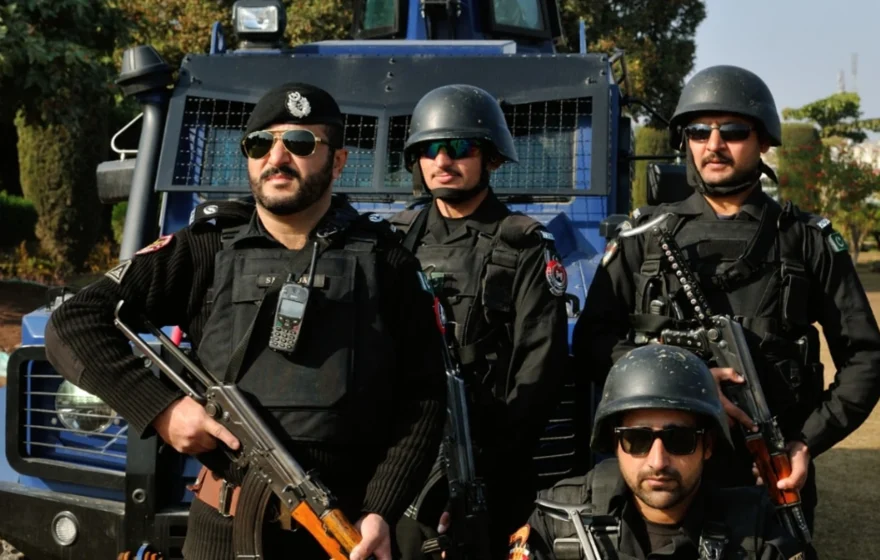
Khyber Pakhtunkhwa Governor Faisal Karim Kundi has told officials to move faster on a long-awaited pay package for the province’s police. The instruction came at a meeting at Governor House in Peshawar on Wednesday, where the governor reviewed progress on the security challenge allowance for police serving in the country’s most dangerous districts.
The meeting looked closely at how police pay in Khyber Pakhtunkhwa compares with other provinces. A comparative review was presented to the governor, and the figures behind it were hard to ignore. For years, officers in the province have argued that they take on far greater risks than their counterparts elsewhere, yet their salaries have lagged behind. The governor’s direction is to close that gap, starting with personnel in sensitive and high-risk zones, who would get priority.
Governor Kundi told the meeting that the government was serious about improving the welfare of the force. “We are taking practical measures to resolve the problems faced by the police force and ensure their overall welfare,” he said. He added that the government was also taking steps to support the families of police personnel who have lost their lives in the line of duty.
The package has been working its way through the system since the middle of October, when the Khyber Pakhtunkhwa Police sent a detailed summary to the governor seeking a major increase in pay. That summary proposed a security challenge allowance of up to 120 per cent of basic pay for personnel in the southern districts and the merged districts, 100 per cent for other settled districts, and 75 per cent for the Hazara region.
The cost of the proposal is considerable. Paying the allowance alone would add more than Rs5.15 billion to the monthly wage bill, a figure the document described as necessary to keep morale high. The summary also asked for billions more for weapons, protective gear, surveillance systems and transport. The governor gave in-principle approval in late October, and officials were told to turn the proposal into a formal executive summary for final approval. Wednesday’s meeting was the next step, with the governor now asking for the work to be completed quickly.
The case for the increase rests on the burden the force has carried. The summary pointed out that the police have been fighting terrorism for three decades, yet their pay remains lower than that of police in other provinces. A report released on Police Martyrs’ Day showed that 2,330 personnel have been martyred since 1970, 2,096 of them between 2000 and 2025. The worst single year was 2009, when 210 policemen lost their lives.
The danger has not eased. At a security briefing at Governor House on November 8, officials were told that between 2024 and September 2026, a total of 1,003 members of the armed forces, 627 police personnel and 808 civilians were killed in the province. In the first nine months of 2026 alone, 302 police personnel were martyred, while security forces eliminated 3,788 terrorists over the past three years. The briefing also laid bare the state of the force: a shortfall of more than 10,000 personnel, a figure the governor has since put at around 17,000 vacant posts, a Counter Terrorism Department short of 638 officers, and a 36 per cent shortage of operational vehicles, with only 12 per cent of personnel having access to anti-drone systems.
In response, the provincial government has unveiled a Rs70 billion security plan, with Rs59.8 billion for the police and Rs10.3 billion for the Counter Terrorism Department. The salary package sits at the heart of that effort. The federal government has also moved separately to grant a security risk allowance worth 250 per cent of basic pay to senior administrative and police service officers in 26 militancy-hit districts, effective from July 1, 2026. That decision covered senior officers, while the governor’s package is aimed at the rank and file who man the checkposts and patrol the roads where attacks are most frequent.
The governor also used Wednesday’s meeting to return to the families left behind. He directed officials to ensure swift progress on a dedicated cadet college for the children of police martyrs, a project that would give those children an education and a path into the armed services and civil institutions. “The KP Police have rendered exemplary sacrifices in the war against terrorism,” he said, and the college is meant to be a lasting recognition of that sacrifice.
What happens next will depend on how quickly the formal summary is completed and approved, and on whether the money is actually released. If the package goes through as proposed, it would be the largest pay uplift the province’s police have seen, with personnel in the hardest-hit districts receiving more than double their basic pay in allowance alone. If it stalls, the gap between what the force is asked to do and what it is paid to do will remain. For now, the governor’s message is that the work must move faster, and that the police on the front line should not have to wait any longer for the pay that recognises it.
