Sindh has thrown open its mineral wealth to investors, with Chief Minister Syed Murad Ali Shah announcing a fresh push to turn its vast coal and mineral deposits into industries, exports and jobs. At a meeting in Karachi on Wednesday, he invited Pakistani and foreign companies to explore mining, processing and value addition, promising clear rules and competitive incentives.
The message was simple: Sindh wants partners, not just buyers. The province, the chief minister said, holds mineral resources that could matter greatly for economic growth, industrial development and jobs, but only if they are developed with modern technology and the value added at home.
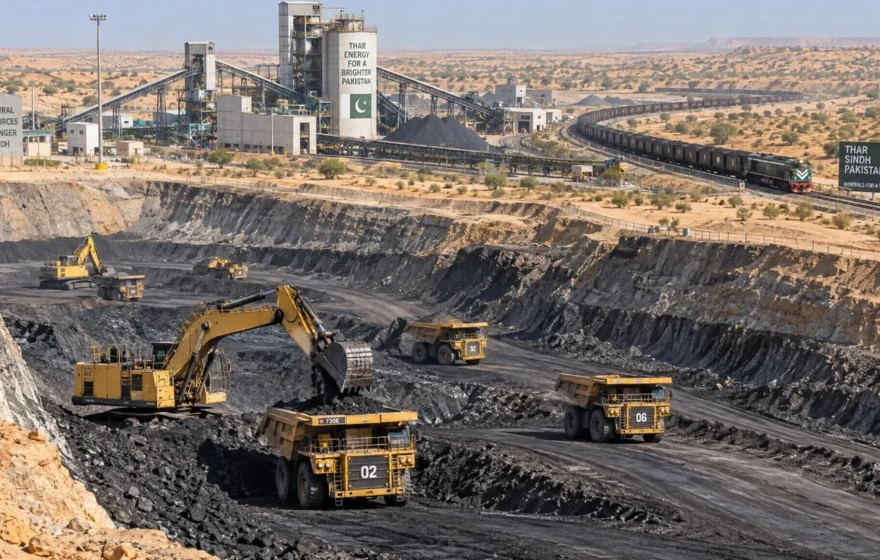
Sindh’s mineral story is dominated by one name: Thar. The Thar coalfield, spread across more than 9,000 square kilometres of desert in Tharparkar, holds an estimated 175 billion tonnes of lignite, making it one of the largest coal deposits in the world. The wider province’s reserves are estimated at around 184 billion tonnes. The field was first mapped in the early 1990s by the Geological Survey of Pakistan and the United States Geological Survey.
That began to change in 2018, when the Sindh Engro Coal Mining Company opened Pakistan’s first open-pit coal mine in Thar Block II. Power plants running on Thar coal in Blocks I and II now generate around 2,640 megawatts, expected to rise to about 3,280 megawatts. The shift to home-grown coal has already saved the country more than 680 million dollars in foreign exchange by cutting the need for imported fuel.
Focus on Processing, Not Raw Exports
The sharpest part of the chief minister’s message was about what should happen after the minerals leave the ground. He stressed that the focus must extend beyond exploration to processing and value addition, and that instead of exporting raw minerals, Sindh should build local processing facilities and the industries that go with them. Processed at home, a mineral supports factories, skilled jobs and export earnings.
Officials told the meeting Sindh had considerable potential for mineral processing, cutting, polishing and export-oriented industries. The chief minister said modern technology in mining could help establish new industries and generate employment, and he asked the provincial minerals minister to line up joint ventures with Pakistani and foreign firms. Minerals Minister Syed Sardar Ali Shah briefed him on the investment prospects.
The push fits a wider pattern in Pakistan’s resource policy, where governments have grown wary of exporting raw materials cheaply and importing finished products dearly. Processing at home keeps more of the value chain inside the country, builds technical skills among local workers and gives the province a steadier income than the boom-and-bust prices of raw commodities. For investors, the offer is access to huge reserves under predictable rules.
Thar Rail Link to Carry Coal to Industry
None of that works, however, without a way to move the coal. The chief minister told the meeting that the Thar rail link would be vital for carrying coal to industries across the country, improving the connection between the mines and the factories and power plants that need the fuel. Without transport, the coal cannot reach the industries that need it.
The railway, a 105-kilometre line running from Islamkot to New Chhor, will connect the Thar coalfield to the existing national railway network, with a last-mile link onward to Port Qasim. Work on the project is now about 68 per cent complete, according to Senior Sindh Minister Sharjeel Inam Memon, and once finished it is expected to carry around 10 million tonnes of coal a year. The federal and Sindh governments are funding it jointly on a fifty-fifty basis, with two billion rupees allocated for this financial year.
The rail link matters because transport has long been the bottleneck for Thar coal. Moving millions of tonnes by road is slow and expensive; a railway changes the economics of the whole field. It also gives Pakistan Railways new freight business and lets industries plan around a reliable local fuel supply.
Alongside the investment pitch, the chief minister was careful to set conditions. He said transparent procedures would be ensured to restore investor confidence. He also directed the authorities to ensure responsible mining, environmental protection and the development of local communities, insisting that projects must create jobs for local residents and rehabilitate the areas affected by mining.
Officials briefed the meeting on proposed initiatives in Thar aimed at giving local communities better access to employment, education, healthcare and clean drinking water. The chief minister stressed that environmental safeguards, community rights and responsible mining must stay central to every project, a recognition that local people have as much at stake as the mining companies.
Whether the new push delivers will depend on the follow-through. The test will be whether joint ventures are signed, processing plants built and the rail link finished. But the ingredients are stronger now: a working mine, power plants running on Thar coal and a railway more than two-thirds built. If the province turns those ingredients into factories and jobs, its desert coal could finally become the foundation of an industrial economy.
