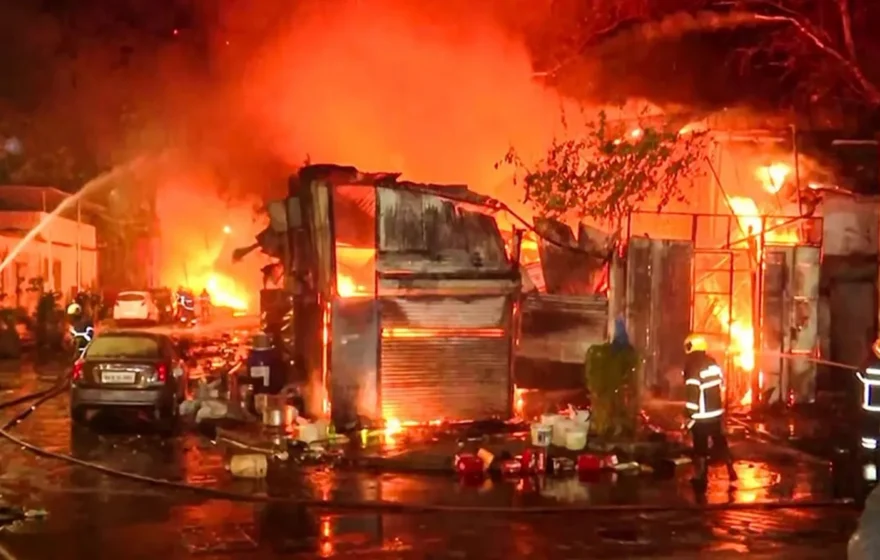
A wedding hall in Sukkur was reduced to ashes on Monday night after firecrackers set off during a Diwali celebration started a massive fire. The hall, housed in the Pakistan Club Hotel near the City Point Bypass, was gutted within a short time, and everything inside it was destroyed. Guests and hotel staff escaped without injury, but the owners say the losses run into millions of rupees.
According to the hotel management, the blaze was caused by the fireworks lit during the celebration. The owners told local reporters that every fixture and fitting in the hall, along with the furniture, electrical and electronic appliances, equipment, carpets and curtains, had been reduced to ashes. The management confirmed to reporters that the fireworks were the cause, and hotel staff said people began rushing to safety as soon as the fire intensified.
The fact that no one was killed or injured is the one piece of good news in an otherwise grim episode. Wedding halls are usually crowded places, and a fire breaking out in the middle of a celebration can turn into a tragedy within minutes. On this occasion, the guests and staff recognised the danger quickly and got out before the flames took hold. The hall itself, however, could not be saved, and the hotel has been left with a building that will need to be rebuilt from scratch.
Diwali, the festival of lights, is celebrated by the Hindu community with lamps, sweets, family gatherings and, for many families, fireworks. But the Sukkur fire is a reminder of how quickly a celebration can turn dangerous when fireworks are used close to buildings, drapery and other flammable material. A single spark landing on a curtain or a carpet can be enough to start a blaze, and once a fire takes hold in a hall full of fabric and decoration, it spreads with frightening speed.
The danger is not limited to Diwali. Fireworks and powerful firecrackers have become a familiar feature of wedding celebrations across Pakistan, and residents in several cities have been complaining about the practice. In Hyderabad, people have reported loud explosions late into the night as wedding processions move through neighbourhoods, with fireworks, explosive crackers and vehicles fitted with high-powered sound systems. Despite repeated complaints, the district administration and police there have yet to take effective action.
Authorities in Rawalpindi moved in the opposite direction only last week. On November 3, officials ordered strict enforcement of the Punjab Marriage Functions Act 2016, warning citizens, wedding organisers and marriage hall administrations that aerial firing and fireworks at wedding ceremonies would draw strict legal action. The warning followed directives from the Ministry of Interior, and violators can face a fine of up to two million rupees and imprisonment of up to one month. The message was plain: fireworks at weddings put lives and property at risk, and the law will be used against those who ignore it.
The wider picture is just as sobering. Insurance data from India shows that burn-related claims rise sharply during the Diwali quarter, running 28 percent above the average of the other three quarters in the 2026 financial year, compared with 19 percent the year before. The pattern repeats every festive season, and the causes are usually ordinary ones: crackers lit without adult supervision, duds picked up and relit, onlookers standing too close, and sparks landing on synthetic clothing. Almost all of these accidents are preventable, yet they happen year after year.
Safety experts give the same advice every season, and it is worth repeating. Firecrackers should only be burst in open spaces, well away from buildings, vehicles, electrical wires and flammable material. They should never be held in the hand while being lit, and a cracker that fails to go off should never be relit or approached. Children and pets should be kept at a safe distance, and a bucket of water, sand or a fire extinguisher should always be close at hand. Anyone who suffers a burn should cool the area under running water and seek medical help quickly.
For wedding halls and hotels, the Sukkur fire carries a direct lesson. Venues that allow fireworks indoors, or close to draped halls and decorated stages, are gambling with their own buildings and with the lives of their guests. Clear rules against indoor fireworks, working fire extinguishers, unobstructed exits and staff who know what to do in an emergency are not luxuries. They are the basic precautions that decide whether a fire becomes a story about property damage or a story about lives lost.
The owners of the Pakistan Club Hotel now face the long task of rebuilding their hall and replacing everything it contained. As the wedding season continues and Diwali celebrations go on, the question is whether hall owners, organisers and local administrations will treat this fire as a warning and act on it, or whether it will take a tragedy to force the change.
