The Sindh School Education and Literacy Department has announced a zero-tolerance policy against fake and proxy attendance in government schools, warning that teachers and other staff who mark themselves present without actually turning up for duty could be dismissed from service. It is the latest and toughest step yet in a long battle against a problem that has quietly damaged public education in the province for years: staff who draw a government salary while rarely, if ever, setting foot in a classroom.
According to an official notification issued by the department, the authorities have taken serious notice of employees who mark attendance through proxies or manipulate digital attendance records while physically absent from their schools. The notification makes it clear that teaching and non-teaching employees caught using fraudulent attendance methods will be marked as unauthorised absent and will face immediate disciplinary proceedings under the Sindh Civil Servants Act, 1973, and the Sindh Civil Servants (Efficiency and Discipline) Rules. The department has warned that penalties could include dismissal from government service, and that people who help employees mark fake attendance or tamper with attendance systems will also face strict action.
To make the warning stick, the department has ordered regular surprise inspections of government schools across Sindh, with teams checking staff against the official records, and told provincial education authorities to close the loopholes in attendance monitoring systems. The department has stressed that employees must be physically present at their schools, and that recording attendance without reporting for duty will no longer be accepted under any circumstances.
The announcement lands against a long and troubled history. Sindh’s public schools have for years struggled with so-called ghost teachers, staff who are on the payroll but absent from their posts, and with attendance registers that could be filled in by colleagues or friends. The province has tried before to fix the problem with technology. A biometric attendance system was introduced to bring transparency to a sector long plagued by ghost teachers and falsified registers, but reports from schools later suggested the system itself had been undermined. A letter published in Dawn in December 2025 described how some monitoring officers collected monthly payments from teachers during inspection visits, how teachers were often warned about visits in advance, and how absent teachers were in some cases marked present in exchange for cash.
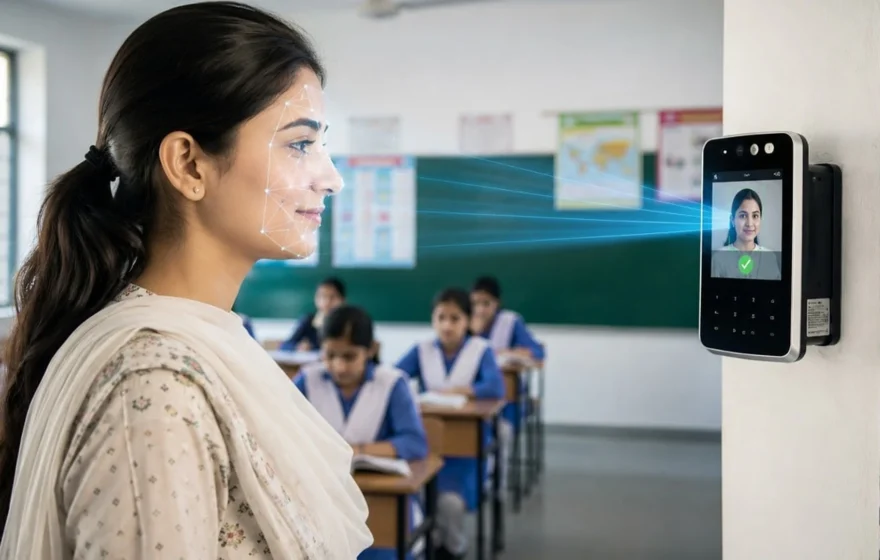
The latest attempt to break that pattern is a facial recognition system called FRAMES, the Facial Recognition Attendance Monitoring and Evaluation System, which the Sindh government began rolling out on a pilot basis on August 17, 2026. Chief Minister Syed Murad Ali Shah approved the system earlier that month, and the first phase covers six districts, one from each division of the province: Karachi East, Hyderabad, Naushahro Feroze, Jacobabad, Ghotki and Umerkot. The pilot covers 49,565 teaching and non-teaching staff, who log arrival and departure through a mobile application that verifies identity through facial mapping. The application works online and offline so it can function in areas with weak internet coverage, and the schools in the pilot districts have been geo-tagged to prevent proxy attendance.
The rollout has not been smooth. On the first morning, technical problems left many staff unable to log their arrival, and some schools had to fall back on paper registers. That shaky start raised questions about whether the infrastructure was ready, but the idea has won support from many teachers, who say automated tracking helps to separate genuine staff from ghost employees who draw salaries without teaching. Under the system, an employee who stays away is served with a show-cause notice, and anyone who keeps staying away after three such notices can be declared a ghost employee and removed from service.
The problem is not limited to attendance alone. Only days before the new warning, on November 8, Education Minister Syed Sardar Ali Shah ordered a high-level inquiry into suspected fake appointments in government schools in Mirpurkhas, after 14 more suspected teachers and employees were identified, taking the total number of suspected cases to 23. The names of the suspected employees were missing from the education department’s biometric registration database, and the inquiry will also look into alleged illegal transfers from Karachi to Mirpurkhas and postings without proper orders. Taken together, the two announcements suggest the department now treats fake attendance and fake appointments as parts of the same problem.
What happens next will matter more than the warning itself. Sindh has issued tough statements about ghost teachers before, and the test will be whether the surprise inspections actually happen, whether the disciplinary cases move quickly, and whether the people who run the attendance systems are themselves held to account. The province’s children are the ones who pay the price when a classroom has a teacher on paper but nobody at the front of the room. If this crackdown is enforced fairly and consistently, it could put real teachers back in front of real pupils. If it fades away like earlier efforts, it will be one more reminder that in Sindh’s schools, the gap between a government order and classroom reality is still the hardest problem of all.
