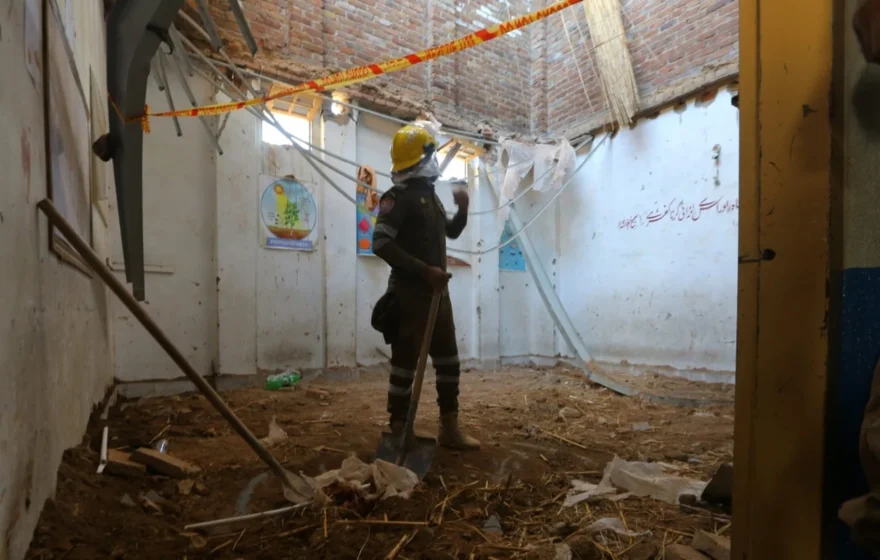
A 14-year-old schoolboy is being treated in hospital after the roof of his classroom collapsed at a private school in Faisalabad. The boy, Sajjad Zahid, a ninth-grade student, suffered serious injuries when the ceiling gave way without warning. Education officials moved quickly, ordering the school sealed and directing legal action against its administration for running classes in a building already in a poor state of repair.
The incident took place at Alflah Grammar School in Chak 132-RB, Sahuwala, a village settlement in Chak Jhumra tehsil of Faisalabad district. According to the school administration, the roof of one of the classrooms collapsed while Sajjad was inside. No other student was in the room at the time, a detail that may have prevented a far worse outcome. Had the room been full, several children could have been caught under the falling debris.
The news spread quickly, and parents in the surrounding villages were left shaken. For many families in rural Faisalabad, a private school in their own village is often the only realistic option, and they send their children there trusting that the building is safe. The collapse has broken that trust for now, and parents are asking how a classroom roof could be allowed to reach such a dangerous condition while children were still being taught beneath it.
The response from the authorities was swift. The chief executive officer of the Faisalabad District Education Authority ordered the school building to be sealed on the spot, and directed that further legal action be taken against the school administration for operating the institute in a dilapidated building. Sealing a school means that no classes can be held there until the authorities are satisfied that the premises are safe. What form the legal action will take has not yet been made public.
This is not the first time that a roof collapse at a place of learning in Punjab has ended in tragedy, and the memory of the worst recent incident is still fresh. On 30 June this year, the roof of a private tuition centre collapsed in the Kahna area of Lahore, killing 14 children aged five to sixteen and injuring several others. Around 30 children were sitting in class when the ceiling caved in and buried them under the rubble, and 14 of them died. The owner of the building and the contractor responsible for its recent construction were arrested. Punjab Chief Minister Maryam Nawaz took notice of the incident and later visited the area to meet the grieving families.
The inquiry into the Kahna collapse exposed serious failures. The tuition centre had no no-objection certificate, so it was operating without the formal approval such institutions are supposed to hold. Officials also found that the roof slab had been removed after only five days, when the rules required a wait of fifteen days. Days later, another young life was lost in a roof collapse in Lahore’s Baghbanpura area, and in Hafizabad a tuition centre roof killed a woman, her son and five young students. Roof and building collapses are a common problem across Pakistan, and experts say they happen mainly because construction standards are poor and safety rules are not enforced properly.
The provincial government responded to the Kahna tragedy with new rules for private schools. On 18 July, the Punjab School Education Department made it compulsory for private schools and tuition centres to obtain a building fitness certificate before registration or renewal. The certificate must come from a registered civil engineer or an engineering firm affiliated with the Pakistan Engineering Council, and the order went to all deputy commissioners and chief executive officers of education in the province. The plan was first aimed at around 3,500 private schools in Lahore, with special inspections for schools in rented premises and residential buildings, which are seen as more vulnerable because many private schools run from houses never approved for institutional use.
The Faisalabad incident now raises an obvious question: did the new rules reach schools like Alflah Grammar School, and did anyone check its building before the roof fell? The education authority has said the school was operating in a dilapidated building, which suggests that the danger was visible and known. If a fitness certificate had been obtained and a proper inspection carried out, the weakness in the roof might have been found in time. Parents will now want to know whether the school held a valid certificate, when its building was last inspected, and who allowed classes to continue under a failing roof.
For Sajjad Zahid and his family, those questions come later. Right now, the focus is on his recovery at the Chak Jhumra hospital, and on what the sealing of the school means for the other children who studied there. Their education has been interrupted, and they will need somewhere safe to study while the building remains closed. The incident is a reminder that school safety is not a matter of paperwork alone. Rules, certificates and inspections only protect children when they are enforced on the ground, in every village school as well as in the cities.
