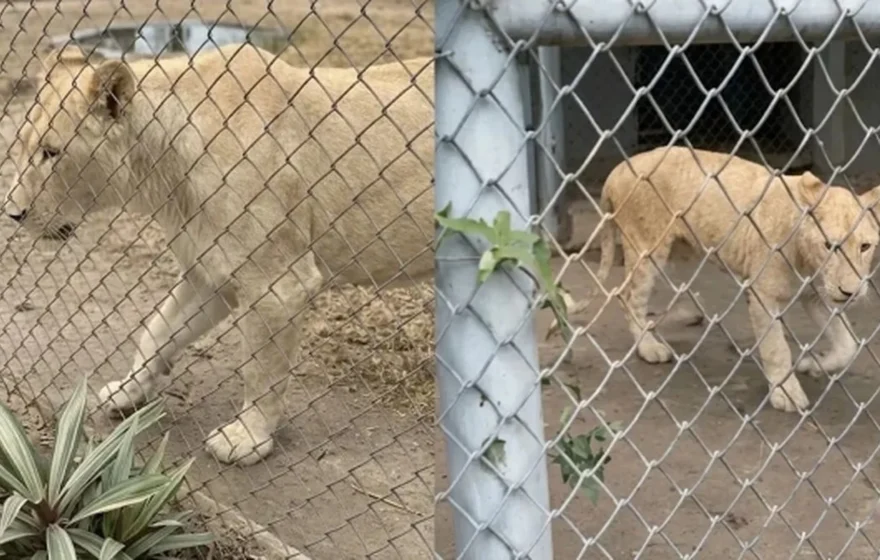
Three white lion cubs at Peshawar Zoo are struggling to walk, and the mystery around their condition has put the zoo back in the spotlight. The eight-month-old cubs have developed mobility problems that leave them stumbling, and a video of them trying to move has spread widely on social media. The Khyber Pakhtunkhwa government has taken notice of the cubs’ condition and has sought a report from the zoo administration.
Zoo officials say a congenital or genetic disorder is suspected as the possible cause, although no firm diagnosis has been made. The cubs have been examined by the zoo’s veterinary section, and the tests so far have not explained the problem. X-rays showed no significant abnormalities in their bone structures, while blood tests and mineral levels were also found to be normal. The cubs are being given nutritional and mineral supplements, and their health, movement and food intake are being closely monitored.
White lions are among the rarest sights in any zoo, and that rarity is part of the story. They are not a separate subspecies, and they are not albinos, but a rare colour variant of the Southern African lion, caused by leucism, a recessive mutation in the gene that controls melanin. A white cub is born only if both parents carry the recessive gene, which is why white lions are so uncommon. The variant comes only from the Timbavati and Kruger region of South Africa, first recorded in 1938, and white lions were considered extinct in the wild from 1992 until a conservation trust reintroduced them in 2004.
The rarity comes with a known risk that wildlife experts have warned about for years. Because the white coat depends on a recessive gene, producing white lions almost always requires inbreeding, breeding closely related animals together, and defects then begin to appear. Reported effects include skeletal deformities, neurological and digestive abnormalities, hind-limb paralysis and serious heart defects. A study of 19 white lion cubs bred at an Italian zoo found four stillborn, 13 dead within a month and six with skull abnormalities. For this reason the Association of Zoos and Aquariums forbids its members from breeding for white lions. None of this proves that the Peshawar cubs’ problem is genetic or caused by inbreeding, since no diagnosis has been confirmed, but it explains why the suspicion has fallen there.
Peshawar Zoo itself has a troubled history when it comes to animal welfare, and that history is part of why this case has drawn such a strong reaction. The zoo opened in February 2018 as the first zoo in Peshawar, spread over 29 acres next to the Pakistan Forest Institute, with around 70 species. It is run by the provincial Forests, Environment and Wildlife Department, and a white lion was already at the zoo by 2021, after being seized in Kohat.
Within months of opening, the zoo was in trouble: in June 2018, a provincial inquiry committee held its top management responsible for a series of animal deaths and called the situation alarming. Against 250 staff required, only 35 workers were looking after around 100 animals plus hundreds of birds. The deaths included a snow leopard, three common leopard cubs, deer and a monkey.
The problems did not end there. In February 2022, it was reported that 40 valuable animals had died since the zoo opened, blamed on inexperienced staff, untimely treatment and an unsuitable environment. At that point the zoo had only one veterinary doctor and four staff for around 150 animals, and no veterinary laboratory. A pair of elephants bought for Rs90 million had still not reached Peshawar after nearly two years, and a Supreme Court petition to import two African elephants was later rejected on the grounds that the zoo lacked adequate facilities.
As recently as October 2025, the Peshawar High Court sought a five-year audit of all zoos and wildlife parks in the province, after a petition alleged that animals at Peshawar Zoo were fed poor-quality food and kept in tight cages without basic facilities.
The Peshawar case is not the first time lion cubs in Pakistan have developed walking problems. In January 2025, three ten-month-old female lion cubs at Lohi Bher Wildlife Park in Islamabad were found with paralysed lower bodies, which the park’s vet called a genetic disease caused by breeding animals of the same stock. In 2018, four African lions at Lahore Safari Park suffered paralysis of their hindquarters, which officials blamed on calcium deficiency. Only last month, the deaths of two seven-month-old lion cubs at Sher Bagh Zoo in southern Punjab came to light seven months late, with officials blaming poor breeding and inbreeding.
For now, the three cubs remain under observation, with their keepers watching every meal and every step. The report the provincial government has asked for should say more about what is wrong with them, but the deeper questions will be harder to answer: how the cubs were bred, whether the zoo has the veterinary strength to care for animals with complex needs, and whether a zoo with this record should be keeping animals as rare as white lions at all.
