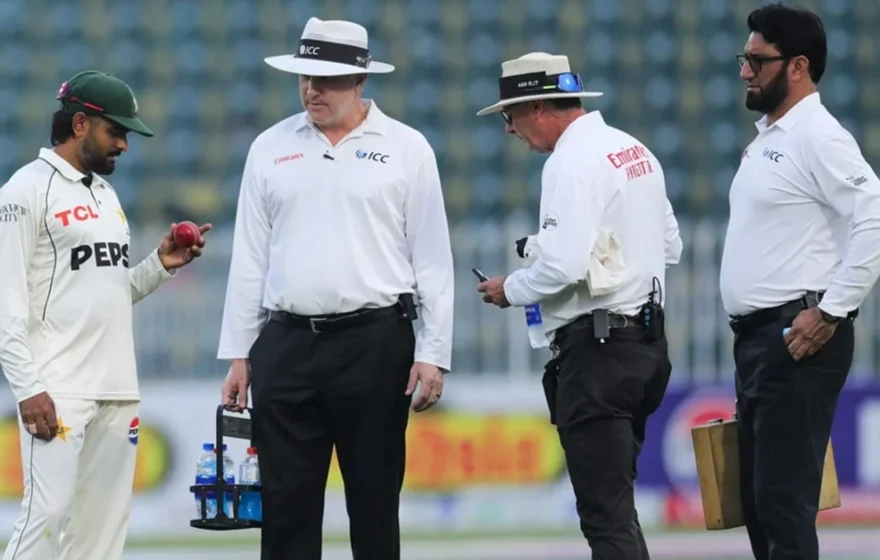
Pakistan captain Babar Azam has said he would be happy to play pink-ball Tests on home soil, but only if his team is given enough time to prepare for a ball that behaves very differently from the red one they use all season. His comments came at the end of a frustrating opening Test against Sri Lanka, a match wrecked by rain and bad light that finished in a draw with around 141 overs lost across the five days.
Speaking at the post-match presentation on Friday, Babar welcomed the idea of using the pink ball in day Tests in Pakistan, while making it clear that a sudden switch would put his players at a disadvantage. The first Test was played at the same venue where the second Test of the two-match series is scheduled to begin on November 17, and Babar said changing the ball for that game would not be practical because the team would have only two or three days to adjust.
You will have to prepare differently for the pink ball and two-three days are not enough because we play with the red ball throughout, Babar said. If we get a chance to prepare with the pink ball for longer then it is certainly something we would be open for, he added, leaving the door open for a pink-ball day Test in Pakistan at a later date.
The International Cricket Council had earlier approved the use of pink balls in day Tests as a way of cutting down the interruptions caused by poor light and bad weather. The logic is simple. The pink ball is easier to pick up than the red one as the light fades, which means play can continue for longer in the evening instead of being called off early.
The idea is not new to Pakistan. The first day-night Test in cricket history was played between Australia and New Zealand at Adelaide in November 2015, and Pakistan were the second team to host one. In October 2016, Pakistan played the West Indies under lights in Dubai in what was also the country’s 400th Test match. Azhar Ali made a triple century in that game, scoring 302, and Pakistan went on to win a tense match by 56 runs.
Yet for all its promise, the pink ball has always divided opinion. Bowlers say it swings more under lights and can be harder to control, while batsmen say it is difficult to see once it gets old and scuffed. Captains usually ask for proper preparation time before a pink-ball match, and Babar’s caution fits that pattern.
The match itself gave Pakistan plenty to think about beyond the weather. After winning the toss and batting first on a pitch that everyone expected to be difficult, Pakistan’s openers gave the innings a solid start, and the team eventually declared at 434 for nine. Five batsmen reached half-centuries, with Mohammad Taha, Tayyab Arif, Babar himself, Saud Shakeel and Arafat Minhas all passing fifty.
Sri Lanka’s reply was built on a 249-run partnership between Dhananjaya de Silva and captain Kusal Mendis, both of whom scored centuries after early wickets had put the visitors in trouble. At one stage Sri Lanka had reached 404 for four and looked set for a big total, before debutant fast bowler Saqib Khan produced a remarkable seven-wicket haul to drag Pakistan back into the game. The visitors were eventually dismissed for 446, a lead of only 12 runs.
Babar was full of praise for the young fast bowler, pointing to the confidence he had built through first-class cricket and his hunger to take wickets. It is very good to see how Saqib Khan played, Babar said. He had a lot of confidence because of the first-class cricket he has played. He had hunger to get wickets and was outstanding.
Pakistan’s second innings was a different story. The home side slipped to 125 for five before Saud Shakeel once again steadied the innings with another half-century. Shakeel had scored 93 in the first innings and fell in the nineties again, making it the third Test in a row in which he has narrowly missed a century, after a similar dismissal against England at Lord’s in August. Babar admitted the team was trying to work out why Shakeel kept getting out in the nineties, but he backed the left-hander as a central figure in Pakistan’s batting. We are trying to figure out why Saud is getting out in the nineties, Babar said. Saud knows very well how to churn longer innings in crunch moments and he is the backbone of our team.
Pakistan finished their second innings at 248 for eight on the final day, during which only 63.3 overs were possible, and the match ended in a draw.
The second Test begins on November 17 at the same ground, and for now it will be played with the red ball. Babar’s message was clear enough: Pakistan are not against pink-ball cricket at home, they simply want the chance to prepare for it properly.
