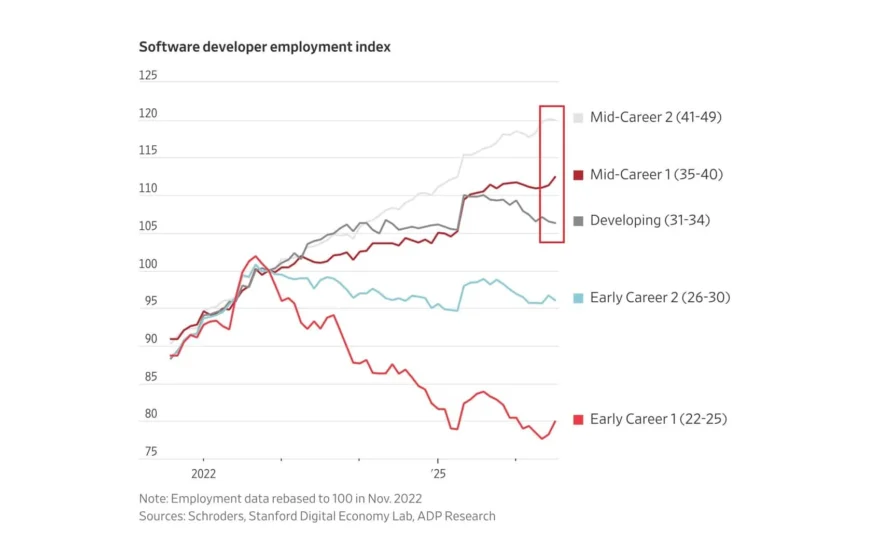
For computer science graduates, the first step onto the career ladder has become the hardest one to find. In the United States, employment among software developers aged 22 to 25 has fallen by nearly a fifth since ChatGPT was launched in November 2022, while employment among developers aged 41 to 49 has risen by the same amount over the same period.
The figures come from the Canaries Dashboard of the Stanford Digital Economy Lab, built on payroll records from ADP Research, one of America’s largest payroll providers. Highlighted this week by The Kobeissi Letter, they land as graduates everywhere, including in Pakistan, ask the same question: has artificial intelligence closed the door on the junior developer?
The split is stark. Developers aged 26 to 30 have seen employment slip 4 percent since late 2022, while the 31 to 34 and 35 to 40 age groups have both grown, leaving a 40 percentage point gap between the youngest developers and their oldest colleagues. On the dashboard’s index, where November 2022 equals 100, early-career developers stood at 81.4 in September 2026, against 120.2 for developers aged 41 to 49.
Entry-Level Work Is Drying Up
The dashboard is the living version of a working paper, “Canaries in the Coal Mine?”, by Erik Brynjolfsson, Bharat Chandar and Ruyu Chen of the Stanford Digital Economy Lab, built on ADP payroll data covering more than 25 million workers. Its August 2026 revision found workers aged 22 to 25 in the most AI-exposed occupations about 19 percent below where they would have been had they kept pace with less exposed peers. The declines are concentrated where AI substitutes for human work rather than assisting it, and the adjustment has shown up in employment rather than pay.
The likely reason is simple. AI coding tools have become good at the routine work that once filled a junior developer’s day: writing basic code, fixing bugs and running tests. Anthropic’s Economic Index found debugging, modifying software to correct errors, was the single most common task in its data, and gave computer programmers the highest observed exposure score of any occupation it tracks, at 75 percent.
That changes the maths of hiring. A company that once needed a team of juniors to clear a backlog of small tasks can now get much of that work done with fewer new hires, while experienced developers who can review AI-written code and spot its mistakes stay in demand. Stanford’s researchers say the gap has opened mainly through reduced hiring rather than layoffs, so the pain falls most on people trying to get in rather than those already inside. Job postings agree: according to Indeed Hiring Lab, senior-level roles made up 69.3 percent of software development postings in the first quarter of 2026, while entry-level roles accounted for just 4.5 percent.
A Warning for Fresh Graduates
For new graduates, the message is that a degree alone may no longer be enough. Employers increasingly want people who can use AI tools well and bring real project experience from day one. SignalFire’s 2025 talent report found that new graduates made up just 7 percent of hires at the 15 largest technology companies, down 25 percent from 2023 and more than 50 percent from 2019. Many are taking a different path: LinkedIn’s Economic Graph found 55 percent of computer science graduates started in non-software-engineering jobs in 2023 and 2024, against 49 percent in 2016.
Pakistan is feeling the same two forces at once. The country’s IT exports hit a record 4.6 billion dollars in fiscal year 2025-26, up about 21 percent from 3.814 billion dollars the year before. Yet a 2026 P@SHA report found entry-level hiring at major tech companies down roughly 25 percent, and entry-level freelance projects down from about 15 percent of listings to under 9 percent. The government has responded with AI Seekho 2026, launched by the Ministry of IT with Google for Developers, Telenor Pakistan and Innovista, to train young Pakistanis in AI-assisted development.
The researchers themselves urge caution about what the numbers prove. Stanford’s team says the data shows a link rather than proof that AI alone caused the decline, and the figures cover only firms using ADP payroll, not the whole job market. Some divergent trends also predate generative AI, and other studies are mixed: firms that adopted GitHub Copilot were 3 to 5 percent more likely each month to hire software engineers, driven by entry-level hires. The honest reading is a hiring squeeze, not a collapse.
That distinction matters for anyone starting out. The graduates getting hired are the ones who can do what the tools cannot: understand a system, judge whether AI-written code is correct, fix what it gets wrong, and ship something real. A degree still opens the door, but the portfolio, the internship and the ability to work with AI rather than against it are what get a candidate through it. Universities and employers will have to rebuild the training ground junior roles used to provide, because if nobody gets a first job, there will be nobody to become the experienced developer companies say they want.
