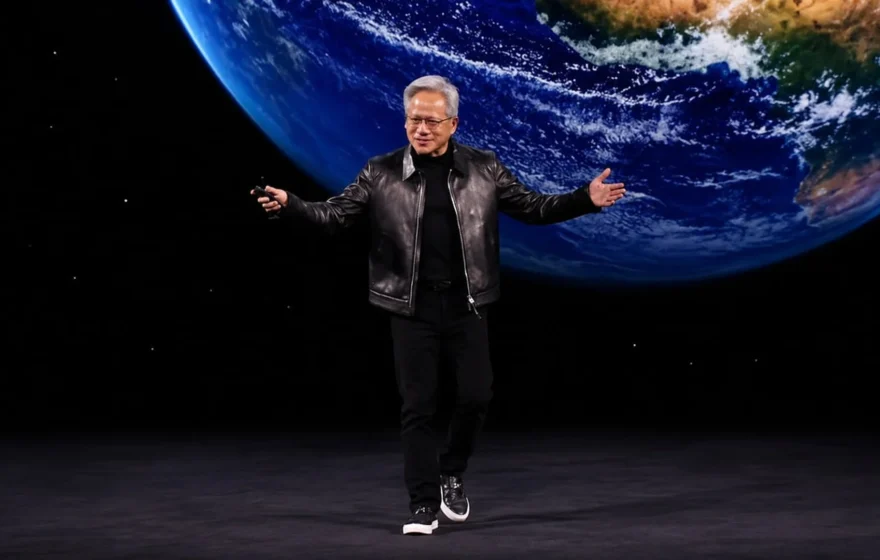
Greenpeace has called on Nvidia to take responsibility for the climate cost of making its chips, urging the company to cut emissions across its manufacturing supply chain and push its suppliers towards renewable power. The demand comes as Jensen Huang steps down as chief executive, leaving interim chief Colette Kress to answer questions the campaign group says have gone unheard for two years. For a company whose chips sit at the centre of the global race to build artificial intelligence, it is an awkward question about what the AI boom is costing the planet.
The group wants Nvidia to extend the clean energy promise it already makes for its own offices to the factories that build its hardware, and to fund new renewable energy capacity. It also wants the company to confront how its chips are used once they leave the factory, including in automated weapons systems.
Emissions Up Sharply Since 2020
At the heart of the campaign is a steep rise in the emissions tied to Nvidia’s supply chain. An analysis published in September by researcher Ketan Joshi, working with Greenpeace and Climate Action Against Disinformation, found that those emissions had risen by 725 per cent since 2020. The Verge reported that the increase amounted to roughly 9.4 million metric tons of carbon dioxide equivalent, a figure that captures how fast the factories making Nvidia’s chips have grown as demand for AI hardware has surged.
Nvidia’s own reporting tells a similar story in different terms. Its sustainability report lists 10.7 million metric tons of indirect emissions for fiscal 2026, of which 9.3 million tons came from purchased goods and services, the category that covers its suppliers. By contrast, the company reported only 9,822 tons of direct emissions from its own operations. The gap reflects the shape of Nvidia’s business. It designs chips but does not manufacture them, relying on contract manufacturers such as TSMC to turn its designs into silicon. The pollution is largely produced by others, on Nvidia’s behalf, even as its processors power most of the large data centres run by the biggest technology firms.
The Cost of Making and Running Chips
The cost does not stop at the factory gate. The Verge reported that demand for AI chips has driven the construction of new fabrication plants that consume large amounts of water and chemicals, while the chips themselves, once installed in data centres, draw heavily on local electricity grids. Rapid hardware upgrades add a third pressure, as older equipment is retired and replaced, raising questions about the discarded electronics the AI boom will leave behind.
A separate estimate by Joshi and his co-authors suggests the official figures understate the full picture. They calculated that running Nvidia’s chips could have produced around 21 million metric tons of emissions in 2025, based on the power those chips consume. That category is not included in the emissions total Nvidia reports, so its published numbers describe only part of the footprint of its products in use.
What Huang Said
Huang addressed the energy question in a September interview on The Ezra Klein Show, arguing that the huge appetite for electricity from artificial intelligence would push companies to buy more clean power. He also acknowledged that data centres would lean more heavily on fossil fuels in the near term, comparing the trade-off to surgery: a surgeon, he said, has to cut a patient open in order to save them.
Greenpeace says it has sought talks with Nvidia for two years without success, and has taken its campaign to the company’s public events. Activists raised the emissions issue during Huang’s keynote at Nvidia’s GTC conference in Berlin in October. Nvidia did not immediately respond to a request for comment from The Verge.
What Greenpeace Wants by 2030
Nvidia says it matched all of the electricity used by its own facilities with clean power purchases in 2025, a milestone it presents as evidence of progress. Greenpeace argues this covers only a small part of the company’s real footprint, because it leaves out the suppliers that manufacture its chips, many of them in East Asia, where grids still depend heavily on coal and gas. The group wants Nvidia to extend its 100 per cent renewable electricity target to the whole manufacturing supply chain by 2030 and to invest in building new renewable capacity, rather than buying up clean power that already exists.
The campaign also asks Kress to address the use of Nvidia’s chips in automated warfare, an issue that goes beyond carbon accounting and into the ethics of what the hardware enables. That demand widens the debate from how the chips are made to what they are made for, and it will be harder to answer with a clean energy pledge alone.
The pressure on Nvidia reflects a wider reckoning for the AI industry. For years its story was told in terms of capability, of models growing more powerful with every generation. Now a second story is catching up, about the factories, the water, the electricity and the waste that make those models possible.
