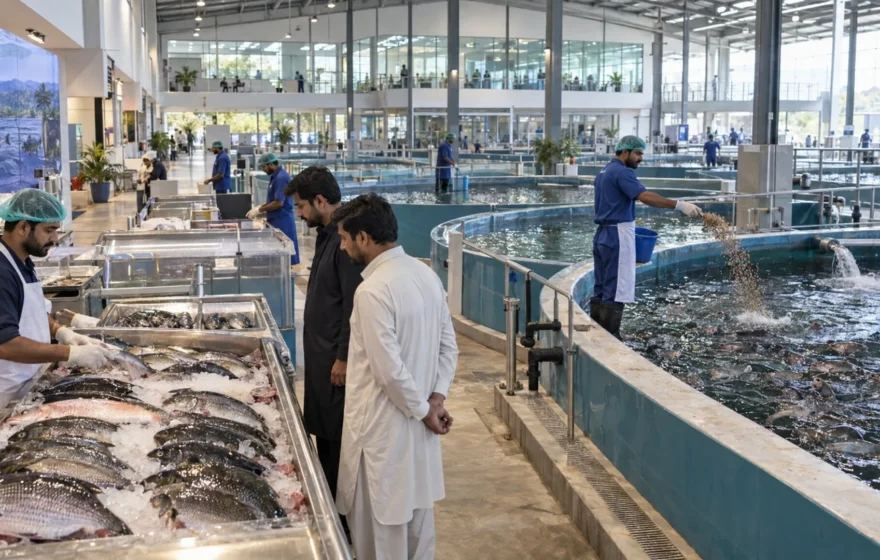
Punjab has approved Rs3.979 billion to set up aquaculture malls across the province, giving its fish farming sector a dedicated push towards modern production and organised marketing. The funding was cleared as part of a much larger package of 11 development projects worth Rs126.668 billion, approved by the Provincial Development Working Party on Friday, a clear sign the provincial government sees fisheries as an industry worth investing in rather than a side activity for rural households.
The aquaculture malls are expected to boost the fisheries sector and create new economic opportunities through modernised production and marketing facilities. The idea is to give fish farmers somewhere proper to take their catch: facilities where fish can be graded, stored and sold under one roof, instead of passing through a long chain of middlemen with little cold storage and little bargaining power for the farmer. For a sector where much of the value is still lost between the pond and the market, that kind of infrastructure matters as much as the fish themselves.
The announcement did not say how many malls will be built, where they will be located, or when construction will begin, and those details will decide whether the money turns into something farmers can actually use. The province is backing the concept while its fish farming industry is still organised around small ponds and informal sales. Aquaculture covers around 27,000 acres in Punjab, according to Food and Agriculture Organization estimates, and private fish farms spread across roughly 60,000 acres produce more than 92,000 metric tons of fish every year. The Fisheries Department supports those farms through 47 hatcheries that supply fish seed, and it has been pressing farmers to adopt intensive methods that produce more fish from less water.
Farming is concentrated in districts such as Sheikhupura, Gujranwala, Attock and Muzaffargarh, where carp, tilapia, trout, shrimp and catfish are raised. South Punjab has emerged as a growing hub of its own, with fish farms covering about 38,000 acres, more than 2,800 registered farmers and 20 hatcheries, seven of them public and 13 privately owned. Officials there have also been experimenting with cage culture in rivers and with biofloc farming, which rears fish at high density in tanks. Even so, average yields in the region have been reported at around 35 maunds per acre, well below what farmers in neighbouring countries achieve, which is one reason the government keeps talking about modernisation.
That gap between potential and performance runs through the whole of Pakistan’s aquaculture sector. The country produced 174,338 metric tons of farmed fish in 2024, according to the FAO, the highest figure on record, and total fish production across marine and inland waters runs to more than 600,000 tons a year. Fisheries exports bring in more than 400 million dollars a year, and the sector employs around 390,000 people directly, contributing roughly 0.4 percent of national GDP. Yet aquaculture in Pakistan has been growing at only about 1.5 percent a year, far behind India’s 8 percent and Bangladesh’s 2.3 percent, with weak post-harvest handling, limited marketing infrastructure and poor management practices named as persistent problems.
That is the context in which the aquaculture malls should be judged. If they work as intended, they would attack the weakest link in the chain rather than simply adding more ponds. A farmer who can sell graded, chilled fish at a transparent price earns more from the same pond, and a buyer who can rely on steady, quality supply is more likely to pay for it. Proper marketing facilities could also help the province’s fish reach bigger urban markets and export channels, where consistent quality and cold storage are non-negotiable. For rural households, where a fish pond can already earn far more per acre than wheat or cotton, better marketing could turn a decent living into a profitable business.
There are risks, too, and they are the familiar ones for development schemes of this kind. A mall built far from the farming clusters it is meant to serve will sit empty, while one without reliable electricity, ice plants and cold storage is little more than a shed with a signboard. The buildings alone will not be enough: farmers will need continued access to quality seed and feed, training in modern methods, and credit on workable terms, and private traders will need a reason to set up inside the new facilities rather than sticking with the informal markets they know. The Rs3.979 billion is a small slice of the Rs126.668 billion package approved on Friday, but it will still need to be spent where the fish actually are.
For now, the approval itself is the news, and the next test will be the detail: locations, timelines and the operating model. If Punjab gets those right, the malls could give a slow-growing but labour-rich sector the marketing backbone it has long lacked, lifting incomes for thousands of farming families. If it gets them wrong, the province will have spent nearly four billion rupees on buildings that change little for the people they were built to help. Either way, the decision puts fisheries firmly on the province’s development agenda, and farmers across Punjab will be watching to see whether the investment reaches their ponds this time.
