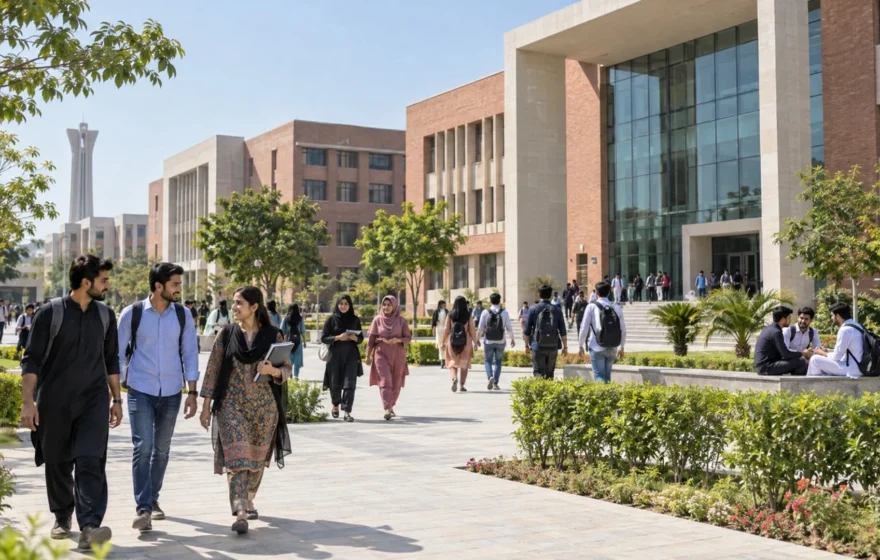
Punjab has approved a Rs18.862 billion upgrade for the Punjab University of Technology in Rasul, Mandi Bahauddin. The funding will pay for new buildings, additional classrooms and better facilities across the campus, giving the institution room to grow and its students a far stronger place to learn.
The decision was taken at a meeting of the Provincial Development Working Party, the Punjab government’s body that vets and clears development schemes before money is released. The allocation for the university formed part of a much larger development package worth Rs126.7 billion, approved at the same sitting, which covered schemes in health, education, roads, traffic management and industry across the province. The working party’s meeting was chaired by Dr Naeem Rauf, chairman of the Planning and Development Board.
For the university itself, the money is aimed at a straightforward problem. The campus at Rasul has been teaching students for generations, but its buildings and facilities have not kept pace with the number of young people who want a technology education, or with what modern engineering and technology teaching now requires. The new funding is meant to close that gap, expanding the campus’s capacity and bringing its academic infrastructure up to date so that students can learn in properly equipped spaces rather than crowded ones.
The university is no ordinary campus. Its story begins in 1873, when a school of surveying opened at the Oriental College in Lahore, training surveyors for the canals, roads and barrages of the Punjab. The institution moved to Rasul in 1912, on the bank of the Jhelum Canal, and over the following decades it changed shape again and again, from a school of engineering to a polytechnic institute and then to the Government College of Technology, Rasul, known for its diplomas in civil technology. It was only in 2018 that the Punjab Assembly passed the law that turned the college into a full university. That long history matters because it means the new investment is not being poured into a new institution with everything to prove. It is going into one of the oldest technical education institutions in the region, one whose graduates have been building the province’s infrastructure for more than a century.
Today the university offers undergraduate degrees in civil, electrical and mechanical engineering technology, along with software engineering and technology management. These practical disciplines produce the technologists that industry, construction firms and public works departments rely on. A bigger, better-equipped campus should mean more seats for students from Mandi Bahauddin and the surrounding districts, and better laboratories and workshops for the students already there. For families in the area, that matters a great deal, because a technology degree from a public university is one of the most reliable routes into steady, skilled work.
The university’s upgrade is only one piece of a much wider spending round. The same meeting of the working party approved Rs11.65 billion for two new hospitals, one in Murree and one in Rawalpindi, and Rs75.99 billion for sewerage, drainage and street paving in thirteen cities under the Punjab Development Programme. A 50-bed hospital in Bhurban was also cleared, along with funding for a new traffic management centre in Lahore. Taken together, the nineteen schemes approved that day were worth Rs126.67 billion, a reminder of the scale of the province’s development programme.
That scale also raises the question that will decide whether this announcement matters in the long run. Approving money is the easy part. Turning an approval into finished buildings takes tenders, contractors, supervision and time, and Punjab has no shortage of projects that were announced with fanfare and then moved slowly. The university’s students and teachers will be watching for the next steps, the release of funds and the first work on the ground, because those are the milestones that turn a budget line into a classroom a student can actually sit in.
There is also a wider point about where Punjab is placing its bets. Alongside the spending on hospitals and roads, the province is putting serious money into education and skills, from this university upgrade to the skills centres approved in earlier meetings of the working party. Roads and hospitals improve life today, but a province that cannot train enough engineers and technologists will keep importing the skills it needs. Investing in a campus like Rasul, with its deep roots and its practical focus, is a bet that Punjab can produce more of those skills at home.
For now, the approval gives the university something it has waited for. A campus that began as a surveying school in 1873, and became a university only eight years ago, now has the funding to build the facilities its students deserve. If the work that follows is carried through at the pace the announcement suggests, the students arriving at Rasul in the coming years will find a very different institution from the one their predecessors knew, larger and better equipped. That is the promise of the Rs18.86 billion. Whether it is kept will be judged on the campus itself, in the years ahead.
