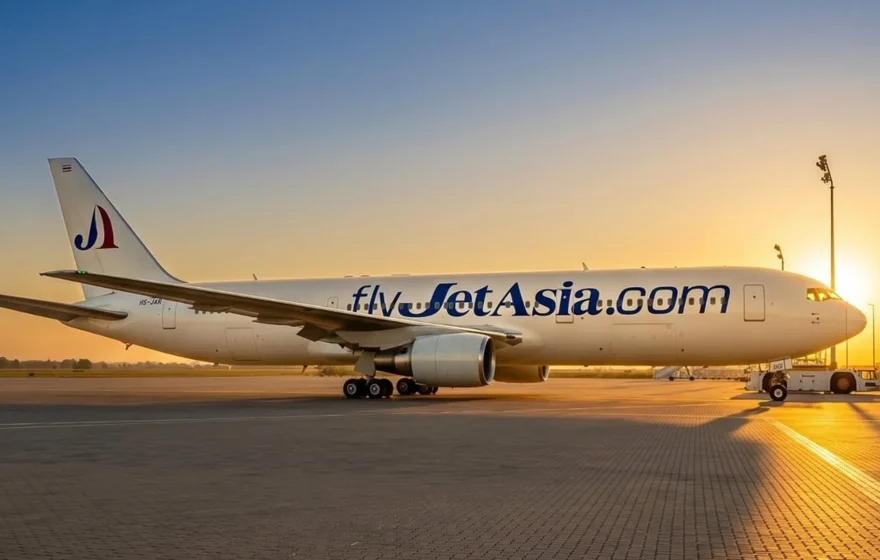
Sialkot International Airport has finally sold a Boeing 767 that sat parked on its apron for more than nine years, bringing to an end one of the more unusual sights in Pakistani aviation. The aircraft, a Boeing 767-336ER, was auctioned for more than 400,000 dollars, above the reserve price the airport had set, and the proceeds have been used to recover the parking dues that built up during its long stay. After nearly a decade as a stationary landmark, the jet is set to leave the airport at last.
The aircraft had been parked at Sialkot since August 29, 2017. It was previously associated with Fly Jet Asia Airways, which had used it for charter flights, and it belonged to Sialkot International Airport itself. For years it stood idle while its future was argued over, a wide-body jet going nowhere on the ground of an airport built to connect its city to the world. The airport eventually decided to sell it, announcing the sale in a Facebook post on May 22, 2026, and inviting interested buyers to submit expressions of interest.
The airport listed the aircraft for several potential uses, including engineering work, spare parts, cargo conversion, training and other projects. It set the reserve price at 400,000 dollars, a figure that reflected the jet’s age and its years out of service rather than the value of a flying aircraft. The sale then went ahead by auction under a court order, and the aircraft fetched more than the reserve, suggesting that more than one buyer saw value in it despite its long sleep.
According to sources, the aircraft had accumulated millions of rupees in outstanding airport dues during its nine-year stay, and the airport recovered those dues from the auction proceeds. That detail explains much of the story. Parking a large aircraft is not free, and the charges keep mounting whether the jet flies or not. By selling it, the airport has turned a liability that had been sitting on its apron into cash, and cleared a debt that had been growing since 2017.
Remarkably, the aircraft was not a wreck. According to sources, its engines, passenger seats and landing gear remained in good condition despite years of inactivity. A parked aircraft can hold much of its value if its key components are preserved, and engines in particular are worth a large share of an old jet’s price.
Sialkot International Airport itself is an unusual place for such a story. It was Pakistan’s first privately owned airport, built by the city’s business community and opened in 2007 to give one of the country’s great export centres a direct link to world markets. Sialkot’s factories produce surgical instruments, sports goods and leather products that are sold around the globe, and the airport was created so that exporters would not have to route everything through Lahore or Karachi.
The Boeing 767, for its part, was once one of the workhorses of long-haul aviation. The wide-body, twin-engine jet entered service in the early 1980s and spent decades carrying passengers across oceans for airlines on every continent. Hundreds were built, and the type became a familiar sight at airports worldwide. In recent years, however, most passenger 767s have been retired as airlines moved to newer, more fuel-efficient aircraft, and many of the survivors have been converted into freighters or broken up for parts. The Sialkot jet belongs to that generation, a machine from an earlier era of flying that outlived its working life.
Aircraft end up stranded like this more often than passengers might imagine. An operator can collapse, run out of money or fall into a legal dispute over ownership, leaving a jet with nowhere to go and no one willing to pay for its upkeep. The airport cannot simply tow it away, because the aircraft is someone’s property, and the courts must decide who owns it and who is owed what. Meanwhile the parking charges accumulate, month after month, until the sums involved make a sale the only practical answer. A court-ordered auction is often how the deadlock is finally broken.
What happens next depends on the buyer. A cargo conversion would give the old airframe a second working life, since converted 767 freighters remain in demand with parcel and freight operators. Stripping it for parts would keep other 767s flying, with its engines and landing gear among the most valuable items. Using it for engineering or training would turn it into a classroom, a use that suits an aircraft too old to fly commercially but still sound in its structure. Any of those outcomes is a better end than another decade parked on the apron.
For Sialkot, the sale closes a long and slightly embarrassing chapter. The airport recovered its dues, freed up apron space and removed a reminder of a deal that had gone wrong. For aviation watchers, the story is a small illustration of how the industry deals with its leftovers, the big machines that outlive their operators and wait, sometimes for years, for a court, a buyer and a second chance.
