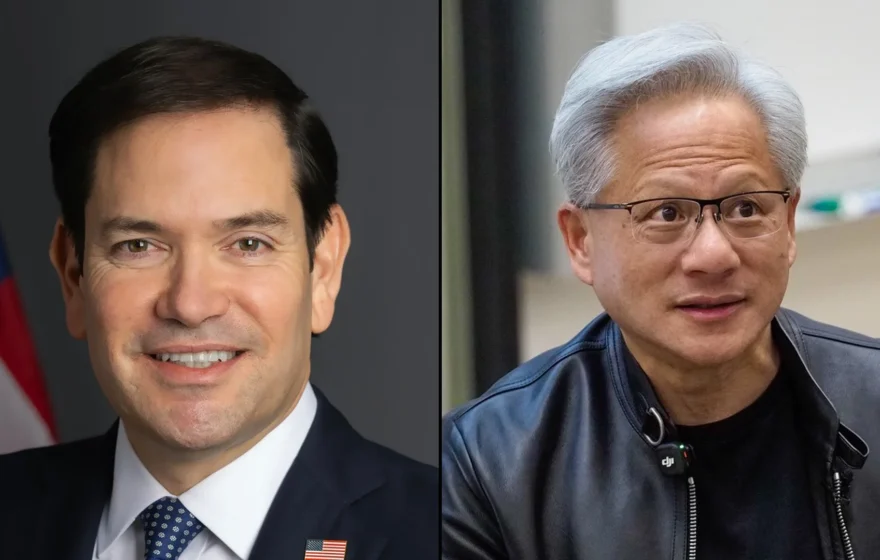
A memo from one of the most powerful figures in Washington set in motion the sudden end of Jensen Huang’s 33-year leadership of Nvidia. According to The Washington Post, Secretary of State Marco Rubio sent President Donald Trump a warning about Huang’s private life, and that warning started the chain of events that ended with the chipmaker’s chief executive resigning.
Rubio’s memo told the president that Huang was in a relationship with a woman whom American intelligence officials suspect of working for Chinese intelligence. It drew on a Central Intelligence Agency report, but Rubio put the findings in stronger language than the original, a person familiar with the matter told the Post. Rubio serves as both secretary of state and national security adviser, and the memo, dated March 30, went to a small group of senior officials in the spring.
The woman at the centre of the warning has been named in reporting as Alice Huang, also known as Huang Le, a former Megaspeed executive. She is not related to Jensen Huang. American intelligence officials suspect her of being an asset of China’s Ministry of State Security, but the allegation has not been publicly established. Some CIA officials are not yet convinced that intercepted communications show she knowingly passed information to Beijing, CNN reported. Attorney General Todd Blanche said on November 12 that neither the Justice Department nor the FBI had confirmed whether she was a spy. She has not been charged, and Beijing denies the allegation.
How the Memo Led to Huang’s Exit
The memo stayed inside the administration for months. Rubio also warned Trump in person. On May 12, 2026, Huang flew to Anchorage to join the president aboard Air Force One on the way to Beijing, although he had not originally been on the passenger list. By then Trump had already been briefed, according to The New York Times, which reported that surveillance had picked up communications pointing to an intimate relationship with an American whose name was masked in the reporting. That American was Jensen Huang.
The allegations became public on October 29. On November 8 Huang admitted the affair and apologised to his family, and Nvidia’s board opened an investigation into whether the relationship had created a security risk. Then came reports of a second affair, this time with a subordinate at Nvidia, and the pressure became impossible to survive. On November 11 the board accepted his resignation with immediate effect, and Nvidia announced his departure the following morning. Huang was out as chief executive and as a director after 33 years.
Rubio has refused to discuss his part in the affair. At the G7 meeting in Paris, he declined several questions about his role in alerting the White House. The Post described the episode as the climax of a long struggle inside the administration over who sets the president’s China policy, and Huang’s departure as a victory for those who had spent years trying to limit his influence over chip exports.
What It Means for Nvidia’s China Business
Huang’s fall matters far beyond one man’s career. He had become a close adviser to the president, and he used that access to argue for allowing China to buy advanced American AI chips, a policy many national security officials regarded as a threat. In May 2025 the Trump administration scrapped a rule restricting exports of advanced AI chips, and in December 2025 Trump approved sales of Nvidia’s H200 chips to China in exchange for a share of the revenue, alarming national security officials.
With Huang gone, those who opposed the sales now have a clearer path. His exit could help Congress push through three measures in a major defence bill: tighter restrictions on exports of powerful AI chips, technology to detect chip smuggling, and limits on China’s access to the equipment used to make advanced chips. Lawmakers are also calling for Huang to testify and demanding a review of the decision to allow those chip exports.
Trump himself has not turned against his former adviser. He still speaks warmly of Huang in public, calling him a legend who had done a fantastic job. That praise sits awkwardly beside the events of the past fortnight, in which the president’s own secretary of state helped to bring Huang down. It also reflects his standing in the industry, where he built Nvidia into the most important company of the AI era. Staff at Nvidia and billionaire Elon Musk are backing a petition calling for his reinstatement.
Nvidia has named chief financial officer Colette Kress as interim chief executive while the board searches for a permanent successor. She takes over at a difficult moment, with the company due to report earnings on November 17. The wider question is whether Nvidia’s voice in Washington will now grow quieter, and whether the chip export rules Huang fought to loosen will be tightened again. For three decades Huang shaped the market for the chips that power modern computing. His departure, driven by a memo, a leak and a scandal, leaves that market and American policy towards China at a turning point.
