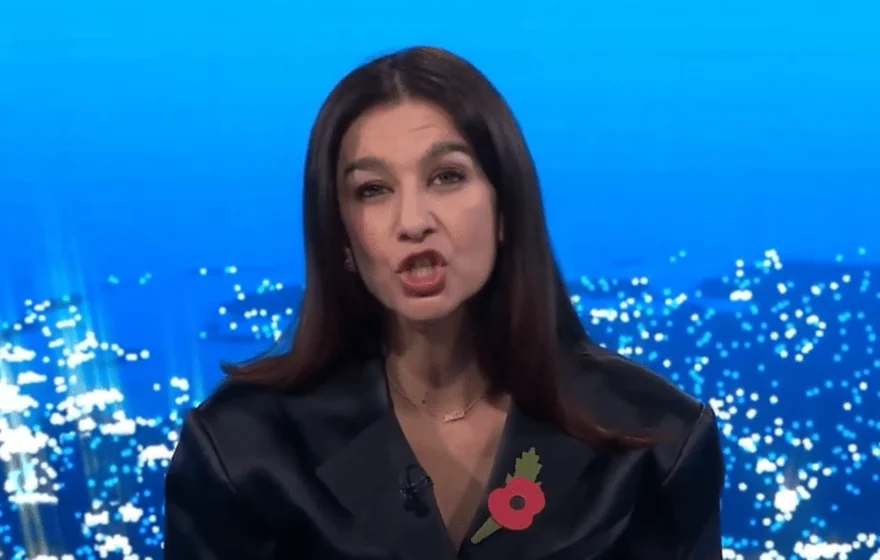
Afghan-born Australian journalist and Sky News presenter Yalda Hakim has warned that a viral video showing her presenting a Pakistan-related investigation is fake and was made with artificial intelligence. The clip spread rapidly across social media before she spoke out, and it was designed to look like a genuine Sky News bulletin, complete with her face, her voice and the familiar visual language of a breaking news report.
“This video is fake. It uses AI to impersonate me and is being passed off as a Sky News report. I never reported this story. Please don’t share the clip,” Hakim wrote on X on November 15. Her denial was blunt and unambiguous, the kind of statement a journalist issues only when a fabrication has travelled far enough to do real harm.
Clip Went Viral Before the Denial
The nearly four-minute clip was styled like a Sky News bulletin, with Hakim’s face and voice used to present claims of a major financial scandal in Pakistan. It was posted on X with a “Breaking” tag and had been viewed more than 360,000 times by Monday.
The choice of subject was no accident. A claim of a major financial scandal, delivered by a trusted international presenter, is exactly the kind of story that travels fast in Pakistan, where a foreign news channel’s authority carries weight. The people behind the clip understood that. They did not need the story to be true. They needed it to look true for long enough to be shared, and in that they succeeded for hours before Hakim’s denial caught up.
Hakim is one of the most recognisable faces in international broadcast journalism. Born in Afghanistan and raised in Australia, she has reported from conflict zones and interviewed world leaders. That recognition is precisely what makes her a target. A deepfake works best when the face is famous, because the viewer supplies the trust before the video has even begun.
The incident is part of a much larger pattern that has grown sharply over the past two years. A study by Reporters Without Borders documented 100 cases of journalists targeted by deepfakes in 27 countries between December 2023 and December 2025, and women accounted for 74 per cent of the cases examined. Female journalists are targeted more often, and the fakes are used to damage reputations, to spread false claims and, in some cases, to promote fraudulent investment schemes dressed up as news.
The scale of the wider problem is now industrial. Research published by Reset Tech in September 2026 tracked 6,601 social media accounts across YouTube, Facebook and TikTok that were producing AI-generated political clickbait and news impersonation, and those accounts had collectively amassed more than four billion views and over 500 million engagements. The Hakim clip was not a one-off prank. It was a product of a system that manufactures counterfeit journalism at scale, because counterfeit journalism pays.
The same techniques have been used far beyond Pakistan. In March 2026, AFP documented deepfake videos of Malaysia’s prime minister and the country’s queen promoting a fictitious assistance scheme, and fake videos of presidents and celebrities have been used elsewhere to push bogus investment schemes.
What makes these fakes so hard to fight is that they exploit the way news is now consumed. Most people encounter a video as a small square on a phone screen, shared by someone they know, with no newsroom and no verification step between the creator and the viewer. A Sky News logo, a studio backdrop and a confident presenter are enough to pass the only test most viewers apply, which is whether it looks like news. By the time a denial arrives, the original clip has often been seen by far more people than the correction will ever reach.
There are defences, but they depend on the viewer. Checking whether the story appears on the broadcaster’s own website or verified accounts is the simplest test, and it would have exposed this clip immediately, since Sky News never carried the report. Looking for the story in more than one reputable outlet helps too, because a genuine scandal of this size would be covered everywhere, not by a single clip on a single account.
Platforms also bear responsibility. YouTube requires creators to disclose realistic content that has been meaningfully altered or synthetically generated, including media that makes a real person appear to say or do something they did not. Enforcement is uneven, however, and a clip can gather hundreds of thousands of views before it is flagged. The gap between how fast a fake spreads and how slowly it is caught is the space in which the damage is done.
For Hakim, the episode is a reminder that a journalist’s face has become an asset that can be stolen and worn by anyone with the right software. For viewers in Pakistan and everywhere else, it is a warning that the next clip that looks like the news may not be the news at all. The safest response is the one Hakim herself asked for: do not share the clip, and check the source before believing what a familiar face appears to say.
