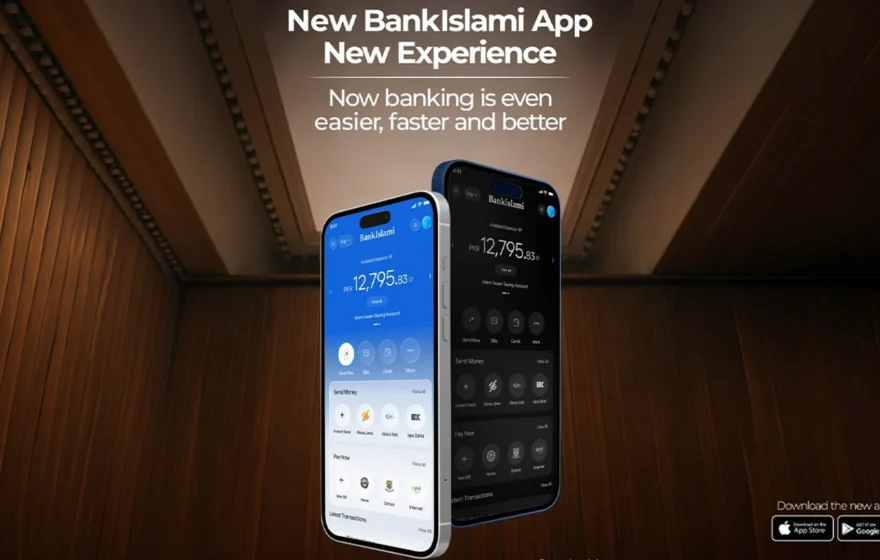
BankIslami has rolled out a sweeping upgrade of its digital banking services, unveiling a redesigned mobile application, a new WhatsApp Banking service and a move to a modern payments platform, in a clear sign that Islamic banking in Pakistan is racing to win customers on their phones.
The package brings three changes at once. At its heart is a rebuilt BankIslami Mobile App, alongside banking through WhatsApp, the messaging service millions of Pakistanis use every day. Behind the scenes, the bank has completed a migration to the payments platform of Euronet, the global payments company, giving its card and transaction systems a more modern foundation. Together, they are meant to turn BankIslami into a genuinely digitally led Islamic bank.
The numbers show how far that shift has already gone. Digital channels now account for 61 per cent of BankIslami’s transaction volume, meaning nearly two out of every three transactions already take place away from a branch counter. Its mobile banking application alone processed transactions worth around Rs557 billion during the last quarter, a figure that shows how much now rides on the new app.
That app has been rebuilt around giving customers more control without a branch visit or a call to a helpline. It carries more than 60 features, including custom transaction limits of up to Rs5 million, scheduled bill payments and bulk payments. Cardholders can block a card temporarily and control international and online use from the phone. The app also works in Urdu, which matters where many users are far more comfortable reading Urdu than English.
Perhaps the most distinctive part of the new app is its Islamic Hub, a section that folds faith into everyday banking. It includes a Qibla locator, prayer and Azaan reminders and Surah recitation, placing religious tools beside account balances and payment screens. For a bank whose customers chose it precisely because it promises Shariah-compliant finance, the app should feel Islamic in more than name. It also sets the app apart in a crowded market where most banking apps compete mainly on speed and offers.
The second leg of the announcement, WhatsApp Banking, takes that thinking further by meeting customers inside an app they already use. Through WhatsApp, BankIslami customers can check balances, ask for account statements, manage card services, place requests, register complaints and find branch information, all without downloading anything new or learning a fresh interface. For customers in smaller towns, where a branch trip can eat up half a day, that convenience is real, and it should ease pressure on branches and call centres.
Underpinning both services is the migration to Euronet’s payments platform, the least visible change but arguably the most important. Euronet Worldwide, listed on the Nasdaq stock exchange, is a global payments processor whose network reaches roughly 200 countries and territories, handling card processing, ATMs and merchant payments through its Ren platform. The move modernises the plumbing behind every card swipe and transfer, and gives BankIslami room to add new services without rebuilding its systems each time.
The move fits BankIslami’s own history. The bank was the first to receive an Islamic banking licence under the State Bank of Pakistan’s Islamic banking policy of 2003, granted on 31 March 2005, and it began operations on 7 April 2006 with its first branch in the SITE industrial area of Karachi. From those beginnings it has grown into a nationwide network of more than 500 branches in 210 cities. This upgrade is the clearest expression yet that Islamic finance can be both principled and modern.
It also lands at a moment when banking in Pakistan is changing fast. The State Bank has spent recent years pushing the country towards digital payments, most visibly through Raast, its instant payment system, while mobile and internet banking have grown steadily as smartphones and cheap data have spread. Islamic banking has been part of that growth, drawing in customers who want their money kept clear of interest yet expect the same slick digital experience as any conventional bank. The new services answer that demand directly.
“Our ambition is to move beyond conventional digital banking and build a more comprehensive Islamic digital finance experience,” said Waqas Anis, BankIslami’s Chief Digital and AI Officer. Looking ahead, the bank wants to carry that approach beyond everyday payments, into Shariah-compliant deposits, financing, investment products and takaful, the Islamic alternative to insurance. The bank presents this as part of its mission of “Saving Humanity from Riba”, the interest it was founded to help its customers avoid.
Whether the plan delivers will depend on execution rather than announcements. Customers will judge the new app on whether it is fast and reliable when it matters, and whether WhatsApp Banking answers quickly and resolves problems rather than simply logging them. Rival banks are making similar promises, and the gap between a good launch and a good everyday service is where such contests are won or lost. If it gets it right, though, the combination of a familiar messaging app, a faith-aware mobile experience and modern payments plumbing could become a template others in Islamic banking will feel pressed to follow.
