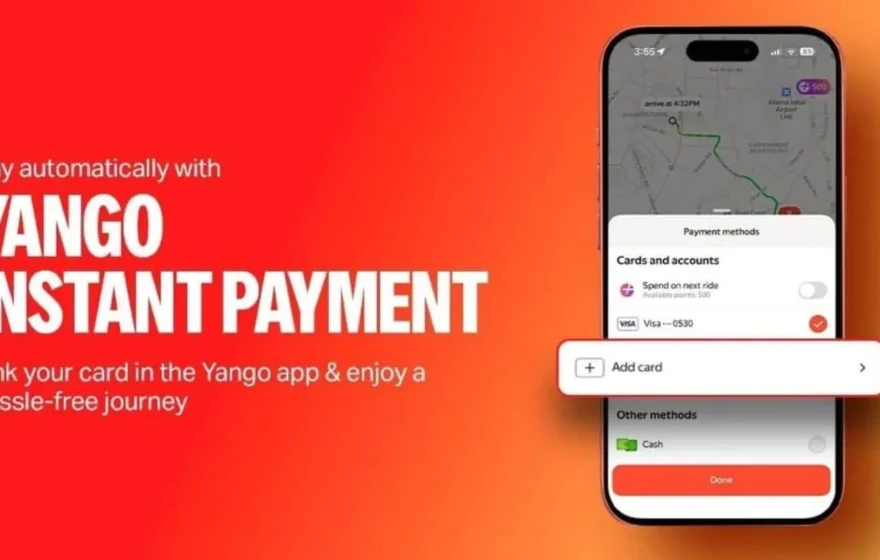
Yango Pakistan has added bank card payments to its app, allowing customers to pay for rides, deliveries and other services with a debit or credit card instead of cash. The company says the change makes Yango Ride the first ride-hailing service in Pakistan to offer card payments, and it calls the move another step towards turning its app into a single place for everyday services.
Customers can link any bank card to their Yango account, including Visa, Mastercard, PayPak and UnionPay cards. Once the card has been verified and authorised, it works across the services inside the Yango SuperApp, so a rider can book a car, order a delivery or use another service and pay for it all without handling cash.
Faisal Iftekhar, Managing Director at Yango Pakistan, said a useful platform had to connect the whole experience, from choosing a service to paying for it. Card payments, he said, were an important step in that direction, giving customers more flexibility within the one app. The company says the launch is part of its effort to build a more connected digital ecosystem in the country.
The timing reflects how quickly everyday payments in Pakistan are moving away from cash. Yango notes that digital payments are becoming increasingly part of daily transactions, and it is widening the ways customers can reach and pay for its services so they can choose the method that suits them best. For a ride-hailing business, that matters, because cash has long been the default way to pay for a ride, and every cash trip brings small frictions, from finding the right change to settling the fare.
Yango is no newcomer to Pakistan. The Dubai-headquartered Yango Group launched its ride-hailing service here in July 2023, starting in Lahore, Rawalpindi and Islamabad, and it now covers five major cities, with Karachi and Faisalabad added along the way. Since then it has kept widening what the app does, adding delivery services in 2024, corporate travel in May 2026, a public transport feature covering more than sixty routes, and a Sharia-compliant Pay Later service in September 2026. The group says it operates in more than thirty countries.
The launch also lands in a market that has changed sharply in recent years. Uber left Pakistan in 2022, and Careem wound down its ride-hailing business here in June 2025, saying the economics no longer worked. That left Yango as the best-known international ride-hailing brand still operating in the country, competing mainly with rivals such as inDrive. In that setting, card payments are not just a convenience, they are a way to stand apart and appeal to Pakistanis who already pay digitally for shopping, food and bills.
The wider numbers back that reading. The State Bank of Pakistan said in its Annual Payment Systems Review for 2025-26, released in October 2026, that retail payments through formal channels reached 14.3 billion transactions in the year, up by about 58 percent, and that digital channels now account for 92 percent of retail payment volume. Its instant payment system Raast processed about 2.76 billion transactions worth Rs80 trillion, with volume up by roughly 116 percent, while QR-enabled merchants rose from 1.09 million to 3.84 million. Cash has not disappeared, and Pakistan remains one of the most cash-reliant economies in the region, with cash in circulation equal to about 34 percent of GDP, according to PwC Pakistan, but the direction of travel is unmistakable.
For riders, the practical gains are straightforward. A linked card removes the need to carry cash or hunt for change, produces a clear record of every trip and delivery, and makes it easier to track spending. For drivers, digital fares mean less cash to carry and fewer disputes over change. The inclusion of PayPak, Pakistan’s domestic card scheme, alongside Visa, Mastercard and UnionPay also means the feature is open to holders of locally issued cards, not only to those with international cards.
Whether the feature takes off will depend on habits as much as on technology. Many riders still reach for cash out of habit, and some will want to see that card payments work reliably, without failed charges or double deductions, before they trust the app with their card details. If card payments prove popular, rivals are likely to follow.
For now, the launch fits a clear pattern. Yango has spent the past three years adding one service after another to its app in Pakistan, from rides to deliveries, transport information, corporate travel and financing, and payments were the missing piece that tied them together. With the central bank pushing the country towards cashless payments, a ride-hailing app that still ran on cash alone was starting to look out of step. By letting customers pay by card, Yango is betting that the next stage of its growth in Pakistan will be won not only on price and availability, but on how completely its app can handle the everyday business of getting around.
